Why Capitalism Can't Survive AI, Part 3: UBI Can't Save Us
A four-part series on the coming economic crisis and the only way through
- Part 1: This Time It's Different
- Part 2: The Shape of the Collapse
- Part 3: UBI Can't Save Us(you are here)
- Part 4: Only One Door Left
Part 1: This Time It's Different covered why AI will permanently replace most jobs. Part 2: The Shape of the Collapse showed what the crash looks like. Part 4 covers the only arrangement that actually works.
In Part 2, I walked through what happens when AI displacement hits the economy. The demand spiral. The standard playbook failing because the displacement is permanent.
The obvious next step is something permanent: universal basic income. Sam Altman wants it. Andrew Yang built a presidential campaign on it. Tax the AI companies, send everyone a check. Most smart people writing about AI seem to assume UBI is at least part of the solution.
It's not. And I don't mean insufficient or politically difficult. I mean the math doesn't work. There is no set of tax rates, spending levels, or policy designs that makes UBI viable under capitalism. Not because of politics, because of arithmetic.
I'm going to walk through this step by step. Each step is simple. None of them are controversial on their own. But when you follow the chain all the way to the end, you arrive at a conclusion that most people aren't ready for.
The scale problem
Most of the people being displaced by AI are not minimum-wage earners. They're the top earners: accountants, marketers, paralegals, software engineers, managers, consultants.
The average income of the top 25% of earners in the US is roughly $130,000 per year. That's about 46 million workers.
Do the math. 46 million displaced workers at $130,000 each is $6 trillion per year. Just to replace the lost income and spending of the workers AI directly displaces. Not to fund roads, schools, the military, Social Security, or Medicare. Just the UBI payments.
Total current federal revenue, from every source, every tax, is about $4.4 trillion.
UBI for the top quarter of earners alone costs 136% of everything the government currently collects. Before funding a single soldier, teacher, road, or hospital.
And that $6 trillion only covers the people AI replaces directly. It doesn't cover the millions more who lose their jobs in the demand spiral: the restaurant workers, construction crews, retail employees, and service workers whose customers were the professionals who just got laid off. As Part 2 showed, the demand spiral can multiply direct displacement by a factor of three or four. The total cost could exceed $10 trillion per year.
We're talking about a program that would dwarf the rest of the federal government combined.
The tax base is the thing that's disappearing
Maybe you're thinking: raise taxes. Dramatically.
On whom?
Most federal revenue comes from income taxes. And most of that comes from the top half of earners, specifically the people with high-paying professional jobs. The exact people AI is replacing first.
You're trying to fill a hole by shoveling dirt from the bottom of the same hole. A software engineer making $180,000 was paying maybe $40,000 in federal income tax and spending $120,000 in the economy. When AI makes her unemployable, both streams dry up simultaneously. The government loses the tax revenue and the economy loses the spending, because they both came from the same person's paycheck. It's one event that looks like two separate catastrophes. And it's happening to tens of millions of people at the same time.
"Tax corporate profits," people say. OK, let's look at that.
Total US corporate profits before taxes are running at about $4.3 trillion per year. That's all of them, every corporation in America, every industry. If you confiscated every cent of corporate profit, 100% taxation, you'd get $4.3 trillion. But you need $6 trillion just for the workers AI directly replaces, and over $10 trillion once you include the demand-spiral layoffs. You haven't funded a single other thing the government does. And you've just taken every dollar of profit from every business in the country.
Even full confiscation doesn't get you there.
Competition destroys the profits you planned to tax
And AI is going to destroy profits.
AI doesn't just let existing companies do more with fewer people. It obliterates barriers to entry. When a handful of people, or one person with AI tools, or an AI agent on its own, can build what used to require 500 employees, every market gets flooded with competitors. And when markets flood with competitors, profits crash. Competition drives prices toward the cost of production, and with AI, the cost of production approaches zero.
In January 2025, investors got a preview of what this means. When the Chinese startup DeepSeek released an AI model that appeared to match America's best at a fraction of the cost, nearly $600 billion was wiped from Nvidia's market cap alone in a single day, the largest one-day loss for any company in US stock market history. The tech-heavy Nasdaq shed over $1 trillion in 48 hours. The panic wasn't about one company. It was about what happens when the barriers to building cutting-edge AI collapse: everyone can compete, nobody can charge premium prices, and the fat margins that were supposed to fund the AI future evaporate.
Software was just the canary. The same competitive dynamic will play out in every sector AI touches. People who advocate "tax AI profits to fund UBI" are imagining a world where a handful of giant companies earn enormous monopoly rents from AI, and the government skims enough off the top to fund checks for everyone else. But that's not the world AI creates. AI creates a world of almost unlimited productivity combined with intense, almost automatic, competition. Under capitalism, that means profits are hard to come by, because as soon as someone starts earning them, competitors with AI tools swarm in to undercut.
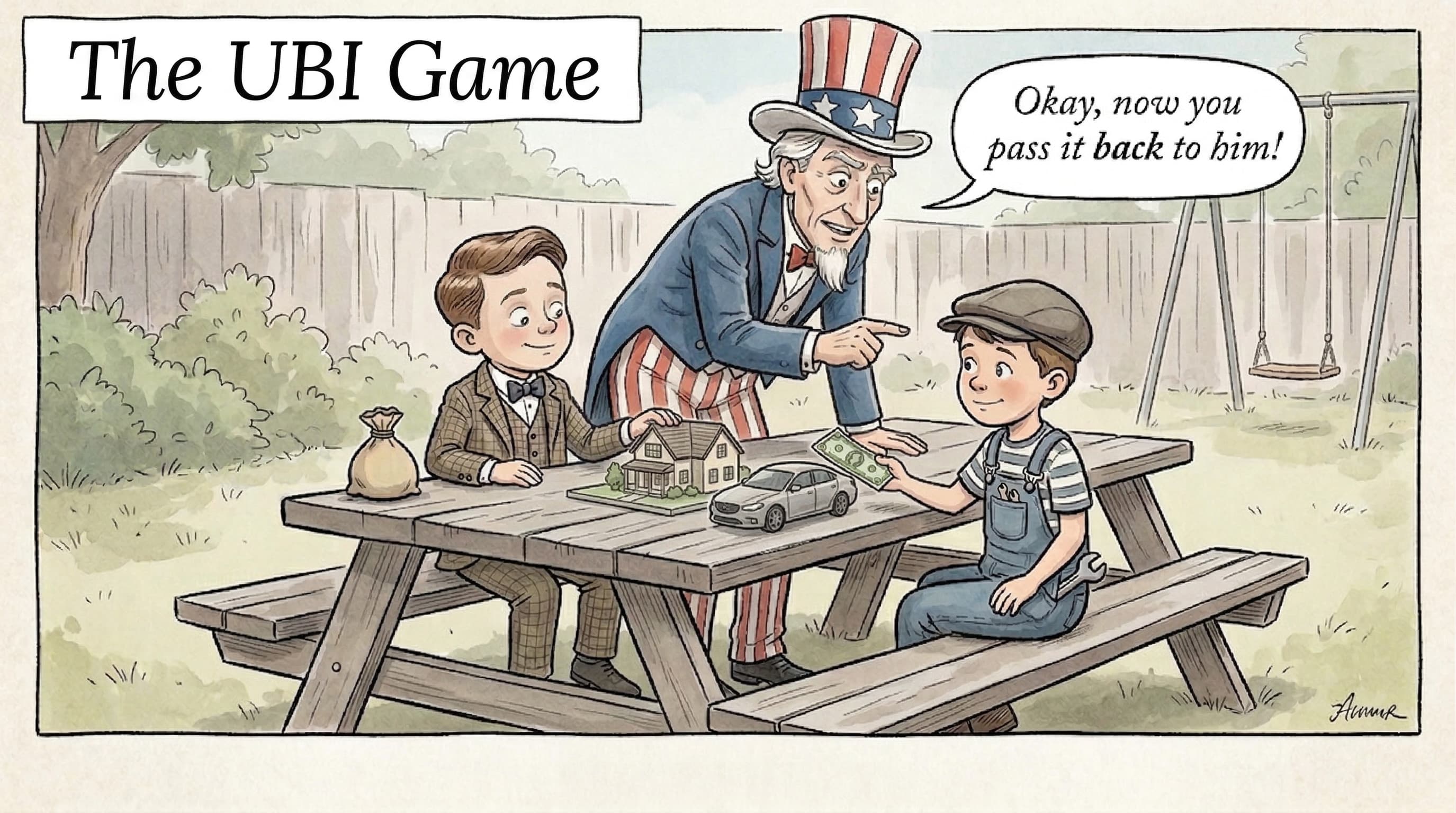
Follow this to its logical conclusion and things get absurd. When AI drives the cost of producing something close to zero, competition drives the price close to zero. The only thing keeping the price above zero is the tax the government slaps on to fund UBI. So you're subscribing to Netflix for $15 a month, but the actual cost of producing and delivering your AI-generated shows is pennies. The rest is tax. The government gave you $15 in UBI for Netflix, just so that Netflix can hand almost all of that right back to the government, which will pass it back to you. It's a game. Government money is being passed in a loop, with a private company sitting in the middle serving no function except as a toll booth that skims a dime off every pass.
This is the great irony. AI could make everything abundant and nearly free. That would be wonderful for humanity. But it's terrible for capitalism, and for the UBI plan to keep capitalism alive, because UBI depends on there being profits to tax. Infinite productivity, infinite competition, and capitalism cannot coexist.
The perpetual motion machine
This is the part that kills the whole idea, even if you wave away everything above. Pretend the tax base doesn't shrink. Assume corporate profits stay high. Imagine competition doesn't drive prices to zero. Grant every impossible assumption.
UBI under private ownership still doesn't work. Because of profit leakage.
Follow one cycle. The government collects $100 in taxes from AI companies. It gives that $100 to unemployed workers as UBI. Those workers spend the $100 at AI-run businesses. The businesses earn $100 in revenue. The government taxes them at 90% and gets $90 back. The owner pockets $10 as profit.
Next cycle, the government only has $90 to give out. Workers spend $90. Government taxes at 90%, gets $81. Owner pockets $9.
Next round: $73. Then $66. Then $59. Each cycle, money leaks out of the system as private profit. The economy contracts. The math is relentless.
To keep the UBI at $100, the government has to print $10 every cycle to plug the gap. That's inflation. Serious, compounding, accelerating inflation.
Now, some of you are thinking: but this is how the economy already works. Money leaks into profits all the time. Why isn't the economy already in a death spiral?
Good question. The answer is the whole point.
In today's economy, profits get recycled back through investment that creates jobs. A factory owner takes her profit and builds another factory. That means hiring construction workers, buying equipment, paying engineers. An investor funds a startup. That means hiring developers, renting office space, paying salespeople. The profit flows out as savings but flows back in as wages. The leak gets plugged because investment requires people.
With AI, that recycling mechanism is severed. When a business owner reinvests her profits, she doesn't hire people. A startup that would have hired 200 people in 2020 now hires none. A founder simply explains the idea to AI and it happens. Maybe AI came up with the idea in the first place at the behest of a venture fund that told AI to create its next generation of investments. In this world, money flows out of circulation as profit and never comes back as wages, because investment no longer requires human labor. The leak is permanent.
For UBI to work under private ownership, you need money to circulate indefinitely without leaking out as private profit. You need a closed loop. But as long as there's private ownership, there's a private owner taking a cut. And that cut, no matter how small, drains the system over time.
In reality, there are many other mechanisms that help our current system keep going despite the leak from profits: governments, corporations, and households take on debt. The government prints money to fund much of that debt. Financial bubbles act like money printing as long as the bubble is inflating, making people feel richer and increasing spending and depressing savings. The U.S. status as the world reserve currency attracts huge amounts of foreign investment, primarily into our financial bubbles.
Those dynamics are all part of the financial steroid cocktail that keeps American capitalism flying high even as real investment lags and even as we keep piling on more and more reasons not to trust in the U.S. dollar or the U.S. financial system. All of these dynamics are unsustainable in the long run, and we have been relying on them for a very long time already. And the crash of the AI bubble that's coming, combined with the mass AI-driven layoffs that will probably escalate around the same time, it's hard to imagine that the reckoning won't finally come for the U.S. debt, U.S. financial bubbles, and ultimately the U.S. dollar itself.
When it does, it will amount to a sledgehammer to all dreams of UBI or job guarantees.
The logical endpoint: 100% taxation
There's exactly one way to stop the leak. Tax profits at 100%. Take every cent. If no money escapes as private profit, the cycle sustains itself.
But think about what that means.
If Elon Musk cannot earn a single dime from producing Teslas, why is he going to spend any time worrying about Teslas? He already barely gives a damn about Tesla when he's making billions. At 100% taxation he'd hit the ketamine full-time and we'd never see him again. We wouldn't see any more Teslas either.
With zero profit, capitalists have zero incentive to produce anything. The entire engine of capitalism is the promise that you can get rich by building something people want. Remove that promise and the engine stops. Nobody starts a company for the thrill of paying 100% of their earnings in taxes. Nobody invests capital if they can't earn a return.
And let's be real: under capitalism, you are never going to tax capitalists at 100%. People like to point out that marginal rates used to be 90% in the 1950s. Those were marginal rates on income above $2 million (in current dollars), and even those rates were riddled with loopholes. Most economists agree that the approximately 10,000 households hit by the 90% tax rates actually paid around 17% in federal income taxes. If 90% only gets you to 17%, you're not getting to 100%.
But suppose you did. Suppose you somehow achieved 100% taxation of all profits. Congratulations: you've ended capitalism. The capitalists no longer control or keep the surplus of the production process. They are owners of their enterprises in name only in the same way that aristocrats are lords of their domains in name only.
You've arrived at public ownership through the longest, most painful, most unstable and absurd path imaginable. Every argument for UBI, followed all the way to its conclusion, ends up being an argument for public ownership. The UBI advocates just haven't followed their own logic far enough to see where it leads.
More reasons the tax will never be collected
Unfortunately, even after dismissing so many hard realities and finding our way to the 100% taxation solution that could theoretically leave our capitalists in some kind of esteemed ceremonial role, presiding over our economy that would be privately owned in name only—even then, there are still so many practical reasons that will not allow this fantasy to work in the real world.
Remember, the only way to make the imagined UBI utopia work will be to collect 100% of profits to recycle through UBI as spending. The prices of most services and many other types of products will be mainly composed of tax. Instead of paying the price of services, you will be paying the price of the tax that will cover your UBI payments.
But the AI-powered companies providing the services that you use don't need to be located in the United States. The product is a stream of data. The employees are software. The US can try to tax foreign companies that sell to American consumers, but enforcement across borders is a problem governments have been losing for decades. Power up your VPN and evade the tax.
Then there's the open-source problem. Much of the AI capability replacing workers is already freely available. Competitive open-source models are already available and they're only going to get better. Even now, anyone with a decent computer can run them. So if you're a service provider that uses AI instead of humans to operate, and the government is taxing the AI that you buy from AI providers, you can get around that tax by simply running your own open-source AI on your own computers.
The UBI plan assumes a world of big, visible, taxable corporations. AI creates a world of tiny, invisible, untaxable producers, millions of one-person, or no-person, operations running open-source AI, selling globally, operating through cryptocurrency or offshore accounts. Or, less dramatically, you just bring the AI and other services you need in house, where it is not taxed, which AI is already making easy for so many use cases. The tax base doesn't just shrink because profits are competed away. It becomes uncollectable.
Finally, there's the underground economy. When tax rates climb high enough, people stop paying. This has happened in every country that has ever tried to impose very high tax rates. The higher the rate, the more people evade. At the rates required to fund UBI, the incentive to operate outside the tax system would be overwhelming. AI makes evasion trivially easy, because AI can help you set up anonymous businesses, route transactions through jurisdictions the US can't reach, and automate the logistics of operating in the shadows.
The social absurdities
Even if you've somehow found a way to make the math work, think about what UBI actually looks like in human terms.
You were an accountant making $130,000 a year. AI took your job. Now you're collecting $130,000 from the government to sit at home.
Your neighbor is a construction worker. Her job hasn't been automated yet because robots still can't hang drywall in a crooked 90-year-old house. Up at 5 AM. Hauling materials in July heat. Wrecking her knees. Making $50,000.
In what universe does she accept that arrangement?
Think about the nurse still pulling 12-hour shifts, the electrician crawling through attics, the plumber, the meat packer. All of them still grinding while the former professional class collects full salary for doing nothing. This isn't a minor political problem. This is the kind of thing that tears a society apart.
And then there are the kids. When the accountant's children grow up, do they also get $130,000 a year to sit at home? You've just created a hereditary leisure class funded by the people who are still actually working. Neither outcome is stable. Neither outcome is something any society would accept for long.
It's silly to even speculate about how we'd solve these social problems under a future capitalist UBI regime. Any version of this would be such a Frankenstein version of capitalism that there's no predicting how dysfunctional and crazy it would get.
What about a job guarantee?
Some people look at the absurdities of UBI and propose a job guarantee instead. The government doesn't just send checks. It gives people jobs. Pays them to do something useful. This sounds better because it avoids the spectacle of a professional class collecting full salary to sit at home while nurses and plumbers grind away.
But a job guarantee under capitalism has the same arithmetic problem as UBI. The money still has to come from somewhere. The government still has to tax or print enough to pay millions of workers whose labor the private sector doesn't want. The profit leakage problem is identical: money flows from the government to workers, workers spend it at private businesses, private owners pocket a cut, the system drains every cycle. Adding a work requirement doesn't change the math. It just adds paperwork.
And what work, exactly? If AI can do most cognitive and administrative tasks better and cheaper than humans, what are you paying people to do? Maybe you pay them to take care of elderly relatives, which they were going to do anyway. Maybe you pay them to pick up litter or sit in an office and file reports nobody reads. Either way, you're describing UBI with a work requirement bolted on, funded by the same impossible tax math, drained by the same profit leakage, producing the same fiscal death spiral. Just with more bureaucracy and less dignity.
The job guarantee doesn't solve the problem. It renames it.
So what's left?
Every exit is closed.
Tax the companies: the tax base is disappearing. Tax the profits: competition is destroying them. Print money: inflation. And even if you could do all of it at once, profit leakage drains the system every single cycle. The money never stops flowing out. The math never closes.
Every path to making UBI work either requires infinite money printing, which destroys the currency, or 100% taxation, which destroys capitalism while leaving us with the worst and stupidest parts of capitalism. Either way, you end up somewhere that isn't capitalism anymore, just the worst of all possible worlds in the name of upholding capitalist private ownership over our collective means of making a living.
So is there an arrangement where the math does work? Where the numbers actually close and abundance is a feature instead of a bug?
That's Part 4.