Chapter 02
Building a 100% Clean Electric Power Grid
Introduction
This is a national mission to transition the U.S. power grid to 100% clean power within a decade, double the size of the grid, and deploy massive new clean electricity generation and storage — rebuilding American industrial capacity, creating millions of good jobs, and delivering energy independence in the process. This mission calls for large investments in domestic clean energy manufacturing so that the U.S. can supply its own needs and join the ranks of clean energy technology exporting nations. In conjunction with the rest of the Mission for America, within a decade, wind and solar power equipment will be manufactured with minimal embedded greenhouse gas emissions, and will therefore fill a high-value niche in the global economy. The Clean Power Mission also calls for a new nuclear program, which is detailed in its own chapter. The objectives of this national mission include reaching zero emissions in U.S. electricity production as fast as possible, speeding the global transition to net zero by exporting clean power and transmission technologies, increasing national wealth, and creating millions of new good jobs for American workers.
This mission creates massive demand for physical work — manufacturing, construction, installation, grid maintenance — that AI cannot replace. At a moment when automation threatens to displace millions of knowledge workers, the clean energy buildout offers a productive economy that puts people to work on things that matter. It also offers relief from the volatile fossil fuel prices that have driven residential electricity rates to record highs: a grid powered by wind, solar, and storage has no fuel costs, insulating consumers from the price spikes that plague a gas-dependent system.
The mechanisms to accomplish this mission include: the Reconstruction Finance Corporation, which will provide investments, guarantees, and deal making; a Clean Energy Standard that will require utilities to reach 100% clean power within a decade; bold presidential leadership to rally the nation behind this mission and break the stranglehold of a dysfunctional electric regulatory regime; and legislation to accelerate the manufacturing and deployment of clean power technologies.
This mission is unique among clean power plans in its short timeline, reliance on exceptional presidential leadership, rejection of point source carbon capture, insistence on nuclear power as being practical and necessary, emphasis on investing in domestic clean power manufacturing, and use of a new national investment institution — the Reconstruction Finance Corporation — which was introduced previously in its own chapter.
We expect skeptics to insist that it is not necessary to get to 100% clean power in 10 years, let alone to additionally double or triple the quantity of clean power production. But the planet gets warmer with every ton of CO2 emitted by power plants. Today’s models predict that even the most aggressive emissions cuts will still see the planet warming to dangerous levels. Every opportunity to further cut emissions must be taken and there is no excuse for the richest, most technically advanced nation on earth not to move as fast as physically and organizationally possible.
Decades ago, when we had far less advanced technology, a smaller economy and a smaller population, we built new power generation and transmission capacity at an even faster rate than is needed now to achieve this goal.1 Critics will argue that our society has devolved into a rudderless nation incapable of building as quickly as it once could. To that, we respond that one of the central purposes of the Mission for America is to resuscitate our national culture back to one that can build again.
Moreover, this mission is designed, as with the other missions in this plan, to make accomplishing it a multiplier of national income, wealth, and general economic and social capacity rather than a subtraction. Upgrading our energy infrastructure is not a burden that we will benefit from stretching over as long a period as possible; it is one more means to reinvigorate our economy and society — the faster we move, the more we will save and earn.
This chapter includes a brief explanation of some of the key functional principles of America’s power grid, as well as of how the current grid and its management fall short.
Context
The following section is intended to give readers the background information necessary to grasp the major problems the nation faces in getting to 100% clean power, as well as the solutions we lay out in the final section of this chapter.
The Goal Defined
The primary goal of this mission is to get the U.S. to 100% clean power within ten years of launch. The mission has a number of additional goals that we specify either because they are necessary to achieve the primary goal or because they are necessary to ensure that the primary goal is achieved in a way that supports the comprehensive Mission for America: ensuring that the switch to clean power is accomplished in a way that builds the nation’s overall capacities and wealth instead of depleting them.
The specific goals of this national mission are to:
Retire all of America’s more than 3,400 fossil fuel-burning power plants within a decade.2
Build new clean electric power generation capacity — not only to replace decommissioned fossil fuel plants, but also to provide enough additional energy to power the nation’s post-transition economy — which may require doubling the size of the power grid.
Reset the primary objective of federal energy regulations to that of creating a stable, reliable, and 100% clean power grid.
Build adequate additional long-distance, high-voltage power transmission lines to create a truly national grid that can move power in required quantities to where it is needed.
Build adequate short-distance transmission capacity to accommodate new power generation sources and higher levels of power demand, from both commercial and residential users.
Develop and deploy next-generation energy technologies such as small modular nuclear reactors and enhanced geothermal energy.
Scale up domestic wind and solar industries, to ensure energy independence, to earn export income, and to provide millions of good jobs for American workers.
Build small and large-scale storage capacity to create a stable and reliable grid that will include large quantities of intermittent renewable power sources.
Achieving these goals will require a sweeping mobilization of the nation’s people, companies, and resources. It will also require shifts in public sentiment to allow support for a new nuclear power program, and to make it unacceptable for politically motivated actors to block needed renewable power generation and transmission projects.
While it is impossible to predict exactly what quantity of electric power will be needed after the full transition away from fossil fuels, we will at least need to double our total power production. The process of decarbonization will lead to so many more things being powered by electricity, either directly or indirectly, through fuels created using electricity — including heating, air conditioning, appliances in homes and buildings, vehicles, ships, airplanes, manufacturing and chemical factories, and some share of the carbon sequestration required by all the modeled scenarios that keep the planet below a catastrophic level of warming.3
What’s Unique About This Mission
This national mission differs from other plans for getting to 100% clean power in several respects:
Its timeline is ambitious but achievable. We believe that as the catastrophic effects of global warming become harder to ignore, and as more aggressive solutions are elaborated, the mainstream position will continue to shift toward comprehensive plans to reach net-zero emissions as fast as is physically and organizationally possible. We believe that, in this context, a 10-year timeline for reaching 100% clean power generation is a reasonable target, and we will attempt to show why that is so in this chapter.
These targets are ambitious, yet we believe they are appropriate for the present moment. The Democratic Party's climate ambitions have shifted dramatically in a short time. In 2016, both Hillary Clinton and Bernie Sanders proposed cutting emissions by roughly 80% by 2050.45 By the 2020 primaries, Sanders was calling for the Green New Deal with 100% renewable energy by 2030,6 and Joe Biden committed to a 100% carbon pollution-free power sector by 2035 and a net-zero economy by 2050.7 The Inflation Reduction Act turned those commitments into action — spurring over $470 billion in private investment and record clean energy deployment — before the One Big Beautiful Bill Act of July 2025 gutted the law's key tax credits.
Despite the many climate deniers, critics, and challengers to a timely and complete transition to clean energy in 10 years, economists and climate scientists have shown that such a transition is possible, though incredibly difficult.8 History, including recent U.S. history, is full of examples of seemingly impossible tasks being completed much faster than anyone thought possible. Often, when there is a will, there is a way. When we are faced with such extreme consequences for moving too slow, we should make plans to move as fast as we think might be possible. Even if we ultimately fail to complete the transition in 10 years, aiming for 10 years will speed up the process to the quickest transition possible.
Moreover, this mission, in combination with all the other national missions in this proposal, is not an expense or a draw on U.S. human or financial capital. If executed as we recommend, it will actually be a multiplier of U.S. capital. For example, by building export industries in the clean power sector, we will earn additional national income and cut down on national expenses in the long run, which will allow the country to do more, not less.
It is a comprehensive plan that includes a full set of policies to get the country to 100% clean power. Most plans include a number of policies designed to encourage the adoption of clean power generation, but do not go so far as to require that 100% clean power is achieved. Some, including those with Clean Energy Standards, may mandate that a state or the country as a whole reach 100% clean power by a future date (e.g., 2050), but they lack a full set of policies to achieve that goal. These plans generally hope that energy markets and investors will respond to the mandated goal or to incentives by doing all the work that is necessary to achieve the goal — despite the fact that many such goals are missed, and many incentive packages do not elicit the desired response.
Our plan proposes a new public financing and deal-making institution that will be capable of providing adequate investment capital and of arranging deals to launch companies and even entire industries. The Mission for America requires that the U.S. begin to restore its public financing and economic restructuring institutions, starting by creating a Reconstruction Finance Corporation (RFC), described in depth in its own chapter. On their own, mandates and incentives are not enough to reach 100% clean power; to get to 100% will require a greater quantity of capital and coordination than private markets are currently able to provide.
Our plan provides adequate financing and assistance for America’s 3,000 utilities to enable them to get to 100% clean power. Merely requiring utilities to convert to clean power is insufficient to achieve the goal; most utilities are very small and will need both capital and technical assistance to go all the way to 100% clean power. Our plan includes a new program within the Reconstruction Finance Corporation that will help finance and assist utilities as they undertake intensive upgrades to the American power grid.
Our plan calls for a national mobilization to build a new nuclear program. Many other plans shy away from requiring a nuclear program because of controversies around cost and safety. Our plan accepts that to get to 100% clean power, we need large quantities of consistent clean baseload power that runs 24/7, and that nuclear power is a safe and feasible option for this. Currently, problems surrounding the cost of building new nuclear capacity can be overcome by building a new nuclear program that creates new nuclear capacity at scale. If the U.S., as well as far less wealthy and advanced countries, could do it in the 1960s and 1970s, we can create a safe and cost-effective nuclear program today.
A push to revive America’s nuclear energy industry will be such a controversial and difficult undertaking that we have decided to give it its own future national mission within the Mission for America. However, in a later section of this chapter we make the case for why nuclear is a necessary, safe, and practical part of the solution to meet America’s energy needs.
The Biden agenda provided a powerful, if temporary, proof-of-concept for green industrial policy. When President Biden entered office, he surprised many on the left by actually attempting to follow through on his promises. Among the various pieces of legislation passed by Congress under Biden, the most important are the Infrastructure Investments and Jobs Act (IIJA), the CHIPS and Science Act, and the Inflation Reduction Act (IRA). The IRA alone triggered over $230 billion in announced manufacturing investment and plans for more than 380 new or expanded facilities.9 However, this model proved politically fragile. In July 2025, the One Big Beautiful Bill Act gutted the IRA's core clean energy incentives, demonstrating that policies built on the tax code are inherently vulnerable to the next administration. This is precisely why the MFA's approach centers on durable institutions — particularly the RFC — rather than tax credits alone.
These Biden-era policies were accomplished by a combination of creative and powerful activism, bold choices by a few key Democratic Party leaders, and the reality of devastating climate change manifesting in bigger and more terrible ways each year. The lesson is not merely that activism and leadership can achieve great things, but that achievements built on tax credits are fragile. The MFA's institutional approach — centering durable institutions like the RFC rather than politically vulnerable tax expenditures — is the answer to this fragility. The National Mission for 100% Clean Power seeks to push the goal further to the elimination of all fossil fuels from power generation as fast as is physically and economically possible.
Our plan aims to reform the entire clean energy deployment process. Many progressive climate plans have been laser-focused on bringing down the cost of clean power generation relative to fossil fuels and creating financial & consumer incentives for clean power adoption. Bringing down relative costs and encouraging the adoption of clean technology is an important part of the transition away from fossil fuels, but it is only one part of the process. Regulatory, political, and capacity issues will continue to plague clean energy deployment long after clean energy becomes significantly cheaper than fossil fuels. Each of those issues endangers our ability to deploy enough clean energy at the necessary scale. Our plan aims to combine the necessary financial investments with the building of new national state capacity and institutions to ensure that clean energy can be deployed.
Why We Must Move Quickly
As with most parts of the Mission for America, we recommend moving at a faster pace than other proposals. The primary reason for this is consistent with other missions: the crisis is too great to wait, and the opportunity is too big to put off.
Because of the terrible urgency of global warming, the whole world needs to reduce every segment of emissions as fast as is physically possible. Emissions from U.S. energy production are one of the world’s biggest single sources of emissions.10 It doesn’t matter that it is “only” 25% of America’s 15% of global emissions.11 Energy production is one of the major sources of emissions that must be ended immediately to prevent catastrophic global warming. Some nations are in a better position to do that now than others. It is unconscionable for those nations to say that they will wait for the slowest nations to act. It makes sense that the richest, most industrialized, and most technologically advanced nations in the world will need to move disproportionately faster and achieve disproportionately more than other nations to slow global warming as much as possible, as quickly as possible. The United States, being the richest, most technologically advanced country in the world, with the largest industrial base, must expect to go the fastest and to do the most.
At the same time, by taking the lead and being the first large country to comprehensively and rapidly get to zero emissions from energy production, the U.S. can both accelerate the global transition, and profit from it. By following the plans recommended here, the U.S. will develop many lucrative industries that can provide materials, technology, services and consulting to the rest of the world as it transitions away from fossil fuels. The final result will be a more prosperous U.S. and a faster global transition away from fossil fuels.
As covered in the introductory chapters, the entire Mission for America is designed not only to reduce U.S. emissions but to contribute to the gargantuan task of the transition to a net-zero global economy. In the case of clean power, the U.S. will make several major contributions under this plan:
Supply the equipment, materials, and management and consulting services to build long-distance high-voltage DC power lines.
Supply the materials, technology, and management and consulting services to upgrade utility companies to be able to handle the electrical upgrade of the entire national economy.
Supply the equipment, materials, and management and consulting services for clean energy.
Build nuclear power plants, and provide management services and security for them.
Pioneer next generation energy storage technologies that can be sold and deployed around the world.
Why This Goal Is Possible
Some say that it’s not possible to act as fast on the energy transition as this mission proposes. They say that America’s regulatory, zoning and approval processes make it impossible to build new power projects or transmission lines as fast as we propose; that government cannot afford the investments that private finance will not cover; that the technology doesn’t exist yet to provide 100% clean power without a fossil fuel baseload; and that it’s not possible or would be too expensive to build nuclear power generation capacity to provide the needed baseload and additional power generation capacity. We will answer each of these objections in turn.
Regulatory obstacles will prevent slow new infrastructure. Saying that we can’t build world-saving infrastructure because of regulatory problems is like a man saying that he can’t start exercising because long ago he promised himself he’d never be a person who goes to the gym. Or, that it would be too difficult for the government to launch a widespread vaccination campaign only a year after the outbreak of a global pandemic. We are not a stagnant society when it comes to many areas of our economy and life, and there is no reason why we need to resign ourselves to stagnation in the area of power generation and transmission. In fact, it is hard to think of an industrial transformation that would have less of a perceived inconvenience on people’s lives than replacing fossil fuel power generation with clean power and building new power transmission lines. In recent decades, our society has accomplished sweeping regulatory changes under both parties that radically changed how people receive and use some of the most important economic products and services in our lives: auto emissions regulations; the break up of telephone monopolies; the rise of mobile phones and subsequent rollouts of new frequencies and technologies for them to operate on; big changes to the regulation of food production and preparation; major changes to traffic regulations and their enforcement; a significant overhaul to the health insurance industry under the Affordable Care Act; constant changes to the tax codes which everyone who files taxes must laboriously keep up with. This list could go on and on.
What is so sacred about the way we currently approve new power plants and new transmission projects that we as a society cannot change it? The simple answer is that every change to how we organize our society is a struggle, and, unfortunately, the forces on the side of building more clean power and transmission have simply been weaker — or perhaps simply less bold and determined — than the forces organizing to stop them. It’s true that the current regulatory system makes it much easier to stop a project than to get one approved. That system has to change. This mission details sweeping reforms that can be passed by a Congress assisted by bold leadership from a president and pushed by forceful lobbying from clean power industries, investors and activists. But even after those reforms, clean power advocates will need to find a way to fight and win against powerful and entrenched interests that oppose change. It will be up to the president who launches the Mission for America to inspire clean power advocates to do so and, in so doing, to tip the political and cultural playing field in their favor.
The government can’t afford it. As the nation and the world switch from fossil fuels to clean power, new profit-making operations will be launched to generate and transmit power, and to provide countless other products and services needed for the transition. If private capital was willing or able to organize the huge investments and deals required to make the transition happen on the timetable required by global warming, it would be doing so already. Instead, it is necessary that the government play the role of investor and dealmaker of last resort. Our government today does not have an institution for that purpose. The Mission for America calls for one to be created in the form of the Reconstruction Finance Corporation, which is detailed in its own chapter. Though these investments require some outlay of public capital, our government is more than capable of raising these funds, which will become streams of income the moment the investments begin returning profits.
The technology doesn’t exist yet. Almost all of the technology needed to produce and distribute clean power is many decades old. The United States has used solar, wind, hydroelectric, geothermal, and nuclear technologies for decades. Some technologies, such as utility scale energy storage, are newer but have experienced accelerated growth in a short period of time. There are also many technologies on the brink of commercialization and widespread adoption, such as enhanced geothermal or hydrogen energy storage, that will further enable a 100% clean energy grid.
Nuclear power is no longer viable. Building out additional nuclear capacity is very much possible. We will give this subject brief coverage in this chapter, and much fuller coverage in a later chapter that lays out our proposed National Mission for Nuclear Power.
How the U.S. Power Grid Is Managed
Nearly everywhere in the world, the power grids in a given area are run by a single entity with a monopoly on power delivery. In economics, power delivery is what’s known as a “natural monopoly” because the most efficient number of companies to have in the power delivery market is always one.12 This is due to the practical reality that it doesn’t make sense to have multiple companies all running their own parallel sets of power lines next to each other from generators to homes.
In some countries, power is delivered by state-owned monopolies, and, in others, by private companies which are usually heavily regulated by the state. The U.S. falls into the latter category. Electrical utilities in the U.S. fall into three categories:
Private investor-owned utilities (IOUs)
Publicly-owned utilities, usually owned by municipalities (POUs)
Cooperatively-owned utilities, i.e. owned by customers.
All are regulated directly by the states in which they operate, and all are monopoly providers.
Nationwide, 168 investor-owned utilities serve 72% of American consumers.13 The rest are served by 1,958 publicly-owned utilities, mostly owned by small cities and towns, and 812 cooperatives, mostly in rural areas.14
Up until the 1970’s, most utilities tended to be fully vertically integrated monopolies that controlled both production and distribution of power.15 In other words, utilities owned the power plants, the power lines, and all the other infrastructure involved in the production, distribution, and consumption of electricity. They made all the short-term decisions about which plants should be operating and at what levels in order to keep the power flowing smoothly. And they made the long-term decisions about when and where to build new power plants and transmission lines. They sent customers their bills and set their rates and other policies. Utilities were not isolated islands; they were connected to each other by power lines, forming a patchwork national grid, and utilities often contracted with each other to share power.
Almost since the advent of electricity in America, utilities have been directly regulated by states. But the federal government quickly began to weigh in too. Today, the federal government sets high-level policies that determine the rules within which states and utilities operate through the Federal Energy Regulatory Commission (FERC).16 The FERC is a bipartisan commission whose five members are presidential appointees, with a rule that no party can have more than three members.17
In recent decades, federal policymakers and FERC commissioners from both parties have pushed for a more market-based approach to power delivery. Though nothing can be done about the monopolistic nature of power lines, the FERC has tried to introduce market forces into electricity production and consumption, with utilities being required to open their networks for use by private producers, and, in some areas, giving consumers a choice about which power providers to pay. Because of the need to precisely control the amount of power entering the grid from minute to minute, however, these efforts have created elaborate farces in which power producers and grid operators essentially playact as market participants. To deliver power reliably, these marketplaces must be so jerry-rigged that they are deeply inefficient. These inefficiencies have often led to short-term disruptions in power delivery, poor long-term planning, and corruption.
Because these new electricity markets were not created through the interplay of supply and demand, but, rather, through abstract negotiations between policymakers and energy lobbyists, they are full of perverse incentives. For example, according to FERC rules, utilities must buy electricity from producers at a uniform price from minute to minute.18 This prevents utilities from negotiating lower prices from wind producers when the wind is blowing hard, or from offering other producers a higher price to keep them operating in anticipation of a coming demand spike.19 Other artificial restrictions on the market have allowed companies to manipulate prices to make huge speculative profits while disrupting energy delivery and costing rate payers huge amounts of money.
To create these contrived marketplaces, the FERC called for the creation of Regional Transmission Organizations (RTOs) — called Independent System Operators (ISOs) when operating inside a single state — to oversee the new power markets in which utilities, producers, and transmission operators would interact.20
Today the short- and long-term decisions that determine the operation, growth and maintenance of the U.S. grid are made by many overlapping and often conflicting groups of people and organizations spanning all levels of government, the RTOs and ISOs, local and state utilities, private producer and transmission companies, as well as various environmental and citizen review organizations.
The Critical Problem of Intermittency
Solar, wind, and even hydroelectric power come with one critical drawback: intermittency. Sometimes the wind doesn’t blow. Sometimes thick clouds block the sun. Sometimes water levels in rivers are too low to power hydroelectric generators. An energy source’s reliability is often measured by its “capacity factor,” meaning how often it operates at max capacity.21 The capacity factor of wind and solar is 34.8% and 24.5% respectively.22 If 100% of our power generation was renewable then, even if we had much more than we needed under normal conditions, there would still be times when there would not be enough energy generated to power society.23 Even if those days or weeks were rare, they could be catastrophic. This problem is the main legitimate argument against transitioning to 100% renewables.
Many renewable energy advocates dismiss fears of intermittency as overblown. They may be right, but it is difficult to know for sure across all scenarios, and the risk should be taken seriously. Reassuring Americans that this transition can be accomplished without the risk of blackouts is key to convincing our whole society that switching to 100% clean power is possible and will be beneficial for all.
Thankfully, there are many solutions to intermittency, including storage, long-distance transmission, and adding more energy generation sources that are not “renewable” but are “clean,” such as nuclear power, to provide clean, reliable baseload. Energy storage allows energy to keep flowing even when power generation dips below what’s needed. Transmission allows power to flow into a region that lacks adequate sun and wind from regions with plenty. Nuclear reactors can provide consistent “baseload” power to the grid, and in the comprehensive Mission for America, will power carbon sequestration, hydrogen production, and other processes even when they are not needed for baseload. We deal with each of these solutions to the intermittency problem in the following three sections.
The Role of Storage in the Energy Transition
Widespread energy storage deployment is essential for a 100% clean energy future. These technologies bolster grid flexibility, capturing excess renewable power during peak periods and releasing it during generation downtimes or high-demand moments.
Energy storage has unique benefits relative to other strategies to mitigate intermittency. Energy storage is much faster to build than either nuclear and long-distance transmission infrastructure, both of which are subject to long permitting processes and strict regulations. The average build time for a utility-scale storage facility is only a couple of years, whereas long distance transmission lines often take 10 years to complete, and new nuclear sites take a global average of 7 years to construct and typically about 10-15 years to finish in the U.S.24
Moreover, when it comes to cost, storage facilities have a growing competitive edge. Battery costs have fallen so dramatically that new solar paired with storage is now cost-competitive with new natural gas generation in many parts of the country.2526 Distributed energy storage available to homeowners and businesses, such as the Tesla wall battery, fill a unique role that can’t be replicated by either transmission or traditional nuclear plants. Transmission and nuclear energy are also essential components of the energy transition, but they have more specialized use cases than energy storage, the latter of which can be more widely and efficiently deployed on a faster timeline.
Energy storage is also a key tool in preventing blackouts during weather crises. Energy demand can spike far beyond generation during severe weather events such as heat waves or freezes, endangering grid stability when people need it the most. The energy stored in batteries or other storage systems can be called upon during these demand spikes to supply power and keep the grid from failing. The potential of batteries to store excess power and then supply it when needed was demonstrated in the September 2022 heatwave in California. California’s batteries provided more power during the critical period of peak demand than Diablo Canyon, the state’s largest power plant.27
The deployment of utility-scale battery storage has accelerated dramatically. The U.S. had just 1,650 MW of installed capacity at the end of 2020.28 By the end of 2024, cumulative capacity exceeded 26 GW — a more than fifteen-fold increase in four years.29 In 2025, the industry set another record, adding approximately 15 GW of new utility-scale battery storage, bringing total installed capacity to over 40 GW.30 Small-scale storage capacity, made up of the type of batteries used to power residential or commercial spaces, is also a growing market.31 The rapid growth of the energy storage industry is no longer just inspiring — it is reshaping the grid in real time.
Energy storage solutions can be broadly classified into three categories: short-duration, long-duration, and seasonal. These categories reflect how much and how long a technology can store energy. Different situations will require the use of different types and durations of energy storage. We will briefly discuss each category and the role they play in the energy transition.
Short-duration energy storage is any storage method capable of discharging power for up to 10 hours. The predominant form of short duration energy storage is lithium-ion batteries. Short-duration energy storage is already commonly deployed on the grid. The benefits of short-duration energy storage have been convincingly demonstrated in recent years. The storage that kept California operating during the September 2022 heatwave was mostly batteries designed to provide up to four hours of power during daily periods of peak demand.
The second type of storage necessary to support the transition to clean energy is long-duration energy storage (LDES). Long-duration energy storage is defined as any energy storage system which would provide 10 hours or more of power. However, there are many new technologies competing to provide LDES – some of which are detailed later in this section. A 2021 McKinsey report found that LDES deployment could mitigate the equivalent of 10-15% of global electricity sector emissions.33 The same study estimated that “10% of all electricity generated would be stored in LDES at some point” and that LDES can reduce the cost of decarbonizing the U.S. power system by $35 billion annually.34
The third type of storage is seasonal storage. U.S. energy consumption peaks in the winter due to heating demand, and during the summer due to cooling demand. Currently, seasonal energy fluctuations are addressed with fossil-fuel-powered “peaker” plants that are only used during periods of peak energy demand. These plants can be assured to be available when needed in part because the U.S. currently stores large amounts of fossil fuels for this purpose, including large amounts of natural gas stored in underground caverns. If the United States wants to entirely phase out fossil fuels, then it will need to develop similar seasonal storage capabilities that run on clean energy. There are a variety of different storage techniques that could fill this role, but most are still in their infancy and not widely deployed. The best option for the seasonal storage of renewable energy in the U.S. is to use renewable energy to produce green hydrogen which is then stored in underground salt caverns. The benefits of using hydrogen for seasonal storage, along with other alternatives, will be discussed later in this section.
This national mission will rely on an “all of the above” strategy, using whatever storage method is best suited for a particular geography and energy market in order to maximize energy storage capacity. Most of our policies are designed to apply universally to all forms of energy storage, though a few do focus exclusively on one technology.
Given the variety of energy storage our policies address, it’s crucial to grasp the nuances of the key technologies. The rest of this section will be dedicated to analyzing some of the most significant forms of energy storage and the role they may play in the transition to 100% clean energy. We analyze two already common energy storage technologies (pumped storage hydropower and lithium-ion batteries), three up and coming technologies (flow batteries, electric vehicles as energy storage, and green hydrogen), and one technology still in development (molten-salt batteries).
Pumped Storage Hydropower
Pumped storage hydropower (PSH) has long been the dominant form of energy storage in America. There are 43 active PSH plants in the U.S., which until recently comprised the vast majority of America’s utility-scale energy storage capacity. In 2025, battery storage surpassed PSH for the first time, with 27 GW of battery capacity exceeding PSH’s 22 GW.35 PSH works by moving water between two different water reservoirs at different elevations. Water in the higher reservoir is moved down to the lower reservoir through a system of tubes and produces electricity by turning a turbine within those tubes.36 The amount of energy stored in a PSH facility is dependent on both the natural terrain of the site and on local weather conditions, such as rainfall and droughts. Larger PSH facilities can function as LDES and provide up to 16 hours of power.37
The main impediment to expanding America’s PSH is geographic. Unlike batteries, which can be mass-produced in a factory and then deployed almost anywhere, PSH has to be co-located with large bodies of water. Unfortunately, this constrains new PSH to a few limited areas. Further complications arise when considering the potential impact that PSH facilities may have on the local environment and community. Creating reservoirs and dams for PSH facilities can negatively impact aquatic life, local agriculture, and important tribal locations.38 All of these concerns further narrow the list of potential PSH locations. Despite these limitations, there are some opportunities to expand PSH capacity. A 2016 DOE study found that there is the potential to increase America’s PSH capacity by 36 GW between now and 2050.39 A more recent study from the Water Power Technologies Office within the DOE identified over 11,000 sites in the contiguous United States where PSH could be deployed.40
Lithium-ion Batteries
Lithium-ion batteries are by far the most common form of battery powered energy storage in the United States.41 The explosive growth of the lithium-ion battery industry has been driven primarily by declining costs and increasing interest from private investors. Lithium-ion batteries can be built to accommodate a variety of different applications, ranging from small-scale storage for homeowners to large utility-scale storage.
This adaptability has made small-scale batteries, such as those serving single homes or buildings, increasingly attractive to home and business owners. By the end of 2025, cumulative residential storage installations reached 9 GWh nationwide, with 3.1 GWh added in 2025 alone — a 51% year-over-year increase.42 The primary driver of small-scale battery storage adoption has been fear of blackouts from grid failures and natural disasters, with most early adoption concentrated in states like California and Texas.43 But the market is broadening: virtual power plant programs in states like Massachusetts, Arizona, and Illinois are now driving residential storage deployment as a grid management tool. Policymakers will need to find ways to encourage consumer adoption outside of these specific circumstances so that the benefits of home battery systems can be felt across the nation.
Lithium-ion batteries have been even more successful as a source of utility-scale energy storage. Most deployed utility-scale lithium-ion batteries provide four hours of power, but the industry is rapidly shifting toward six- to eight-hour systems as costs fall and grid operators procure longer-duration storage. Developers also compensate by co-locating multiple battery systems at a single site to increase total capacity.44
The rise in deployment is primarily due to the price of battery packs sharply declining in recent years. The cost of lithium-ion battery packs has continued its steep decline, falling 93% since 2010. As of 2025, the volume-weighted average price reached $108/kWh, with packs for battery electric vehicles falling below the long-anticipated $100/kWh benchmark to an average of $99/kWh.45 Costs for stationary storage applications were even lower, averaging $70/kWh, with further declines expected.46 Given their mass production and versatile deployment, lithium-ion batteries will likely dominate our energy storage landscape for the foreseeable future.
Flow Batteries
Flow batteries are a type of battery that uses conductive liquid electrolytes which are pumped – or “flow” – from tanks through a flow cell. Two different electrolytes are kept separate within a flow cell by a membrane that divides the cell in two, but which permits charged particles to be exchanged between the electrolytes. The electrolytes generate electricity when they react with the conductive electrode on their side of the membrane.47 The nature of the technology means that, in order to achieve large storage capacity, the batteries must be large and heavy, limiting their use for many applications where smaller batteries are required, but also making them ideal for grid-scale utility storage, where size and weight are less relevant. A significant advantage of flow batteries is that a battery’s storage capacity can be increased by simply getting bigger tanks for the liquids, instead of having to buy additional stand-alone batteries.48
Flow batteries can provide power for up to 10-14 hours. The long duration capabilities of a flow battery give it an advantage over lithium-ion batteries when used for utility-scale storage.49 Flow batteries have an operating life of 25 years compared to an expected life of 8 years for a lithium-ion battery that was cycled daily. When used at a large scale, flow batteries are expected to be low-cost.50 Flow batteries also are safer as they are not at risk of fires, which can be a problem with lithium batteries.51
The flow battery industry is entering a new phase of growth, driven by rising demand for long-duration energy storage capable of providing 10 or more hours of discharge — a critical capability for grids with high renewable penetration. Several promising designs using low-cost, widely available materials like iron, zinc, and vanadium are advancing toward commercial scale, and the global flow battery market is projected to grow at a compound annual rate exceeding 20% through the early 2030s.52 Several U.S. utilities have begun piloting flow battery systems for grid-scale applications, and new manufacturing capacity is coming online domestically and internationally.53 The sector remains in its early commercial phase — with high upfront costs and limited manufacturing scale compared to lithium-ion — but flow batteries' long cycle life, safety profile, and use of abundant materials position them as a key complement to lithium-ion in a fully decarbonized grid.54
EVs
One of the most significant sources of battery storage is one that is still not widely integrated into the grid: the millions of EV batteries that will soon be on the road and plugged into charging stations for hours at a time. When EV batteries are plugged into charging stations, they can send power back to homes and the grid. This process is known as bidirectional charging. Bidirectional charging will allow utilities to use the power stored in EV batteries to provide low-cost energy to consumers and increase grid flexibility.55 An average EV battery can store around 66 kWh of usable electricity which could be called upon by utilities in times of need — enough to mitigate sudden demand surges or loss of generation capacity.56 Some EV batteries can even power a home for up to three days.57 Bidirectional charging is a relatively new technology, but it is being integrated into new EV models.
The benefits of using EVs as energy storage are immense. EV battery storage will make the transition easier for average Americans and private corporations by reducing the amount of investment needed to meet America’s climate goals. Most Americans already rely on their car for daily transportation, and all Americans will need to convert to EVs over the next couple decades. Using EVs as energy storage can help Americans satisfy both their transportation and home storage needs with a single purchase. EV owners can be compensated with credits on their utility bill for electricity sold back to the grid, and can earn up to $3,000 per year.58
Utilities and private clean energy investors benefit by having to build fewer stand-alone energy storage systems, freeing up capital to invest in transmission or generation capacity instead. Early studies comparing the impacts on the grid of using EV batteries as energy storage relative to using stand-alone battery storage have shown that the same grid benefits can be achieved at a fraction of the cost when using EVs.59 Using EVs to reduce the amount of stand-alone or utility-scale batteries will reduce the overall demand for lithium – an already scarce resource needed for consumer electronics and clean technologies. Any investment in EV manufacturing and deployment is, thus, an investment in decarbonizing both the transportation and electricity sectors.
As of mid-2025, the U.S. had approximately 6.5 million registered electric vehicles on the road, and our National Mission for EVs lays out a plan for 100% of all new cars sold in America to be electric, and for the entire fleet of passenger vehicles in America to be electric by mid-century.60 The high number of EVs that will be on the road within the next decade, the vast majority of which will have bidirectional capabilities, will allow EVs to become a critical form of energy storage in the US.
Hydrogen
Electrolyzer and fuel cell technology allow curtailed electricity to be used to create hydrogen from water, which can then be stored and converted back to electricity when needed. Using hydrogen for LDES requires that storage sites be paired with on-site renewable generation. Where this isn’t possible, transmission lines will bring renewable energy to the storage site. A real advantage for green hydrogen production compared to methane-based hydrogen production is that green hydrogen can be produced anywhere there is water and a supply of clean electricity. It does not require the massive production and distribution system necessary for methane-based hydrogen.
While hydrogen can be stored above ground in metal tanks, the most economical solution for storing large amounts is one that is already employed by the oil and gas industry for storing crude oil, natural gas and hydrogen — storing it in underground salt caverns.61 Much of the current seasonal storage for natural gas is stored in underground formations, and so is the crude oil in the U.S. strategic petroleum reserves. Caverns now used for natural gas storage can be repurposed for hydrogen storage. Indeed, hydrogen has been stored in salt caverns in the Gulf Coast for decades.62 There are already three salt caverns in Texas being used to store hydrogen. They are not for energy storage per se; instead, they store hydrogen for industrial consumption. Although salt cavern storage is constrained by geology, the U.S. is fortunate enough to have several locations across the country where hydrogen can be stored.63
Private companies are already investing in hydrogen storage in salt caverns as an LDES solution. The Advanced Clean Energy Storage (ACES) project in Delta, Utah — now majority-owned by Chevron and backed by a $504 million DOE loan guarantee — is nearing completion at a former coal power plant site. The project will convert over 220 MW of renewable energy into 100 metric tonnes per day of green hydrogen, stored in two massive salt caverns and used to fuel a hydrogen-capable gas turbine that will supply the western U.S. power grid. A key aim is to provide seasonal storage for the California power market, storing excess power generation from the spring and supplying it back during periods of peak demand in the late summer.
The two salt caverns being built for the ACES project will store over 300,000 MWh (300 GWh) of dispatchable clean energy — more than the entire U.S. battery storage fleet could deliver in a single four-hour discharge cycle.64 The average U.S. household uses approximately 0.9 MWh per month. One storage cavern, then, could power approximately 160,000 households for a month. The operators of the Utah project claim that the salt formation has enough capacity for 100 of these caverns, the equivalent of energy storage to supply 16 million households for a month. There are approximately 15 million households in California. This is an eye-opening prospect.
Molten-Salt
Molten-salt batteries are a type of battery that can store power for weeks or months at a time. They use salt as an electrolyte, which changes from solid to liquid when heated. Melting the salt allows its constituent charged ions to flow through the battery. Applying an electrical voltage to the molten electrolyte causes its ions to separate out according to their electrical charge. This electrolyzing process requires energy which can be provided to the battery from clean sources. Once the battery is fully charged, the battery is placed in a room-temperature environment. The drop in temperature causes the molten salt electrolyte to solidify in its newly separated arrangement, thus storing the energy in the battery until it can be melted again.
Molten-salt batteries are still in their infancy and have yet to be widely commercialized, but, if successfully deployed, they would provide many benefits to the power grid and be an essential form of seasonal storage. Their primary advantage over other types of batteries is that they have remarkably lower discharge rates — the rate of energy loss while a battery is not in use. Early tests show that a molten-salt battery can maintain 92% of its charge over a three-month period, and around 80% over a 6-month period.65 Molten-salt batteries could be charged during the summer, when solar generation is at its peak, and then discharged during the winter, without utilities having to worry about whether the battery would already become depleted in the interim. Molten-salt batteries have a long lifetime, around 30 years, and can withstand frequent use.66
There are still barriers preventing the widespread use of molten-salt batteries. Most molten-salt batteries have a high heating point of around 180 degrees Celsius, and the energy used to thaw the battery is the equivalent of around 10-15% of the battery’s total capacity.67 Researchers appear optimistic that they can lower the working temperature, but it is unclear what the final result will be. The high working temperature will limit the battery to mostly industrial settings. Most advanced molten-salt batteries are still in the development stage and are around five to ten years away from commercialization, so the final cost of manufacturing the batteries is unknown, and it is unclear whether they will be financially competitive with other potential forms of seasonal storage.
The Urgent Need for More Electricity Transmission
Building more power transmission lines is one of the biggest obstacles to getting to a 100% clean power grid. We need more long-distance, high-voltage transmission lines in order to move power from areas where wind, solar, hydroelectric, and nuclear power are abundant to places where energy demand is high. But we will also need thousands of miles of new short-distance lines to connect new clean power facilities to the grid, and to connect new high-quantity consumers of power to the grid, such as hydrogen production facilities and charging clusters for electric truck fleets.
The urgency has intensified. U.S. data center electricity consumption more than doubled from 76 TWh in 2018 to 176 TWh in 2023, representing 4.4% of total U.S. consumption. Projections for 2028 range from 325 to 580 TWh. Data centers now account for roughly half of projected U.S. power demand growth this decade. The Stargate project alone aims to build up to 10 GW of data center capacity with up to $500 billion in planned investment — but faces grid interconnection queues exceeding five years. The grid we have was not built for this kind of demand growth, and the transmission bottleneck is the binding constraint.
The problem is not that it’s difficult to build power lines — transmission lines are a simple technology that Americas has been building for more than 150 years — it is that the process of approving new power lines is pathetically slow. Most transmission line projects must pass through multiple layers of approval processes by many different agencies at local, state, regional, and federal levels. All of the agencies involved are understaffed and working with a set of processes and rules that could not be more inefficient if they were intentionally designed to be so. Some of these rules are imposed by counterproductive legislation. Others are just a matter of tradition and carelessness.
Additionally, projects only get off the ground and reach fruition when utilities and regional transmission organizations (RTOs) are able to accommodate them. Here, again, these organizations are often working with inadequate staff and with perverse incentives deriving from the upside-down business models of utilities in which they reap greater rewards the more slowly and inefficiently they invest.
Finally, in the course of approval processes for power lines, if anyone in the community affected by a project opposes it, this can greatly delay or kill the project altogether. Delays themselves can kill a project if investors get cold feet and pull out.
There is no reason why transmission lines should be any more difficult to site than other pieces of energy infrastructure. Those get built, however, because even though there are complex, multi-level review processes, and even though citizens are free to object and demand compensation, an ultimate decision-maker exists that can say yes to these projects. In the case of natural gas pipelines, for example, the FERC is that final decision-maker. It was given that power in the Natural Gas Act of 1938. The fracking boom that revolutionized U.S. energy over the past few decades was in part made possible by the FERC having this power to give the final and definitive go-ahead for new gas pipelines. Interstate transmission projects, on the other hand, have no codified final decision-maker.
Our proposals in this mission call for giving the FERC the same authority over electric power projects as it has over natural gas projects and giving the federal government more power to fund and build projects on their own. But it will take more than that, because organized anti-clean-power groups, and the companies that fund them, are going to keep fighting to stop any project that will lead to more clean power. That is why this mission requires the president to change our culture to make it more unacceptable to accept defeat when it comes to building things that our society needs. Change of any sort is always opposed. We used to have a culture that listened to, compromised with, and compensated opponents, and pushed ahead when change was necessary and beneficial. Today, we have a culture where regulators, officials, and investors throw up their hands too quickly. This needs to change, and the president is the only person who can attempt to initiate that change. We devote part of this mission to political strategies that will work toward that end.
Nuclear Power
The current administration's aggressive nuclear push — including executive orders to quadruple nuclear capacity and restructure the NRC — demonstrates that political will for massive energy investment exists. The MFA's task is to extend that will to the full clean energy portfolio.
Nuclear power is a highly controversial topic among environmentalists and energy policy wonks.68 Many fear that nuclear power is too dangerous to include in America’s energy mix. Even though nuclear accidents have been extremely rare, and even though the few that have happened took place in old plants in other countries, many argue that nuclear accidents are so catastrophic that the only acceptable risk of one happening is zero. Many opponents of nuclear power also argue that it is too expensive and difficult to build nuclear power plants today.
Supporters of nuclear power contend that it is the safest form of energy the world has ever known, if you count actual deaths and injuries caused by all kinds of energy generation.69 Even solar and wind kill more people per unit of energy produced in manufacturing and installation accidents, and in failures such as blade malfunction and wind turbine fires.70 The effects of pollution from burning fossil fuels, which nuclear could help us replace faster, kill millions of people every year.71 Moreover, many nuclear supporters argue that it would be the cheapest and easiest-to-maintain form of power available, if we changed regulations to make it easier to build nuclear plants and then rebuilt a robust nuclear industry.72
But passions run high on this topic. It can be difficult to discuss the facts of how dangerous nuclear power really is because radiation has taken on a kind of mythical identity as something uniquely and almost infinitely dangerous. The radiation released from normally-functioning nuclear plants is negligible — a fraction of the natural background radiation from buildings, the ground, or the sky. A coal plant, by comparison, releases far more radiation than a nuclear plant because of naturally occurring radioactive materials in coal. In rare nuclear accidents, however, significant quantities of radioactive gasses and liquids have been released, as in the cases of Chernobyl and Fukushima. Many nuclear opponents believe that any amount of radiation being released in an accident would be so lethal that it’s unacceptable to allow any risk of that happening, no matter how small or unlikely.
Before addressing the issue of the risks and costs of nuclear power, we need to answer why we are talking about nuclear power at all. Nuclear power plants are capable of producing very large amounts of power and do not emit greenhouse gasses or any other kind of air pollution during the generation process. They don’t have intermittency issues, and can run consistently for decades. Once they are built, the cost per unit of energy of operating and maintaining them is extremely low even compared to comparative baseload fossil fuels. The levelized cost of energy (LCOE) for existing coal is about $41 per megawatt-hour (MWh), natural gas is about $36 per MWh, and nuclear is only $33 per MWh.73 Also, even compared to solar and wind power per unit of energy, nuclear power requires far fewer natural resources and has a far smaller greenhouse gas footprint.74 A wind farm that produces the equivalent amount of power to a nuclear power plant requires massive quantities of land, significant natural resources and labor to manufacture, and extensive amounts of energy to transport across the planet to their installation location. For some of the duration of the Mission for America, the work of building and transporting wind turbines and solar panels will be mostly powered by fossil fuels. Moreover, the transition away from fossil fuels will require so many natural resources that less resource-hungry technologies are very beneficial. For all these reasons, nuclear power is an attractive zero-emissions solution to powering the planet.
Our assumptions going into this project were that nuclear power was too risky and too expensive to be seriously considered. Upon closer review, however, a different picture emerged. We make the full case for nuclear power in a separate chapter covering the National Mission for Nuclear Energy. Here we will just briefly answer the questions about risks and costs.
First, accidents that would release high levels of radiation are made incredibly unlikely by new nuclear reactor designs.75 However, it is unwise to say in any field that an accident is completely impossible. If nuclear critics are correct then a nuclear accident would be so catastrophic that any chance of an accident — even approaching zero percent — is unacceptable. Therefore, let’s talk about how dangerous a nuclear accident actually is.
The reality is that even the worst nuclear catastrophe in history, the Chernobyl disaster, harmed millions fewer people than a single year of burning fossil fuels. An estimated 7 million people die each year from air pollution, with fossil fuel combustion — brown coal, coal, and oil — as the leading source.76 Furthermore, a 2013 study published by the American Chemical Society (ACS) shows that the displacement of fossil fuel use by nuclear power has prevented nearly 2 million air pollution-related deaths and has the potential to save millions more.77 In the Chernobyl disaster, 2 workers were killed in the initial explosions and 28 firemen and emergency workers died from acute radiation syndrome in the following months.78 The most dangerous contamination was concentrated in the areas immediately surrounding the plant, primarily in modern-day Belarus and Ukraine.79 There are various estimates of how many people might have gotten cancer later from exposure to elevated levels of radiation in the surrounding areas. While it is impossible to know exactly how many that would be, the most widely cited estimate — from the IAEA, WHO, and UNDP's joint Chernobyl Forum — projects approximately 4,000 eventual cancer deaths among the most exposed populations, though some broader studies put the figure higher.80
But even if the death toll reaches the thousands, what is important to keep in mind is that those deaths from one freak accident are millions fewer than what is caused by the normal operation of our fossil fuel economy in a single year.
One other way to put the Chernobyl disaster into context is to consider that the United States has detonated more than 1,000 nuclear bombs in military tests. Combined with other nations, the world total for nuclear detonations is more than 2,000. Many of these were carried out within the continental U.S. right in the open air. Collectively, those tests released an estimated 100 to 1,000 times more radioactive material into the atmosphere than the Chernobyl disaster. Of course, we are not arguing that that was acceptable. It absolutely should not have happened. But it puts something into perspective: If radioactive gas being released from a reactor is a world-ending event, then how did we get through 2,000 nuclear bombs being detonated without catastrophic effects for the world?81
Besides safety, the other major argument against nuclear power is that it is more expensive than solar and wind. That comparison is, however, both unfair and inaccurate. Once a nuclear power plant has been built and is operational, its per-unit cost of power is far lower than that of any other form of power generation.82 The problem is that the construction costs of building new nuclear plants have spiraled out of control in the United States and in many — but not all — other countries.83
Two factors are driving the rise in construction costs: Poor regulation and lack of scale. The current state of nuclear power regulation in America is broken. Nearly all American nuclear power plants came online between 1970 and 1990, with a significant slowdown following the Three Mile Island accident in 1979.84 The most recent plant to enter service is Watts Bar 2, which came online in 2016: the first plant to do so since 1996.85 Overall, the Nuclear Regulatory Commission (NRC), which was created in 1975 and oversees the industry, takes an average of 80 months to approve new construction and operation licenses.86 This contrasts with the United Kingdom which averages a 54-month approval process.87 The most recent approvals in the U.S. came in 2012 for two reactors at Vogtle in Georgia, and two more reactors at the Virgil C. Summer plant in South Carolina. Since then, Vogtle has seen significant delays and has cost over $30 billion, while construction work on the new reactors at the S.C. plant was stopped.88 We will discuss this problem in depth in the chapter devoted to the National Mission for Nuclear Power, but the crux of the problem is that the NRC was charged with pursuing a policy of zero risk tolerance in nuclear plant operation.89 In practice, this is impossible and has made it incredibly difficult to build new plants.If nuclear plants were regulated by the same agencies and according to the same principles as other energy facilities, they would be far cheaper to build and just as safe.
The other factor driving the rise in construction costs is lack of scale. We have gone so long without building nuclear plants that we have lost access to the specialized categories of workers and companies that are needed to build them.90 In China, where they are building many nuclear plants at any given time, a body of specialized workers and contracting companies has grown up around the industry and gets more experience with each new plant. In the U.S., workers and companies must approach many tasks involved in building a new nuclear plant facility with no experience, which is incredibly difficult and, thus, very expensive.
The Promise of Geothermal
Geothermal energy is a renewable energy source that uses heat stored beneath the Earth’s surface to generate carbon-free electricity. Geothermal plants drill wells deep below the Earth’s crust until they reach locations where hot water or steam reservoirs exist. The system directs the extracted hot water or steam to a geothermal power plant, where it drives turbines connected to generators, converting the thermal energy into electricity. Geothermal is a form of baseload energy generation that can run for 24 hours a day and helps fill gaps from intermittent sources.91
Geothermal energy provides only a small amount of total U.S. power and the geographical limitations of the technology makes further deployment difficult There are 99 geothermal power plants in the United States with a total capacity of nearly 4 GW — or around 1% of total energy capacity.92 Conventional geothermal power is heavily constrained by geographical factors, as there are very few areas within the United States with existing fissures that contain enough underground water or steam to generate a relevant amount of power. Nevertheless, opportunities for modest expansion of conventional geothermal capacity exist. A recent DOE study estimated that around 60GW of new geothermal energy could be added to the grid by 2050.93 Even with an additional 60GWs, geothermal energy would still make up a small part of the total U.S. power grid.
Researchers have spent decades working on enhanced geothermal technologies that overcome the geographical constraints of geothermal energy. Enhanced geothermal technologies re-open existing fissures or create new fissures in the Earth’s crust and then pump water into them to create a reservoir.94 Enhanced geothermal projects can create reservoirs thousands of feet underground, enabling projects to reach deeper and hotter areas of the Earth. This advancement allows for projects in areas previously unsuited for geothermal use.
While the potential of enhanced geothermal is undeniable, its journey has not been straightforward. The first enhanced geothermal demonstration project in the U.S. began in 1970 at Fenton Hill, New Mexico, led by Los Alamos National Laboratory.95 Yet, despite the tech having been around for half a century, it has struggled to scale beyond a few experimental wells. Project developers have struggled with drilling deep enough, finding hot enough reservoirs, and have had to manage risks around seismicity.96 Managing all of these concerns is expensive, and enhanced geothermal plants have struggled to be cost-competitive with other forms of energy generation.97
However, recent projects have achieved a significant commercial breakthrough. Fervo Energy's Cape Station project in Utah is on track to deliver 100 MW of 24/7 clean power to the grid in late 2026, with a second phase adding 400 MW by 2028 for a total capacity of 500 MW.98 Southern California Edison has signed 320 MW in long-term power purchase agreements for Cape Station output — the largest geothermal PPA in history — and Fervo has secured a separate 115 MW agreement to supply Google's Nevada data centers through a different project, demonstrating broad market confidence in enhanced geothermal's commercial viability.
While the exact per-MWh cost of Fervo's projects remains confidential, the company has secured long-term contracts totaling over 400 MW across multiple projects, indicating its price is competitive for firm, carbon-free power.99 However, the federal financing and tax incentive structures established by the IRA, which were critical to project economics, are being actively dismantled as of early 2026, creating headwinds for the cost-competitiveness of future projects.
Fervo is not the only company advancing enhanced geothermal technology. Quaise Energy, an MIT spinout, is developing millimeter wave drilling technology that can vaporize through hard rock to reach superhot temperatures deep underground. In 2025, Quaise drilled 100 meters with the technology and demonstrated drilling rates of up to five meters per hour through some of the hardest rock in the world.99 The company's first commercial pilot, Project Obsidian near Newberry Volcano in Central Oregon, targets 50 MW by 2030 with potential expansion to 200 MW.
Enhanced geothermal is rapidly graduating from a promising experiment to a commercially viable source of firm, clean power. This breakthrough is especially critical given the explosive growth in electricity demand from AI data centers, which require precisely the kind of 24/7 power geothermal provides. While geothermal is unlikely to serve as the sole foundation of the clean energy transition, it is a powerful complement to wind and solar — providing the firm baseload power that intermittent sources cannot. The government should dedicate substantial resources to backing this sector, and the growth of an enhanced geothermal industry could power millions of American homes, create jobs for workers displaced from the fossil fuel industry, and facilitate the transition to a 100% clean energy grid.
The Comprehensiveness of the Mission for America and the Clean Power Mission
The various parts of the national mission for clean power are designed to reinforce each other — and the same is true across the broader Mission for America. As discussed in the introduction, a comprehensive approach is very often easier and more effective than pursuing individual projects in a one-off manner.
Within the Clean Power Mission, comprehensiveness is key in several areas. Financing will flow adequately thanks to government financing, guarantees, purchase agreements, and other forms of investment offered by the Reconstruction Finance Corporation. Clean energy projects will be enabled by comprehensive upgrades to utility infrastructure, technology, and transmission. A clean energy standard and generous clean energy subsidies are the drivers that bring it all together. Any one of these carried out in isolation without the others would have a positive impact but would fail to transition the grid to 100% clean power. Only when executed together will these policies accomplish the goals of this national mission.
Consider the Clean Energy Standard (CES) as an example. A CES requires utilities to replace fossil fuel generation with clean energy sources over a set period of time. The CES is already a mainstream proposal that has support among many Democrats in Congress. The CES is one of the most powerful tools the federal government has and is the cornerstone of this mission. However, it will be incredibly difficult for utilities to comply with any clean energy standard, on any reasonable timeline, without the other proposals in this mission. Utilities will need to spend billions of dollars upgrading their systems to be ready to handle 100% clean energy. Most utilities in the United States do not have the money or technical expertise to successfully make those upgrades on their own. Therefore, the federal government will need to step in to provide financing and technical assistance — far beyond what is offered currently — to utilities throughout the duration of the energy transition.
The comprehensiveness of this mission not only will make the mission easier to complete, but will also make it easier to enact in Congress. Without the money and support offered by this plan, utilities would fight against the CES tooth and nail, knowing that it would be difficult or impossible to comply with. Of course, they will still fight a CES, even with all the perks we are proposing for them. But these perks will allow the president to win many utilities over, to soften the opposition of the rest, and to explain to both Congress and the public that opposition from utilities is rooted in a knee-jerk opposition to change of any kind. This is the same type of opposition that has knee-capped American growth and prosperity — and the same type of opposition the Mission for America will overcome.
Solutions
The solutions presented below aim to transition the U.S. power grid to 100% clean power within a decade of the mission's launch. The overall approach combines economic incentives with regulatory mandates, buoyed by executive leadership and a vision for a resilient, clean grid. Our solutions here rely heavily on the Reconstruction Finance Corporation (RFC) which will offer crucial coordination, investment capital, and other types of support to industry players of all sizes. Congress must pass sweeping legislation, including: a Clean Energy Standard mandating utilities invest in clean energy generation, new tax credits for clean energy manufacturing and deployment, and sweeping reforms for permitting and siting new transmission lines and clean energy projects. As with all other national missions, the clean power national mission will require bold and direct leadership from the president, their administration, and the RFC’s clean power team.
Solution 1: Creating a Clean Energy Standard (CES)
The Challenge
The share of power generated from clean energy in the United States, such as wind and solar, is rising every year. The United States generates over three times more wind and solar power than it did 10 years ago.100 The vast majority of new capacity added to the grid since 2019 is from clean energy sources — and the lead is growing every year.101 The trend toward clean energy has accelerated dramatically. In 2025, solar alone accounted for 72% of all new utility-scale generating capacity, with wind and solar together making up 87% of additions through October — while natural gas contributed less than 13%. For 2026, EIA projects a record 86 GW of new utility-scale capacity, with solar, wind, and battery storage accounting for 93% of planned additions. After factoring in coal plant retirements, virtually all net new capacity is projected to come from clean sources. Battery storage has been a particular bright spot: installed capacity grew nearly 50% in 2025 alone, adding over 13 GW, and 24 GW is planned for 2026.102 These trends are driven by economics, not policy — and have continued despite the rollback of federal clean energy support.
Unfortunately, as inspiring as the pace of deployment may be, it is still insufficient.103 Given the current model for building out clean power, each additional step toward 100% clean energy will be more difficult than the last. For example, suitable sites for new clean power facilities get harder to find as they are used up.104 Existing clean energy policies may get us to 50% or even 80% clean power relatively quickly. That next 20%, and especially the last 10% or 5%, will be much more difficult. At the current rate of deployment, reaching 100% clean energy could take decades longer than the climate crisis allows.105 Avoiding that catastrophic outcome will require a fundamentally different approach than the one we are currently using.
A Clean Energy Standard (CES) is the foundation of any viable plan to get the nation to 100% clean power. A CES refers to a federal policy that sets clean energy generation benchmarks for utilities across the country. Instead of merely encouraging investment in clean power, it requires that utilities phase out fossil fuels and get to 100% clean power by a specific date. Our CES calls for 100% clean energy within ten years of enactment, with a strict definition of clean energy that excludes all fossil fuels. In this mission for 100% clean power, the CES provides long-term guaranteed demand for clean energy, unlocking billions in private financing that is still standing on the sidelines. The national commitment provided by the CES will tip the playing field in favor of clean power investors and developers, making it easier for them to overcome the many obstacles to building the capacity we need to meet the goal of 100% clean power.
A sprint to decarbonize the energy sector will require America’s nearly 3,000 utilities to significantly upgrade their systems at a speed that most of them are unaccustomed to and unprepared for. The technical and physical bottlenecks slowing clean energy adoption occur at every point in the energy production and distribution processes, and will require major investment to fix.106 For example, utilities need new substations, face a backlog of old transformers incapable of handling home solar systems, and must upgrade millions of power lines to homes and businesses to accommodate the big jumps in demand required by electric vehicles, home electrification, and new electrical industrial processes.107 Utilities will benefit from encouraging and investing in energy efficiency to mitigate the need for new generation. If utilities don’t receive the support they need to make these necessary upgrades, the CES will fail and the nation will not be able to achieve 100% clean power.
Electricity in the United States is delivered by nearly 3,000 utilities falling into the following three categories: 1,958 publicly-owned utilities (POUs); 812 customer-owned cooperatives (COUs); and 168 investor-owned utilities (IOUs), of which a small number cover about half of electric customers.108 Each utility operates within the constraints of its own unique set of financial incentives, bureaucratic requirements, state and local regulations, and other local concerns that dictate their day-to-day actions and long-term planning — or lack thereof.
IOUs are profit-driven monopolies that generally make their money by marking up their costs at a fixed rate set by state regulators. This often creates a perverse incentive to work as slowly and inefficiently as possible, because the more things cost, the more money the utility will make.109 For instance, instead of investing in comprehensive upgrades that would benefit all customers, upgrades are often carried out on a one-off basis for customers individually who consequently face long wait times and high costs. However, things are not as hopeless as they may seem. Some states have achieved great results by simply requiring utilities to make long-term plans that take efficiency into account.
POUs have sometimes been more successful in adding new renewable generation. In principle at least, public utilities are incentivized to deliver power in the most efficient and cost-effective way possible, and to follow long-term plans that accomplish this aim. In reality, however, POUs are often susceptible to local political headwinds that oppose renewable energy, or that, for ideological reasons, favor creating the appearance of markets over creating real efficiency. Even when there is a will, sometimes there is not a way. Some POUs, especially smaller ones, lack the capital and expertise to make and carry out long-term plans for upgrading to meet the challenge of phasing out fossil fuels.110 Many smaller and rural cooperatives have struggled to keep pace with the energy transition because of their inability to raise equity for financing, a lack of access to some tax incentives, and interference from pro-fossil fuel political forces.111
Regulators must give utilities and their communities clear incentives to invest efficiently in order to clear a path for 100% clean power, as well as equipping them with the resources and financing they need to make it happen. Our proposed CES is designed to combine these much-needed investments with a comprehensive national planning tool.
The following explanation of our proposed Clean Energy Standard is divided into five parts:
Define and lay out the program’s goals.
Make the case for the energy sources that should qualify for the standard.
Specify the best practices and policies that need to be implemented alongside a CES.
Specify the executive branch actions that will guarantee successful implementation of the CES.
Specify how the Reconstruction Finance Corporation will financially support utilities as they transition to a 100% clean energy grid.
What Is a Clean Energy Standard? Many versions of a CES have been proposed by policymakers and think tanks. A CES is a federal policy that requires utilities to work toward cleaner power and reach certain benchmarks by given dates. The benchmarks are often expressed as a percentage of a utility’s total energy generation that must come from clean sources.112 By requiring utilities to meet benchmarks on a timetable, the government can coordinate an energy transition that ensures that America meets its decarbonization goals.
Many proposals for a coordinated transition away from fossil fuels revolve around what is known as a Renewable Portfolio Standard (RPS). An RPS works similarly to a CES, but is limited to renewables alone. We have already discussed the debate around whether renewables can and should provide 100% of the nation’s energy needs, and made the case that it would be unwise to insist on renewables alone. Many studies have suggested that renewable power sources can supply 80%-90% of America’s current electricity needs.113 Our CES calls for nuclear power to be used as a baseload power source to cover that last 10%-20% — and, additionally, as a means to rapidly achieve the huge quantities of additional power that will be required by the complete transition away from fossil fuels, as well as to power new applications, such as CO2 drawdown.
Thirty states presently have some form of a clean energy standard or renewable portfolio standard (RPS).114 These programs vary from state to state. Only Rhode Island, Washington D.C., and Maryland aim to run on entirely clean energy within the next decade.115 Minnesota passed legislation in 2023 to reach 100% clean energy by 2040.116 Other states commit to being clean or mostly clean by 2050. We believe that any timeline stretching beyond a decade does not meet the urgency of the moment. State programs cannot be expected to reach this goal on their own, because they lack the resources and powers of the federal government. Many of the existing state CES and RPS programs are a great start, and have provided lessons and inspiration, but they will never be enough.
Four variations of a CES were introduced in the 117th Congress, but not enacted.117 A variation of the CES known as the Clean Energy Performance Program (CEPP) was initially included in the president’s Build Back Better Act before being removed due to opposition from Sen. Joe Manchin (D-W.V.). Each variation proposed a different mix of acceptable energy sources, timelines, and enforcement mechanisms.
Since then, the political landscape has shifted decisively against federal climate action. No new CES legislation has been introduced, and the current administration proposed a full repeal of all GHG standards for power plants in June 2025. The task facing a 2029 MFA president is not simply enacting a CES — it is rebuilding the regulatory infrastructure that has been dismantled, including reversing the repeal of EPA's 2009 endangerment finding, which provided the foundational legal authority to regulate greenhouse gas emissions at all. The MFA's CES proposal must be understood as a policy for a 2029 president to champion, not as a politically feasible goal today.
The timelines of most of these state programs and federal proposals stretch until 2050 or later, which we insist is too slow, and often include natural gas, with or without the use of CCS, as a clean fuel. At the same time, many contain effective economic incentives, regulatory designs, and implementation processes. Our intent is to take the best features of existing clean energy standards, identify necessary changes, and explain the key decisions policymakers must make in creating a CES that can get the U.S. to 100% clean power within a decade.
Two exemplary CES proposals are the Evergreen Collaborative’s Roadmap to 100% Clean Electricity by 2035: Power Sector Decarbonisation through a Federal Clean Electricity Standard and Robust Clean Energy Investments and Justice-Centered Policies, and the Clean Energy Standard Act of 2019 proposed by Sen. Tina Smith (D-MN) and Rep. Ben Ray Luján (D-NM).118 Our proposal draws on the basic ideas and structure of these proposals, adding a faster timetable and more supporting investments and regulations, and excluding natural gas.
Defining Clean Energy. The 100% Clean Power Mission includes the following forms of energy production to be allowed under the CES:
Solar
Wind
Hydroelectric
Geothermal
Nuclear
Biomass
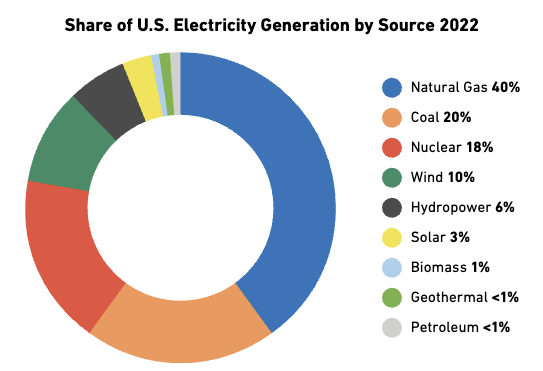
Source: U.S. Energy Information Administration. (2023, October 20). What is U.S. electricity generation by energy source? In Frequently Asked Questions. https://www.eia.gov/tools/faqs/faq.php?id=427&t=3
Most areas of the U.S. have the potential to host large quantities of solar and wind generation. Those that don’t will have access to new generation capacity being built in other parts of the country via new long-distance transmission lines. The declining costs of wind and solar mean that widespread adoption is accessible to most utilities and won’t hurt consumers’ bottom line.119 Yet these energy sources are insufficient on the intermittency problem explained above. This should not be seen as a deal breaker for either wind or solar, as they still produce energy even when they are not operating at maximum capacity, and there are many ways to mitigate intermittency, such as storage and long-distance transmission. Nevertheless, renewables will need to be complemented by other energy sources that are not constrained by day-to-day weather conditions.
Hydropower will likely remain a small but important part of the decarbonization process in the coming decades. Hydropower provides around 6% of total U.S. electricity generation.120 Hydropower has greater geographical constraints than wind or solar. There are only so many large bodies of water capable of producing significant hydropower. The list of potential sites becomes smaller when removing potential sites that would cause significant damage to the local environment or wildlife. Typically, only small amounts of new power are added from hydropower each year. The 2016 DOE study Hydropower Vision estimated that the United States could add up to 50 GW of new hydropower capacity by 2050 — including 13 GW of new generation and 36 GW of pumped storage — a roughly 50% increase over current levels, but still only a small share of our total electricity needs.121
Geothermal energy is poised for significant growth. The United States is currently the world leader in geothermal energy, with nearly 4 GW of installed capacity, though this accounts for only about 0.4% of total electricity generation.122 America’s existing geothermal capacity is nearly entirely from traditional geothermal plants, which require specific geographic conditions to produce power, and there is limited potential for expanding traditional geothermal capacity. However, as discussed in a prior context section, enhanced geothermal technologies have achieved their first commercial breakthroughs. The DOE estimates the United States can add 90 GW of geothermal generation capacity by 2050 with the use of enhanced geothermal technology — enough to supply up to 12% of U.S. electricity demand.123 Enhanced geothermal would be especially valuable as a form of baseload energy that can alleviate the intermittency problem posed by other renewables.
Our decision to include nuclear energy in this mission is controversial, but it is essential if we are to reach our goal of 100% clean power. The intermittency problem of solar and wind will need to be addressed through some combination of energy storage and dispatchable or baseload energy generation. The continued growth of energy storage could slowly decrease the need for non-intermittent energy sources, but that future remains far off. For the near future, America will need a source of non-intermittent generation to complement the growth of renewable energy. Beyond the problem of intermittency, it would be a severe drain on natural and land resources to double or triple our current total supply of electricity using only renewables.124 Nuclear energy remains America’s best non-renewable alternative.
Nuclear power traditionally operates as a baseload form of energy as plants run year-round at relatively consistent rates, but most modern nuclear reactors in America are capable of adjusting their output to meet variations in demand.125 Nuclear reactors operate at maximum capacity 92.5% of the time on average — 1 1/2 times as dependable as natural gas and 2 to 3 1/2 more dependable than wind or solar.126 The U.S. already has 96 GW of nuclear energy capacity installed, constituting around 18% of total electricity generation.127
As discussed above, the widely publicized disasters that have occurred over the past decades were serious but anomalous. At the present time, nuclear power is still the safest available form of nonrenewable power generation. It is worth contextualizing the risks and rewards of nuclear relative to its alternatives, especially natural gas. Some form of non-intermittent energy is necessary to reach 100% universal clean energy. Nuclear is not competing with more wind or solar; it is actually making more wind and solar possible by providing grid managers a consistent, clean source of backup power. It’s more accurate to understand nuclear energy as competing with natural gas and other fossil fuels. Absent nuclear energy, the United States will continue to rely on natural gas to provide energy when renewables cannot.
Besides the fact that natural gas is not a zero-emissions energy source, it also is far less safe for the community around where it is produced and consumed. While nuclear accidents or community harm are rare, the pollution from fossil fuels contributes to millions of excess deaths across the globe each year.128 These deaths are invisible to outside observers, as they have not been catastrophized the way nuclear accidents have been — even though fossil fuels are responsible for far more excess death and suffering. And while nuclear energy poses environmental challenges in respect of uranium mining and waste storage, no energy source — not even wind and solar — is without local environmental challenges. In a future chapter, we explore how next-generation nuclear power plants can further minimize health and safety risks. But for now, it is enough to know that nuclear is dramatically safer than fossil fuels, making it infinitely preferable as a baseload to correct for renewables’ intermittency. From both reliability and public health perspectives, nuclear energy plays a fundamental role in the path towards 100% clean energy.
Our CES proposal excludes the use of natural gas, even with carbon capture. CES proposals often include the combination of natural gas and carbon capture as a way to overcome the intermittency issue or to make the program more politically palatable to representatives from states with high levels of natural gas production. We exclude it for two reasons. First, the aforementioned environmental and societal harms of natural gas should not be tolerated in any circumstances other than as a very last resort. As long as the country commits to expanding its renewable and nuclear sectors, we will be able to meet our decarbonization goals without having to rely on natural gas. Second, we reviewed the literature and spoke with relevant stakeholders and concluded that, while carbon capture is fine in theory, it remains an unproven technology that is both expensive and energy-intensive to operate. Waiting on still-to-be-discovered carbon capture technologies could artificially extend natural gas plants past their ideal expiration dates and undermine the decarbonization goals of CESs that include gas and carbon capture. Policymakers should be open to the addition of future carbon capture, should effective and scalable technology come on the market, but we advocate excluding this option from the CES until further advances occur.
What Congress Must Do
National legislation is necessary to create a CES and drive it to completion. Our CES requires that Congress pass legislation that achieves the following nine objectives:
Enact into law a Clean Energy Standard that requires U.S. utilities to phase out fossil fuels and get to 100% clean energy in 10 years. Our clean energy standard is based on the Clean Energy Standard Act of 2019 proposed by Sen. Tina Smith (D-MN) and Rep. Ben Ray Luján (D-NM), with the key difference that we reject natural gas and carbon capture as an eligible energy source.129 Our eligible sources are limited to wind, solar, hydroelectric, geothermal, biomass and nuclear.
Create a new program in the DOE to oversee a new national CES. The Department of Energy was formerly home to the Office of Energy Efficiency and Renewable Energy (EERE), which coordinated with state agencies and utilities and managed a robust data-collection capacity. In late 2025, however, EERE was dissolved as a standalone office, renamed the Office of Critical Minerals and Energy Innovation, and had its budget cut by 74%.130 Rebuilding this capacity will be an early priority for a 2029 MFA president. A restored and expanded clean energy office within DOE is the natural home for CES oversight, given its history of working with local utilities on regulatory and financial issues. For the CES to succeed, it is essential that the DOE program overseeing it be agile and independent, capable of adapting to changing circumstances, and with adequate staff and resources to be out in the field meeting regularly with utilities, developers and other stakeholders in order to ensure that progress benchmarks are met.
Require the DOE to create and manage timelines for utilities to reach 100% clean power and establish any beneficial intermediate benchmarks. Utilities vary greatly in their sizes and capacities. Each utility will require its own timeline to meet decarbonization goals. The DOE will have to evaluate the starting point and capabilities of all utilities, and work with them individually to develop reasonable decarbonization timelines. Utilities that have already achieved high rates of renewable energy generation will reach their 100% goal in 10 years with ease, while utilities with low renewable rates may struggle and need extra assistance and a longer lead time in the beginning. Timelines must be clearly articulated to utilities and must not be subject to unexpected change midstream.131 Timelines should include interim goals between the beginning of the program and their 100% clean energy completion date. Utilities who fail to meet their benchmark goes will be subject to fines and other penalties. It is important that the DOE is very clear what benchmarks utilities need to meet and when, as ill-defined or shifting benchmarks will allow utilities to either cheat the system by undershooting their initial targets, or be unfairly penalized for not meeting targets that don’t make sense.
Give the DOE teeth. The DOE must be given the power to enforce consequences for utilities that fail to make progress in phasing out fossil fuels and ramping up use of clean power. Such consequences could include pulling federal funding unless changes are made, or even dissolving failing utilities and folding them into neighboring utilities that are succeeding. The DOE should be given the authority to work with the Reconstruction Finance Corporation to buy out Investor Owned Utilities that refuse to progress toward clean power and convert them into public utilities or cooperatives.
Create a trading market for “Clean Energy Credits” to permit flexibility and track the progress of utilities in transitioning to clean power. The Smith-Luján bill includes an effective model for tracking overall national progress toward 100% clean power generation that we recommend implementing as part of this CES. Every megawatt-hour of qualified clean energy generation will be awarded one federal Clean Energy Credit. All credits will be tracked in a federal Clean Energy Credit trading program.132 The credits can be used to measure the amount of clean energy being generated, as well as functioning as the benchmark metric for utilities as they climb toward their goal. Utilities that exceed their required credits each year can either bank the credits for up to two years or choose to sell them to another utility on the credit trading market. Allowing the banking and trading of credits will give utilities a degree of flexibility should an unexpected event (a climate-related disaster or a financial crisis, for example) cause them to miss their designated benchmark.
Mandate that every utility undertake a long-term “Decarbonization Pathway Study.” To accommodate the needs of utility companies during this transition, it’s essential to properly understand what their needs are. Congress should mandate that all utilities undergo a new comprehensive and long-term review and planning process — what we term a “Decarbonization Pathway Study” (DPS). Each utility will use its DPS to show how it plans to fulfill its CES obligations within the ten-year horizon while keeping rates reasonable for their customers. The DPS will include, but not be limited to:
Expected demand increases over the length of the CES.
Necessary transmission expansion.
Consumer savings.
Grid reliability.
Environmental protection.
Climate resilience.
Necessary technology upgrades.
Congress should also instruct utilities to create strategies that encourage and streamline the use of rooftop solar and other distributed energy technologies. Deploying more distributed energy sources on the grid results in a cheaper and more efficient pathway to achieving a 100% clean energy grid by reducing the need for utilities to make large capital investments in utility-scale energy generation and transmission projects. However, many utilities will need to undergo technical upgrades to integrate distributed energy generation sources onto the grid effectively. A utilities DPS report must clearly lay out what investments will be necessary for a utility to integrate distributed energy resources onto the local grid and how the utilities plan on implementing those investments.
Decarbonization Pathway Studies are, in effect, a national version of the Integrated Resource Planning (IRP) that 35 states already mandate for their utilities.133 IRPs do not currently require a decarbonization plan, but they do require utilities to estimate future demand along a 20-30 year timeline, to investigate both demand- and supply-side factors, to look at expected and necessary transmission loads, and to take into account other technical upgrades that may be required (e.g., substation upgrades).134 Building decarbonization into existing IRP programs will provide numerous benefits across every level of government. It will help local utilities better plan for the rapidly changing policy landscape together with community stakeholders. Utilities that already use the IRP process tend to focus more on energy efficiency reforms that result in lower rates for consumers. In states where they have been implemented, these IRP studies have provided benefits to both utility managers and ratepayers.
The Decarbonization Pathway Study is not a legal contract that utilities must follow. Rather, it is a roadmap for them and the federal government to assess local needs. Like existing IRP programs, utilities that complete a DPS will not be legally required to implement every course of action outlined in their plan. Utility needs and considerations will change throughout the course of the CES. Breakthroughs in technology, economic changes, and other unknowns may transform a utility’s best course of action. The intent of the DPS is for utilities to find the areas where technical upgrades must be made to bring new clean energy generation online and to decrease energy costs for consumers. Utility managers and policymakers will be better able to account for vulnerabilities and create proactive public policy once there is clarity on what is needed on the ground.
The creation of these plans should not delay ongoing decarbonization efforts. Utilities will be expected to continue to comply with the CES and any other decarbonization projects as they draft their DPS. During the planning process, utilities will continue to access any preexisting grants, loans, or other financial assistance programs already in effect before the implementation of this program. Once they complete their DPS, utilities will have access to financial assistance from the Reconstruction Finance Corporation (RFC).
Identify and offer “lowest common denominator” grants. Once utilities have completed their DPS, the Federal Energy Regulatory Commission (FERC) should identify the reforms and changes shared by the greatest number of utilities, take this information to Congress, reporting on where major vulnerabilities and needs lie, and craft reasonable data requirements for reporting and qualification parameters so that Congress can begin crafting more precise procedures. For example, if two-thirds of utilities require new substations, a new congressional block-grant program for substations makes better policy sense than a flood of loan applications to the RFC.
Authorize and fund the creation of a team at the RFC for the 100% Clean Power Mission with a mandate to assist utilities in fulfilling the CES. This team will serve as a willing investor for any clean energy projects or other upgrades that utilities have trouble financing on their own. The team may also proactively look for investment opportunities that span utilities — for example large wind, solar, or nuclear projects that would provide power for many utilities at once. In an ideal world, entrepreneurs, utilities and RTOs would set up all the clean energy projects they will need on their own initiative. In reality, some parts of the country will be underserved. One part of the RFC’s clean power team’s mandate must be to invest in clean power projects to fill those gaps.
What the President Must Do
Executive Leadership
As with nearly all of the national missions we are proposing, legislation alone will not be enough to accomplish this 100% Clean Power Mission. During the first 100 days of the new presidential administration, the president must lobby personally and publicly for the new national CES, and explain to the American people how it will benefit them and make America more secure and prosperous. The president and White House staff must deploy a comprehensive political strategy to enlist all key stakeholders, drawing in utility managers, governors, local officials, RTO/ISO officials and other decision-makers involved in local utility markets.
The president’s political strategy must include the following actions at the very least:
The president must convince the American people that phasing out fossil fuels in power generation and replacing them with clean power is essential to the nation’s survival, and one of the keys to renewed prosperity. The president must successfully force a national conversation about fossil fuel power generation which achieves following:
Show that around a fourth of all US emissions come from power generation.
Show the extent of illness caused among Americans and around the world by fossil fuel power generation.
Show the math on how cheap power will be in a 100% clean power future once all the infrastructure has been built.
Demonstrate how lucrative the global market for clean power is, including wind, solar, and nuclear, and show how the U.S. can become a leading exporter of those technologies.
Show how far the U.S. has fallen behind other countries in implementing clean power.
Demonstrate the economic harm and national weakness that will come from remaining almost entirely dependent on foreign companies for clean power technology.
Create the president’s 100% Clean Power team to oversee the transition process. In the case of other national missions in this plan, the primary leader and team with responsibility for the mission is located within the Reconstruction Finance Corporation. In the case of clean power, however, the problem is so political and requires participation from so many federal agencies and states, that we call for a team reporting directly to the president with members representing the FERC, DOE, USDA, DOI, RFC, key states, utilities, RTOs, investors, and corporations. The inclusion of important stakeholders from across the political spectrum, including those from state and local government agencies, is what separates the president’s 100% Clean Power team from the team at the RFC.
During times of historical crisis and economic transformation, the president has often relied on a team of officials who oversee day-to-day changes and report directly to the Oval Office. President Roosevelt assembled a team of military and industrial leaders to oversee the economic mobilization for World War II. During the Great Recession, President Obama assembled a Presidential Task Force on the Auto Industry in 2009 to oversee the industry’s resurrection. This task force was led by a Wall Street leader with experience in corporate restructuring, overseen by senior Treasury and White House officials, and reported directly to the president. The creation of a team overseeing the implementation of the CES, composed of key executive branch members, regulators, governors, and private sector leaders, will be key to the success of the program.
The president’s 100% Clean Power team will oversee utility progress, locating any bottlenecks that may be slowing the adoption of clean energy, and identifying executive actions to overcome them. The team will review the formal measurements that utilities present to the Department of Energy, and it will engage with utility companies and clean energy providers on any issues that emerge. Second, the team will act as the eyes and ears on the energy transition in the utilities for the White House. It will ensure that utilities are taking advantage of RFC funding, and that this funding gets out the door. Third, the team will review existing federal programs that aid utilities in transitioning to clean energy and ensure that these programs are being utilized. Implementing the CES, DPS and RFC programs will inevitably take a fair amount of time and cooperation between executive agencies, but this delay should not be an excuse for inaction. Prior to any of these programs being passed into law, the team will be working on matching federal funding with the needs of stakeholders. The composition and goals of the president’s 100% Clean Power team will inevitably change over time, but these are examples of the tasks a president might assign to its members.
The president must appoint a leader to head a Clean Power RFC Team at the Reconstruction Finance Corporation. The Clean Power RFC Team will be responsible for providing investment and coordination for new power generation and transmission projects. As in other areas, the RFC team will act as a long-term investor looking for profitable deals that the private sector is too timid or slow to fund. The RFC can also play the role of a guarantee investor to unlock private funds.
Beyond investment, as with other missions, the RFC will be responsible for initiating new startups, joint ventures, mergers, and any other sort of deal to fill in missing links in supply chains or other missing capacities. The chapter on the RFC explains this in greater depth, but here we will give two examples of possible interventions in service of the Clean Power Mission.
As discussed above, this mission calls for funding and technical assistance for America’s 3,000 utilities as they embark on long-term planning processes, as well as on the work of carrying out comprehensive upgrades. The smaller utilities — which is nearly all utilities — will especially require technical assistance. Based on our discussions with utilities and consultants who advise them, we believe it is likely that there will be a serious shortage in technical assistance capacity to serve these utilities. If necessary, the RFC should step into this gap before the need is even felt in order to supply investments to existing utility consulting companies to grow and offer financing to startups or existing companies that want to get into the sector.
Convene utility leaders and sell them on the goals laid out in the CES. Maintaining support from utilities will be just as important as maintaining support from the American voter. The president must convene as many key players from the industry as possible, even before being sworn in, and convince them that the goals laid out in the CES are both attainable and a net positive for the industry. The president should introduce them to the leader of the RFC clean power team and make a promise that the RFC will stand by their side as they transition to 100% clean energy.
To help win over utilities, the president should present the national mission for clean power not as a mandate but as an opportunity for the utilities to upgrade their infrastructure. Almost all utilities have publicly spoken about how they need to do more upgrades to their technical infrastructure than they are capable of doing with their current resources. Under the national mission for clean power, utilities will have access to more federal money and financing than ever before. The national mission for clean power is an opportunity for utilities to finally do the upgrades many have wanted for decades. By the end of the national mission, utilities will have completed billions of dollars in new infrastructure upgrades and will be better equipped to handle the needs of a 21st-century grid. Framing the mission in this light will help the president secure the enthusiastic support of utility managers across the country.
Maintain pressure on utilities during the transition process. Even if the president is successful in garnering support from most utilities, it is likely that at least a few utilities will be vocally opposed to the clean energy mandates included in this mission. The economic benefits of clean energy to a utility and its customers may be indisputable, but many utilities are temperamentally conservative and resistant to change even when it would be in their favor. Utilities may attempt to slow-walk their transition or even publicly come out against the president and the CES. If this should occur, the president will need to respond and defend the goals of the national mission for clean power. In public, the president should openly state that the utility is denying its customers energy that is cleaner and cheaper than what they use now. In private, the president and the RFC team leader should call the hostile utility and work to convince them to cooperate with the CES. This may involve more threats of public shaming or it may be that the RFC can secure their support through promises to be more supportive financially. However the president chooses to go about it, it is essential to the success of the mission that all utilities remain on board with the goals laid out in the CES – and the president should not shy away from using the bully pulpit to ensure that happens.
RFC Leadership
Create a utility upgrade fund within the Reconstruction Finance Corporation. Once a utility has identified, through the DPS process, vulnerabilities that it predicts will delay its decarbonization process, the federal government can help the utility overcome them by helping provide capital and investment to hire new workers and buy needed technology. The RFC will have a fund created specifically for utilities to access various forms of financing like those offered to other projects. These should include low-interest loans, loan guarantees, lines of credit, investments in exchange for equity stakes, and other financing options.
Utilities must complete their DPS before applying for any RFC financing options, and they must demonstrate that CES compliance is contingent on receiving that financing. Like all of the funding and financing offered by the RFC, this assistance represents an investment in American industry that will both move the country to a zero-emissions economy and provide good jobs for Americans by stimulating demand for new utility upgrades across the country.
New financing opportunities will benefit IOUs, POUs and cooperatives. Cooperatives will benefit the most from access to capital since their funding opportunities are limited. Unlike investor-owned and public-owned utilities, cooperatives do not have access to direct public funding, and they can’t raise capital through equity. Providing low-interest loans and lines of credit would open up possibilities for alternative financing that will support their often meager budgets. Through the RFC, POUs would have access to capital that could supplement public funding and make them less vulnerable to local government budgetary issues. This, in turn, would free them up to take on more ambitious projects than local public funding might otherwise allow. IOUs would benefit from this capital as well, and the RFC would have the option to take equity stakes in those IOUs in return.
All RFC investments must be contingent on utilities acting as good-faith partners in the energy transition. Utilities must demonstrate that any investments received from the RFC are necessary to meet their CES goals and that the utility is using the money effectively. The RFC should also refrain from working with utilities that take actions that are against the goals of the Clean Power Mission. One example would be utilities implementing bans on rooftop solar or bi-directional home energy batteries. If utilities have good-faith concerns over integrating certain technologies, they can work with the RFC to create an investment plan to overcome these concerns. The leader of the RFC’s clean power team must discern between utilities working with the RFC in good faith and those impeding the transition out of self-interest or intransigence.
Identify and resolve supply chain shortages for utility equipment. Utilities can only upgrade their infrastructure if the technology they need is readily available and fairly priced. Unfortunately, as is the case with so many key industries, America has not fostered a secure domestic supply chain of essential grid technologies. This has left America dependent on foreign imports for critical grid technologies and will make it difficult to build the necessary grid upgrades to reach 100% clean energy within a decade.
An important example of this is America’s shortage of high-voltage transformers. High-voltage transformers take power produced from generation sites and turn it into usable power for homes and commercial uses. The United States has only a handful of facilities that produce high-voltage transformers, and imports account for roughly 80% of the nation’s power transformer supply.135 Lead times for large power transformers now exceed two years, and the supply deficit is projected at 30% in 2025.136 Existing manufacturers of high-voltage transformers will not be able to supply the number of transformers necessary to decarbonize the power grid within a decade, and it is very likely that the same is true of other essential technologies.
The RFC must immediately begin identifying key technologies that are not produced in the United States, or will likely be in short supply during the transition to 100% clean energy. The DPS will help clarify which technologies will be most in-demand. Once the RFC has identified the key technologies, they must immediately begin drafting up investment plans for new manufacturing capacity. The RFC should begin this process by reaching out to existing manufacturers and enticing them to expand their operations through the use of loans, loan guarantees, equity investments, or any other tool available to the RFC. If existing manufacturers fail to commit to sufficient production targets, the RFC should expand their search to include foreign producers willing to build factories in the United States and American companies who are open to manufacturing these technologies for the first time.
The RFC also should consider establishing a stockpile of essential grid technologies. To accumulate the stockpile, the RFC would enter into purchase agreements with new and existing manufacturers. Once the RFC has stockpiled a sufficient amount of a given component they have two options. One option is for the RFC to resell components to utilities if supply chain issues unexpectedly raise prices. The other option is to use the stockpile for emergency grid repairs following a natural disaster or physical attack on the grid. A national stockpile of utility equipment would be a boon to both utilities and manufacturers. Utilities would benefit from having a supply of grid components they could rely on in case of an emergency, and manufacturers would benefit from having a new source of guaranteed demand for their products.
Solution 2: Increasing America’s Transmission Capacity
The Challenge
At the turn of the millennium, the National Academy of Engineering prompted a group of its members to rank the engineering accomplishments of the 20th century. Which accomplishment had most improved the quality of life for all members of society? The engineers did not choose the automobile, aviation, or the internet. Instead, they gave the prize to the country’s electrical grid.137 The ability to move power around communities and around the nation, taking it from where it is produced to where it is needed, has enabled a century of economic growth and vastly improved living standards. Unfortunately, America’s investment in its energy grid has not kept pace with demand, with blackouts and brownouts becoming a chronic problem and major grid failures such as the 2021 Texas power crisis becoming more common.
The urgent need to transition to 100% clean power has exposed even greater weaknesses and bottlenecks with the U.S. power grid — and with our current capacity as a nation to improve it. Switching to clean power will require a huge number of new changes and additions to the grid in every community including the following:
Adding new power generation facilities, such as wind and solar farms — both large and small — in countless communities everywhere in the country.
Adding utility-scale storage facilities that draw power from the grid when there is a surplus and feed it to the grid when it’s needed.
Adding new technology to every home and building to allow small-scale storage to be integrated into the grid (e.g., EV batteries that accept surplus power and help power the grid when there is a deficit) as well as allowing the smart regulation of appliances.138
Adding higher-capacity power lines to homes, buildings, parking lots, factories, and transport depots to handle increased demand for electricity — for example, the need to charge EVs at home, or fleets of electric trucks at warehouses.
Adding long-distance transmission lines to carry power from areas where wind and solar are abundant to areas where energy demand is high — for example from the wind farms of Texas and Oklahoma to the Upper Midwest and Southeast.
This section focuses on transmission capacity, which includes both long-distance transmission lines that carry power across the country, as well as short-distance transmission lines which carry power from local substations to homes, or that connect a solar farm to the grid.
Most utilities are not adequately keeping up with demand for upgrading local delivery capacity — for example, by adding high-capacity power lines to EV fleet charging locations, or to older homes that require upgrades for EV charging and general electrification. Even now, wait times for those kinds of upgrades can be very long — and demand for EVs has barely begun to take off.
Utilities are also under investing in Grid Enhancing Technologies (GETs). GETs are a variety of strategies, systems, and technologies used to increase the efficiency, reliability, and resilience of the electric grid. They help manage power flow, reduce congestion, and make it easier to integrate clean energy sources onto the power grid.139 Equipping existing transmission lines with certain types of GETs will enable more power to pass through existing lines.140 This will reduce the need for new transmission lines and could potentially save billions of dollars over the duration of the Mission for America.141 The federal government can help provide financial and technical assistance to utilities to facilitate more investment into GETs. A few examples of GETs include:
Dynamic-Line Ratings,142
Advanced Power Flow Controls,143
Flexible AC Transmission Systems (FACTS),144
For a different set of reasons, the nation currently appears to be incapable of building new long-distance, high-capacity power lines and short-distance power lines to connect new power generation or utility-scale storage facilities to the grid. These are absolutely essential to advance the nation toward 100% clean power.
The country needs to be able to add massive amounts of new clean energy to the grid locally, and then transfer much of that power very long distances from regions where solar and wind energy is abundant to densely populated or highly industrialized regions. If the development of our grid was the greatest engineering accomplishment of the past century, then the expansion of the grid system in order to solve the climate crisis is one of the great challenges of the present one. To have a realistic shot at meeting our decarbonization goals, America must continue to expand its overall transmission capacity and develop a nationally-connected grid capable of transmitting power over the huge distances that separate one region of the country from another.
Researchers at Princeton found that America may need to triple its current transmission capacity by 2050 in order to bring enough new clean energy online to lower emissions and stall the climate crisis.145 This may sound like a Herculean task, but a little bit of growth on a consistent basis will prove effective. What is currently lacking is a policy framework that will enable the necessary growth.
Much of this new transmission needs to be able to carry power from one end of the country to the other. Areas with the highest potential for wind and solar generation capacity are far from the areas of high demand. The U.S. interior has the potential to generate vast amounts of renewable energy, but the Northeast, by contrast, would have to build greater numbers of wind turbines or solar panels to generate the same amount of energy. In a scenario where the United States develops long-distance transmission lines, it will be possible to move cheaper excess power from the interior to coastal load centers. In fact, moving power over long distances from the Midwest to coastal population centers would be cheaper than attempting to build mass quantities of less-effective renewables in those areas.146 Building out this transmission capacity not only saves those costs, but it is also forecast to lower rates for consumers, saving up to $100 billion, and cutting consumer electricity bill rates by 30% by 2050.147 The existing policy landscape, however, makes it nearly impossible to pursue such projects.
The roadblocks that prevent grid expansion can’t be attributed to a single cause. Instead, a series of policy and economic problems have accumulated to create a hostile environment for new projects. These roadblocks fall into three distinct categories: regulatory, financial, and interregional cooperation. We offer a suite of policy proposals for the federal government to take on all three.
Permitting new transmission lines. The regulatory process of permitting and siting new transmission lines is a significant bottleneck. Permitting and siting disputes delay projects for years and sometimes shut them down completely. Currently, a new transmission line project can take eight to ten years to develop. Over half of that time is spent on permitting and siting.148
Under our current regulatory framework, transmission projects need to be approved by every state that a project passes through, and, often, by specific jurisdictions within a state. These states will have different, even conflicting, approval standards for new projects.149 Each state approval process can take years to complete, and a single veto from one of these decision-makers can kill a project years into development. Some long-distance powerline projects must pass through states that will not receive power from them. This was the case with the Clean Line project that proposed to transport wind power from Texas and Oklahoma to the Southeast. Opposition from Arkansas defeated the project. In this case, as in so many others, the mismatch between the national interest and the political self-interest of some state-level actors paralyzed the development of a new multistate transmission project. The slow, procedural death of transmission projects isn’t confined just to the transmission sphere. Bureaucratic paralysis is the major reason the country is unable to complete most new major infrastructure projects.150
An earlier legislative attempt to circumvent regulatory bottlenecks initially failed, but has since been revived and strengthened. In the Energy Policy Act of 2005, the Department of Energy was granted the authority to designate National Interest Electric Transmission Corridors (NIETC) for areas where transmission congestion poses a risk to the security of the grid system. The act allowed FERC to directly issue permits for new transmission lines within the NIETC even if the affected states had withheld their approval. Acquiring a permit through this method was supposed to allow developers to effectively sidestep the arduous state approval process and immediately begin the process of acquiring the land for the project.151
This permitting process, often referred to as “federal backstop siting authority,” was initially hampered by vague and subjective criteria — in both designating the NIETC and in permitting projects within a designated corridor. This regulatory ambiguity came to a head in 2011 in California Wilderness Coalition v. Department of Energy, in which the Ninth Circuit Court of Appeals vacated the DOE’s only two NIETC designations.152 For over a decade, the DOE did not attempt another designation. In 2021, however, the Bipartisan Infrastructure Law amended and strengthened the backstop authority, clarifying that FERC can issue permits even when a state has denied — not merely failed to act on — a siting application. The DOE reopened the NIETC designation process in late 2023, published a preliminary list of ten potential corridors in May 2024, and advanced three to the final phase of review by December 2024. FERC also finalized new backstop siting procedures in May 2024. Whether the current administration will continue to advance these corridors remains to be seen, but the legal framework for federal backstop siting is now substantially stronger than it was a decade ago.
Financing new Transmission lines. Another major bottleneck is obtaining adequate financing. Even optimally constructed transmission projects require significant capital to get off the ground. High costs can often discourage potential investors. Cost overruns due to siting delays and disputes over cost-sharing push those costs even higher. While the long-term costs of transmission pay for themselves in reduced energy costs and fewer new generation plants, the upfront costs for developers can still run into the billions of dollars. Recent legislation has begun to address this gap — the Bipartisan Infrastructure Law created a $2.5 billion Transmission Facilitation Program, and the Inflation Reduction Act added $2 billion in direct loan authority and $760 million in siting grants — but far more federal support will be needed to match the scale of the challenge.
Increasing interregional cooperation. The United States does not have a truly interconnected grid. Instead, three separate interconnections operate independently. The Western Interconnection serves the western half of the U.S. and Canada, the Eastern Interconnection serves the eastern half of the country, and the Texas Interconnection covers most of Texas.153 Though some power is shared along the seam — the term used to describe the border where the Western and Eastern interconnections meet — very little cooperation or power-sharing occurs otherwise. Entities within these interconnections, called Regional Transmission Organizations (RTOs), manage power sharing, generation and transmission in a select regional area.154 They ensure reliable transmission by running wholesale electricity markets where electricity is bought and sold. RTOs were created as voluntary organizations in 1999 under FERC order 2000, which stipulates the criteria for RTO establishment and its essential functions.155 Roughly two-thirds of the total U.S. power supply is managed by an RTO.156
Map of Regional Transmission Organizations
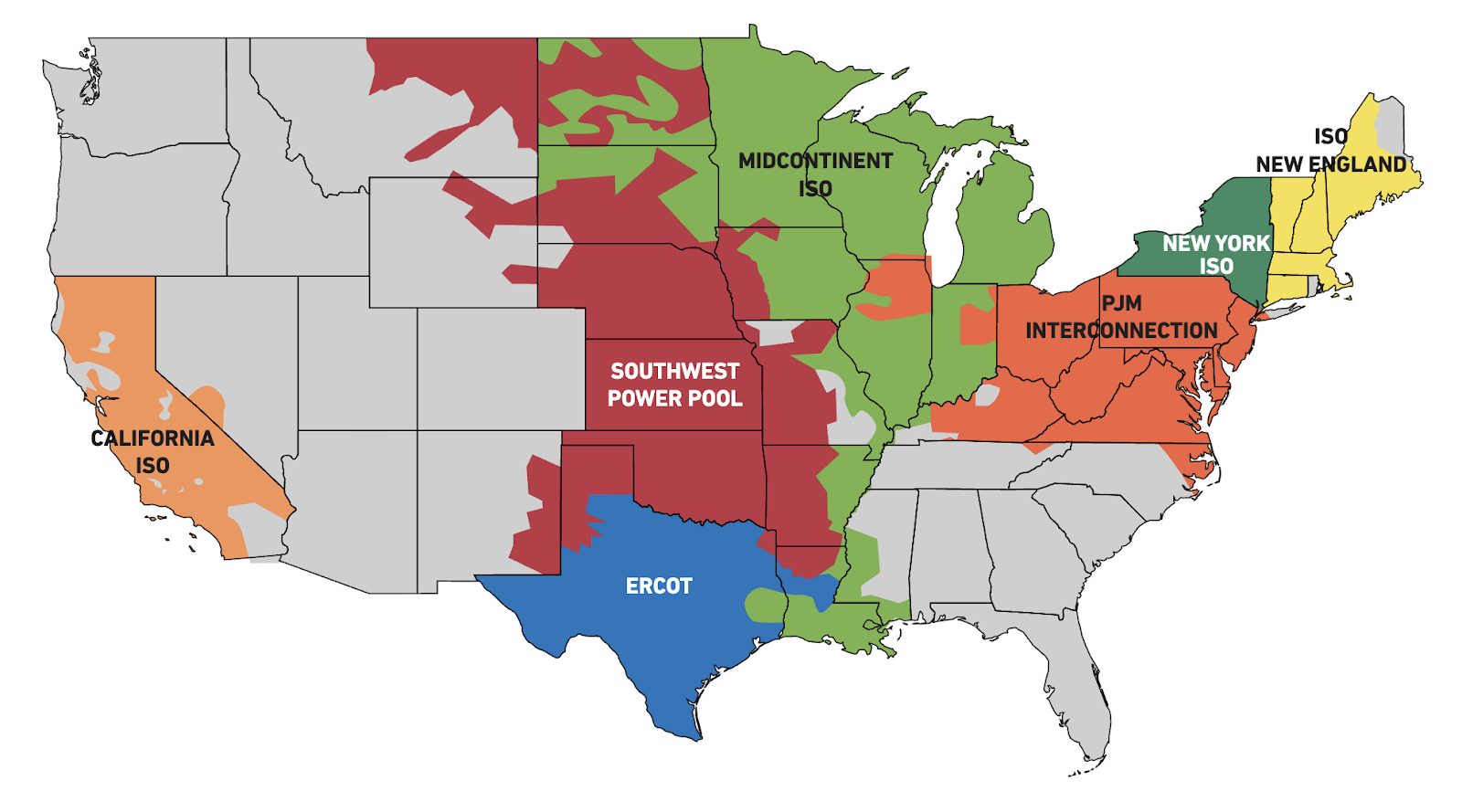 Source: Sustainable FERC Project (n.d.). ISO RTO Operating Regions [Original image]. Retrieved from https://sustainableferc.org. Adapted/Modified by New Consensus.
While power sharing within interconnections and RTOs has been growing in recent years, very little occurs between RTOs or interconnections. Nevertheless, much of the transmission capacity that needs to be built will require interregional cooperation and the development of a genuine national grid system. The current system makes this impossible, denying millions of Americans access to high-quality, low-cost energy sources.
The scale of the gridlock is staggering. As of the end of 2024, roughly 2,300 gigawatts of generation and storage capacity were actively seeking grid interconnection — nearly double the country's entire installed generating capacity. While this marked the first decline in queue size in over a decade (down from 2,600 GW in 2023), only 13% of projects that entered the queue between 2000 and 2019 had actually reached commercial operation, and the median time from interconnection request to operation has doubled to over four years.
Recent federal action has begun to address the planning deficit. In May 2024, FERC issued Order No. 1920, requiring grid operators to develop 20-year regional transmission plans for the first time — considering future changes in the resource mix, demand growth, and extreme weather — and to reform how the costs of new transmission are shared. The order established a formal role for states in cost allocation and directed grid operators to submit compliance proposals by mid-2025. PJM, the nation's largest grid operator, filed its proposed long-term planning process in December 2025. However, Order 1920 faces dozens of consolidated legal challenges in the Fourth Circuit, and its durability under the new Republican FERC majority is uncertain. More fundamentally, even if the rule survives, it addresses only planning and cost-sharing — not the primary obstacle: siting authority. Getting permission to build a transmission line across state boundaries remains a decade-long gauntlet of state permits, environmental reviews, and local opposition. A federal backstop or unitary siting authority for projects of national significance remains the missing piece.
What Congress Must Do
Model Federal Energy Regulatory Commission (FERC) permitting and siting authority on the 1938 Natural Gas Act. Under the Natural Gas Act of 1938, the FERC is the sole body tasked with permitting and siting new interstate natural gas pipelines.157 When a developer wants to build a new interstate natural gas pipeline, they submit a proposal to the FERC. The FERC then decides whether or not to issue the certificate of “public convenience and necessity” that will allow developers access to the route. The FERC has the ability to exercise eminent domain authority in certain limited instances.158 While states and localities still have a say in the development of new pipelines, projects are not required to get approval from every impacted jurisdiction. A single state cannot directly veto an entire project, though states have at times used environmental permitting requirements to block pipelines indirectly. New natural gas pipelines are not exposed to the multiple approvals and competing jurisdictions that new transmission projects must contend with, and, consequently, can get faster approval for far more ambitious projects.
If Congress takes on the crucial project of upgrading the national grid, it must pass new legislation that gives the FERC the same unitary authority in permitting and siting new interstate transmission projects that it has with respect to natural gas pipelines. Without a national actor capable of both weighing the national consequences of transmission build-out and of moving past the process of multiple approvals and competing jurisdictions, the transmission deficit will continue to grow and the country will not meet its clean energy goals.
To ensure that there is no backlog of transmission applications, Congress should mandate that the FERC follows strict deadlines when deciding whether to issue a permit. FERC should finish any necessary reviews and make a decision on a permit within 18 months of receiving an application. Congress will likely need to appropriate extra funding to the FERC so that the agency can increase their administrative capacity.
States’ rights proponents have opposed consolidating permitting and siting power within the FERC.159 We are puzzled by their objections. Opponents claim to be worried about federal overreach when discussing transmission, yet they accept the accelerated approval of natural gas pipelines. This policy change simply levels the playing field, addressing the unfair regulatory environment that grants special privileges to hazardous natural gas pipelines while placing excessive burdens on new transmission projects that connect clean sources of energy to our nation’s grid infrastructure.
The FERC permitting process contains substantive environmental review checks and pathways to ensure fair treatment for landowners.160 Balancing urgently needed infrastructure projects against the need for careful review to protect ordinary citizens makes responsible, clear-eyed FERC leadership essential.
Create an investment tax credit for new transmission projects. Tripling America’s transmission capacity over the coming decades will require massive levels of private investment. An investment tax credit for new transmission projects will be an essential tool for enticing private capital to invest in projects large and small across the country.
An investment tax credit for transmission already has the support of key Democrats. President Biden’s original Build Back Better Act included a new tax credit for transmission projects modeled on the successful Investment Tax Credit for solar projects. The Biden proposal called for a tax credit worth 6% of the cost of investment, and projects that meet wage and apprenticeship requirements could claim up to 30%.161 Other similar proposals include Senator Martin Heinrich’s (D-NM) Grid Resiliency Tax Credit Act of 2023, which includes a 30% tax credit for regionally significant transmission projects and grid-enhancing technologies.162 No transmission-specific tax credit was ultimately enacted. The MFA’s proposal for a transmission ITC remains necessary — and, given the demonstrated fragility of tax-code-based incentives, should be paired with RFC direct investment.
Tax credits have proven politically fragile — the IRA’s clean energy credits were killed within three years. The transmission ITC must be paired with RFC direct investment to ensure grid modernization continues regardless of the political cycle. Unlike tax expenditures, which proved vulnerable to repeal, RFC investments create physical assets and institutional capacity that endure.
Many of the existing proposals, particularly the Grid Resiliency Tax Credit Act, are excellent starting points for Congress to work from. However, there are a few ways Congress could further improve upon the existing proposals. Our recommendation is that Congress pass the Grid Resiliency Tax Credit Act but with the following three changes:
Include both interstate and intrastate transmission lines: The Grid Resiliency Tax Credit Act currently applies only to regionally significant projects — those that cross two or more states or extend at least 150 continuous miles. Although interstate transmission projects are certainly more difficult and expensive to build than intrastate lines, it is crucial that the credit encompass intrastate transmission line projects as well. While smaller in scale, intrastate transmission lines will be vital to building a 100% clean energy grid. Large states such as Texas and California will need to dramatically expand their intrastate transmission capacity as they transition to a 100% clean energy grid. Expanding the credit to include intrastate transmission projects will enable states to meet their CES requirements and build a more durable grid.
Raise the payout rate for transmission lines longer than 500 miles. The up-front cost and risk associated with investing in a transmission project increases with the size of the project. The reasons for this are relatively simple; larger projects require more materials, a larger workforce, and, most notably, a greater expanse of land. Expanding the payout rate for the largest of projects will ease investor concerns about the viability of the most ambitious projects, and direct more money towards the long-distance projects America desperately needs.
Make the credit direct pay: Making the credit direct pay will allow developers can receive the full benefit of the tax credit regardless of their existing tax liability. When a tax credit is not direct pay, applicants can only claim a credit as large as their existing tax liability. This means that investors whose tax liability is smaller than the total value of the credit either have to accept a smaller payout or take their credit to the complex tax equity market. Those taxpayers will not be able to participate in the program to the fullest extent, and will thus be less likely to invest in new transmission projects. Making the credit direct pay will allow everyone to fully participate in the program and encourage more investment in transmission lines.
Implementing this credit in full would usher in billions of dollars of new investment in transmission lines. An American Council of Renewable Energy (ACORE) study calculated that an investment tax credit for transmission would “create upwards of 650,000 good-paying jobs, enable an additional 30,000 megawatts of renewable energy capacity, spur more than $15 billion in private capital investment in the near term, and provide $2.3 billion in energy cost savings for the lower 80% of income brackets.”163
Expand federal authority to create public-private partnerships under Section 1222 of the Energy Policy Act of 2005. Using public-private partnerships to build out new electrical transmission lines with direct government financing is a significant area of untapped potential. Section 1222 of the Energy Policy Act of 2005 gives the Department of Energy the authority to do just this.164 Under Section 1222, the DOE is currently limited to projects within the Southwestern (SWPA) and Western Area (WAPA) Power Administrations. Other than this geographic constraint, this power is otherwise quite broad.
Map of Power Administrators
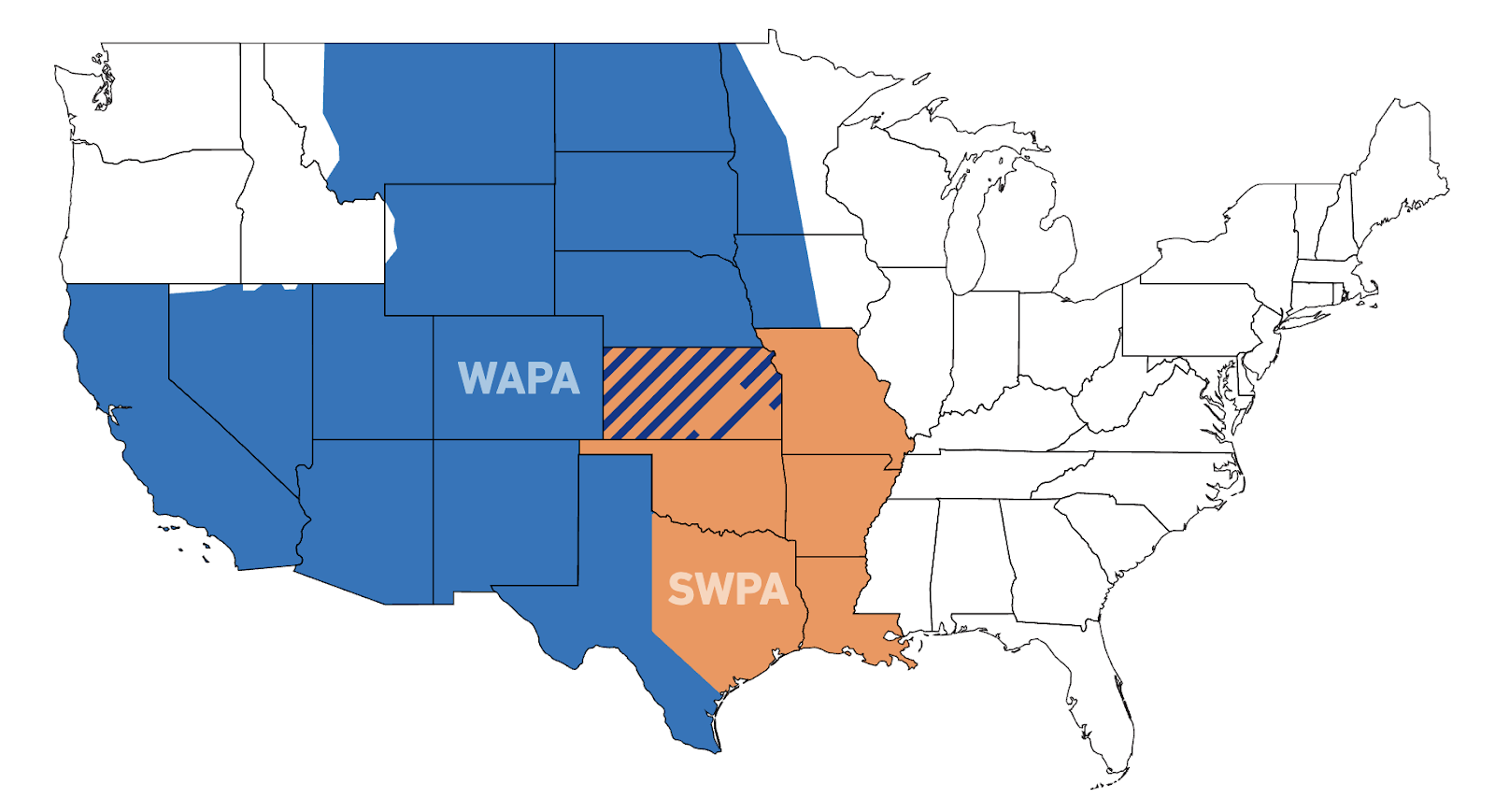 Source: Western Area Power Administration. (2023, August 24). PMA map [Original image]. Retrieved from https://www.wapa.gov/about-wapa/regions/pma-map. Adapted/Modified by New Consensus.
This power remains mostly untested. Section 1222 has been used only once, for a transmission line that was eventually abandoned for unrelated reasons. Nevertheless, this broad power still exists and can provide a foundation for broad federal investment in new transmission lines. We recommend the following three reforms.
Expand Section 1222 to cover the entirety of the country. The DOE must have the authority to invest in new transmission lines wherever they are needed. This requires Congress to eliminate the existing geographic constraints and clarify that lines may cross through multiple power markets. Expanding the program’s jurisdiction will give the DOE leeway to pursue larger projects and fix transmission bottlenecks wherever they may occur.
Empower the federal government to actively seek out partnerships. The federal government should take the initiative and develop projects without waiting for a private investor to express interest where a project is vital to the national interest. The legislation must instruct the DOE to assess where essential transmission routes will lie and to regularly engage in seeking partnerships for these projects. But it must also allow the DOE to initiate the building and operating of needed lines even before a private actor appears.
Adequately fund the DOE’s mission in this area. Mass amounts of new transmission projects are needed, and sufficient public capital must be made available through both congressional appropriations and the RFC.
What the President Must Do
Executive Leadership
The president must advocate for a new national mission: A massive grid build-out. Until the FERC has siting and permitting authority over new transmission projects, transmission line projects will still be stalled. The president must act to push these essential projects through. Public campaigning and personal outreach to decision-makers should highlight the benefits of new transmission lines: Cheaper rates, cleaner air, grid security, and new jobs. Transmission lines are frankly too boring on their own for most Americans to think about. But, every American wants their utility bill to be lower and to never worry about blackouts. Connecting transmission to the material conditions of day-to-day life will make it easier to drum up support for new projects.
There will be times when the President must call out bad faith actors or take a stance on a controversial project. The president would be wise to pick fights only with powerful, generally unsympathetic actors. This advocacy power should be used strategically and deployed mostly when political or economic self-interest stalls projects. Publicly fighting with individual small farmers would clearly backfire on the president and make the government look like a bully. It is important, both morally and politically, that landowners are always fairly compensated for their land when a transmission project is built. The focus should instead be on bad actors who are blocking projects for purely ideological reasons or who are in the pocket of the fossil fuel industry. Why should a small group of well-off, bad faith actors be able to deny average Americans affordable electricity? How will America remain the world’s leading economic power if a small group of individuals prevent us from modernizing our power grid? These are the type of conversations the president will need to initiate among the American people.
Make the case for the 100% Clean Power Mission to utilities and transmission developers. The president must convene the most important players in the transmission sector — private developers, utilities, local decision-makers, and more — and make the case for elevating transmission to a national-level concern as a core part of the energy transition. The goal is to create momentum for the use of either Section 1222 or funding from the newly created Reconstruction Finance Corporation to spur new transmission projects. Even before these programs come online, the message that the federal government is willing and able to finance large-scale transmission projects must go out to utilities and developers in all 50 states. This may involve the president’s 100% Clean Power team regularly assembling leaders from the transmission sector to spur dialogue. Transmission projects, even under ideal conditions, take years to complete; therefore this work must begin early in the administration so the effects can be felt before the end of the president’s first term.
White House Leadership
Appoint bold FERC commissioners. All of the country’s resources and powers must be put in play to achieve a zero-emissions economy, and the president must lead the country toward that goal. Nowhere is federal leadership more essential than in appointing bold, competent administrators. The FERC is led by a team of five commissioners, two of whom must be Republicans and two of whom must be Democrats: The fifth may be either a Democrat or a Republican. Republicans now hold a 3-2 majority on the commission, with Chairman Laura V. Swett leading a reorientation toward pipeline permitting and AI data center energy needs. FERC commissioners make crucial regulatory decisions relating to power markets, clean energy, transmission, energy storage, natural gas and a host of other issues key to the success of this national mission. If the president is given the opportunity to appoint a new FERC commissioner, they must choose an appointee willing to make bold regulatory decisions in aid of the country’s new clean power mission.
The new powers given to FERC will mean little if the leaders at the FERC are not willing to exercise them. If new permitting and siting authorities are vested in the FERC, then the agency needs to be proactive in quickly approving new transmission lines — most crucially, those that provide sizable consumer savings or that allow a utility to meet its Decarbonization Pathway Study goals.
Use existing federal power to designate National Interest Electric Transmission Corridors (NIETCs) in order to build out transmission capacity. The federal government must deploy its power to designate NIETCs, and use federal backstop siting authority to override opposition to the build-out of new transmission lines. The following three actions taken by executive branch agencies could expand America’s transmission capacity without the need for any new congressional action.
NIETC designation power must be transferred to the Federal Energy Regulatory Commission (FERC). The DOE should transfer its power to declare NIETCs to the FERC in order to consolidate transmission siting authority into one agency. Under the Department of Energy Organization Act, the secretary of the DOE can delegate specific authorities to the FERC unless otherwise explicitly prohibited.165 No new congressional action would be needed. The FERC already offers faster turnaround time on new permits. Its large bureaucracy is well versed in implementing transmission policy.166 Giving the FERC greater authority to coordinate action between different regional actors, and greater latitude in the permitting and siting process for all transmission lines, will simplify the regulatory process for stakeholders. Project developers and community advocates in the transmission sphere would all deal with the FERC.
The FERC must use the Clean Energy Standard (CES) to measure necessity and national interest. Under its new authority, the FERC will use the CES and Decarbonization Pathway Studies (DPSs) discussed in Solution 1 to determine where transmission is most needed and to create new corridors there. The Bipartisan Infrastructure Law broadened NIETC criteria to include areas where consumers are expected to be harmed by a lack of transmission in the future, and DOE published detailed guidance in 2023. But FERC should go further, clearly defining “congestion” to mean areas where current transmission capacity prevents utilities from meeting their mandated CES goals, or impedes their ability to implement their decarbonization plans. The DPSs can be used to determine which lines are essential to a utility’s CES goals. Defining congestion in this way will allow for proactive building, predicting demand, and building new transmission to mitigate future congestion. The BIL also clarified that FERC can issue backstop permits when a state has denied — not merely failed to act on — a siting application, and FERC finalized these backstop procedures in May 2024. This authority must be exercised assertively.
Streamline FERC and state cooperation. In California Wilderness Coalition v. Department of Energy, the 9th Circuit Court of Appeals ruled that the designation of a new corridor can only come after genuine consultation between the designating authority and the impacted states.167 The court stipulated that consultation needs to go beyond the ability for states to comment on such designations; the FERC and the states must share data and other key determinants.168 Under its new designation power introduced in the above policy, the FERC must work in consultation with affected states to ensure that consensus is reached for each NIETC designation. Individual states should have input into the development of new power lines, but they should not have unilateral veto power over lines designated as essential for the greater national energy mission.
Use existing rights-of-way to build new transmission lines. One area of transmission expansion that requires no change to NIETC law is the development of new transmission lines on existing rights-of-way such as highways and railways. Building along existing rights-of-way, using routes already designed to connect America’s major population centers, will allow the government to bypass much of the complicated siting and permitting process. Much of the land used for highways is already approved for other projects. The FERC should study whether any existing rights-of-way are conducive to the development of new transmission projects. If so, they should immediately begin the permitting process and scouting potential developers. When no private developers appear, the executive branch should begin the process of developing lines through public-private partnership powers outlined in the following section.
The DOE should proactively use expanded Section 1222 power to start building out new lines. After Congress authorizes a new expanded jurisdiction for Section 1222, the executive branch must act. If the federal government finds that a particular transmission route will bring substantial economic or decarbonization benefits, but no private developer expresses interest, then the DOE should use its expanded authority to begin building out new lines independently. In these instances, the DOE and the FERC can cooperate to expedite the permitting process and ensure that lines are built as quickly as possible. Since the lines must be initiated and built by the DOE, but can be approved only by the FERC, the two must coordinate closely. The initial lines chosen for the 1222 process should:
Enable a utility or utilities that uses the new lines to comply with CES.
Connect consumers to lower-cost, renewable generation.
Improve grid reliability.
Be too expensive or complex for a private developer to undertake on their own.
A long-distance line connecting wind generation in the Midwest to an urban area in the Northeast, for example, would be practically impossible for a private developer to finance on their own. Financial support from the DOE would be crucial to realizing the project. If no private developers are willing to undertake these kinds of projects, even as part of a public-private partnership, then the DOE needs to have the authority and the capacity to complete them itself.
Mandate that every electrical provider participate in a Regional Transmission Organization. Currently, participation in an RTO is optional for electricity providers. The FERC has consistently supported a bottom-up participation model, arguing that the merits of RTO participation speak for themselves. Yet roughly a third of the country is still not under RTO jurisdiction, and further expansion of RTOs is unlikely without a strong political push. The FERC has the power to issue an order mandating that all electrical providers in the United States participate in a new or preexisting RTO. It should issue such an order.
This idea is gaining steam among energy policy experts. In June 2021, nine former FERC commissioners and chairs wrote a letter arguing for the FERC to exercise its power and expand participation, citing the benefits that RTOs provide in more quickly deploying renewable energy, developing new transmission, and decreasing emissions.169 Expanding power markets to the rest of the United States would help ensure greater access to low-cost renewables, and create the regional transmission necessary to meet our Clean Energy Standard goals.
RTO membership must be mandatory to facilitate interregional dialogue and to ensure, in turn, that all areas of the United States are included in the energy transition. Existing RTOs have proven themselves incapable of engaging in interregional planning. Yet they do provide formal representative outlets for different areas of the country to voice their collective energy concerns.
Our previously discussed proposals — centralizing permitting and siting authority within the FERC and initiating public-private partnerships to proactively build new transmission — mean that RTOs would not have a central role in initiating interregional transmission planning. Yet, creating universal access to RTOs will ensure effective management of new lines and bureaucratic cooperation between regions throughout the development process. Under this new arrangement, interregional cooperation between RTOs will not plan new lines, but will instead oversee the FERC’s transmission development goals, continue their power management responsibilities, and ensure that their customers’ interests are being represented in the planning process.
RFC Leadership
The RFC clean power team leader must work closely with the RTOs, state governments, and private developers throughout the duration of the building process. The leader of the RFC clean power team must remain personally involved with the key stakeholders in all transmission projects the RFC invests in and see that the project is built to completion. Hundreds of thousands of miles of new transmission lines will be built throughout the duration of the Mission for America, and the leader of the RFC clean power team cannot reasonably be expected to be intimately involved in all of them. Many smaller projects can be built in a timely manner without any involvement from the RFC. However, the team leader must be immediately aware of where national bottlenecks are occurring or if any lines the RFC is invested in are having difficulties being finished. The only way the RFC team leader can do this successfully is by remaining personally connected to key stakeholders and government officials so they can respond to problems as soon as they arise and move beyond bureaucratic constraints.
Our system of governance has become so bureaucratic and disconnected from average Americans, that it is difficult to imagine what it is like for a government official to be this personally involved in a privately funded project – but this is precisely how America functioned at the height of its economic power. The original Reconstruction Finance Corporation (RFC) provides a useful case study for how this dynamic may work. The RFC never invested in a major project without its chairman Jesse Jones, or a leader from one of its many subsidiary corporations, developing a relationship with the key stakeholders. If a project was underperforming expectations, Jones would call the developers and figure out how he could help move the project forward. If the project was underperforming due to a failure of the developer, Jones would not shy away from browbeating the project’s leadership team into making any necessary changes. Jones himself was so involved in the success of the RFC’s many investments that the phrase “you better see Jesse” was a common refrain among businessmen and government officials during his tenure as chairman. This level of personal relationship was a foundational part of the RFC’s strategy and is one of the main reasons it was so successful in saving the American economy.
This style of personal leadership will be uniquely important in the transmission sector because of the many different actors responsible for building a large interstate transmission line. Building a new transmission line requires action from more than just the company building the line. Local utilities need to be able to connect the line to the grid, renewable energy projects need to be built and connected to the line, and there must be cooperation between the various RTOs that the line passes through. A problem with any of these steps could potentially delay a project by years. Under existing institutions, this problem would result in a process of indefinite bureaucratic back-and-forth. The leader of the clean power team can rise above that trap by using their personal relationships with key actors to facilitate a solution to whatever bottleneck is endangering a project.
Make an investment in a bold interregional long-distance transmission project as a “Day-One” investment. Investors in the transmission sector have been conditioned to believe that long-distance interregional transmission lines are impossible to build in the United States. Not only have most high-profile projects failed, the government’s prior attempts at removing regulatory and financial barriers have been half hearted and unsuccessful. Congress, the president, and the RFC will all have a role to play in undoing the negative disposition investors have towards interregional projects. The actions taken by the president and congress in this section are the strongest actions ever taken by an administration in the transmission sector, but it will be up to the RFC to demonstrate to investors and the American people that these reforms are sufficient to build bold interregional transmission lines. To demonstrate their commitment to interregional transmission, the RFC will need to have an interregional transmission project lined up as a “day-one” investment to unveil to the American public at the start of the clean power mission. This investment will serve as a proof-of-concept project for the president’s overarching transmission strategy and show that interregional transmission lines can finally be built in America.
The importance of this investment cannot be overstated. The RFC must do whatever it takes to get the project done on time and within budget. This investment will be the administration’s biggest opportunity to prove to developers that the reforms they passed are capable of building the transmission infrastructure the country needs. If the project is successful, then developers will be likely to pour billions of dollars into interregional lines across the country. If the project fails, it will damage the legitimacy of the administration’s transmission reforms and investors will be significantly less likely to support future projects. The RFC will need to take many proactive steps to ensure the success of the project. These actions may include; working with the FERC to make sure that the line gets approved quickly, smoothing out any bottlenecks that may emerge in the supply chain, regularly updating the president on the project’s progress, and identifying or investing in clean energy projects that could connect to the transmission line.
Create a dedicated group within the Clean Power RFC Team who focuses on deploying Grid Enhancing Technologies (GETs). As discussed earlier, GETs are strategies, systems, and technologies used to improve the efficiency, reliability, and resilience of the electric grid. Many utilities and long-distance transmission line owners across the country have already used GETs to reduce consumer prices and promote clean energy adoption. However, most utilities and line owners have not fully utilized the potential of GETs, mainly due to underinvestment resulting from a lack of capital, technical know-how, or willingness to pursue extensive technical upgrades.
To address this issue, the RFC needs to create a subdivision within the Clean Power RFC Team responsible for providing financial support, technical assistance, and the determination that line owners may lack. This subdivision, called the GETs team, will proactively identify utilities and individual long-distance power lines that would benefit the most from adopting GETs. Once a line or utility is identified, the team will take all necessary steps to ensure that GETs are deployed.
The first job of the team is identifying what GETs a line-owner would benefit from and then convincing the line-owner to make that investment. Some line-owners won’t require much convincing from the RFC and will easily be persuaded to invest in GETs. However, many line-owners will need more encouragement.
The RFC can overcome hesitancy about the financial viability of a line-owner’s investment by providing cheap, long-term financing to line-owners. When the line-owner is a local utility, this loan can probably be included in the Utility Upgrade Fund introduced in Solution 1. When the line-owner is a private transmission operator, the loan should be handled by the GETs team.
The GETs team will include a group of technical experts whose role is to educate line owners on deploying and utilizing GETs to their fullest potential. This team will help overcome any concerns line-owners have about how to integrate GETs with their existing assets. Additionally, this team will be responsible for resolving any technical bottlenecks that may arise during the deployment process. The team will have to remain on-call to respond to technical problems with any GETs related investment made by the RFC.
Solution 3: Investing in Clean Energy Manufacturing
The Challenge
The problem of reducing emissions is fundamentally a matter of replacing dirty, inefficient fossil-fuel machinery and infrastructure with clean alternatives. But widespread adoption of renewable energy technology — solar panels, wind turbines, batteries, hydrogen electrolyzers, and more — can only happen when the technology is affordable and accessible across America. To achieve this in the necessary timeframe will require that the federal government invest public funds in the renewables industry and its workers. For this reason, a new industrial policy for renewable energy is essential.
The expansion of the renewable energy market revolves around the basic premise that someone must make the solar panels, wind turbines, and batteries, and someone must be willing to buy them. For these two things to happen, we must simultaneously drive down the costs of renewables while developing new productive capacity here at home.
The country needs to produce more clean energy components here in America. The dangers of relying on global supply chains for essential clean energy technology have been demonstrated repeatedly. In 2021, supply chain disruptions drove the first increase in solar panel costs in seven years, threatening to cancel or postpone 56% of worldwide utility-scale solar projects.170171 More recently, Chinese manufacturers have flooded the market with panels priced below the cost of production — driving module prices to historic lows near $0.08 per watt — while China's manufacturing capacity of 500 GW per year now dwarfs global demand.246 This dependence on a single country for the majority of the world's solar supply creates its own risks: when China moved to curb oversupply in late 2025, prices immediately began rising. Investing in domestic manufacturing is the only way to create a resilient supply chain capable of transitioning our economy towards a clean energy future.
This means subsidizing relevant industries by investing in a domestic supply chain for essential materials, building factories and training workers. This push, in turn, must be founded on the creation of a new industrial policy capable of significantly expanding entire industries within the United States.
The United States was once the world leader in developing and manufacturing renewable technologies. In part because of a lack of a national industrial policy, however, manufacturing has moved to other countries. This phenomenon can be seen most clearly in the solar panel manufacturing industry. In 2004, the United States accounted for 13% of global solar panel shipments. By the late 2010s, that share had collapsed to less than 1%, as Chinese manufacturers — backed by over $50 billion in government subsidies — captured more than 80% of the global market at every stage of the supply chain.172173 The IRA, however, proved this decline was reversible. Driven by manufacturing incentives — particularly the Section 45X advanced manufacturing production credit — U.S. solar module manufacturing capacity surged from roughly 10 GW before the IRA to over 50 GW by early 2025, a five-fold increase in under three years.174 The OBBBA modified but did not eliminate the 45X credit for solar manufacturers, preserving the original phase-down beginning in 2030. However, new Prohibited Foreign Entity restrictions and domestic content requirements are creating significant compliance complexity, and the credit for wind components was cut short, ending after 2027 rather than phasing down through 2032. The initial success of 45X demonstrates a core MFA principle: targeted manufacturing incentives work, but they work best when paired with the kind of patient, long-term public financing — through an institution like the RFC — that doesn’t depend on the political survival of any single tax provision.
Reviving domestic manufacturing is a core tenant of the Mission for America. Renewable energy offers an excellent example of an essential industry that should be developed here in America through a strong, comprehensive industrial policy. Onshoring domestic manufacturing provides tangible benefits for both the success of the energy transition and for the average American worker.
Creating a new clean energy manufacturing industry at home will advance the deployment of new solar generation and provide the basis for hundreds of thousands of new, high-quality jobs for Americans. In 2023 alone, 28,000 jobs were added building new clean energy manufacturing facilities, and the clean energy construction workforce has already grown to over 1.6 million. Solar manufacturing provided more than 33,000 domestic jobs in 2023 — and could reach 115,000 by 2030 with sustained investment.175 A comprehensive industrial policy through the RFC would multiply these gains further.
American companies have proven they have the desire to expand their operations and capital investment when supported by even modest government incentives. The Inflation Reduction Act triggered a historic wave of private sector investment. By early 2025, companies had announced over $380 billion in new capital investments for clean energy manufacturing, leading to plans for more than 380 new or expanded facilities.176 The response from the solar industry far exceeded initial projections. U.S. solar module manufacturing capacity grew from roughly 10 GW before the IRA to over 60 GW by late 2025 — a six-fold increase in three years, with major manufacturers like First Solar (~14 GW of domestic thin-film capacity across Ohio, Alabama, and Louisiana) and Qcells (targeting 8.4 GW including a first-of-its-kind fully integrated facility in Georgia) making the U.S. a serious force in panel production.177 Module assembly led the way, but the critical upstream supply chain — ingots, wafers, and cells — has been slower to develop. By late 2025, domestic cell capacity had reached only 3.2 GW despite over 34 GW under construction or announced, and ingot and wafer production remains the weakest link, though new facilities from Hemlock and Qcells have begun to close the gap. The full supply chain is now technically reshored, but actual production remains well below domestic demand — exactly the kind of scaling challenge that an RFC-led industrial strategy would address by financing the full production chain from raw material to finished product. However, the One Big Beautiful Bill Act of July 2025 curtailed or eliminated many of these incentives, putting the pipeline of future investment at risk.
Increasing access to clean energy is an investment in the future of America itself. Critics claim that the costs of this investment are too high — that the United States simply cannot afford the massive expenditures needed to fund a revival of domestic industry. Such reservations seem to evaporate when the defense budget or special interest handouts are discussed. The investments we advocate are proportional to the threat we face as a nation. They are not “handouts.” They will pay for themselves through an increase in America’s productive capacity. They will help mitigate billions of dollars in damages from severe climate change. America has abandoned the idea of investing in its citizens for far too long. The Mission for America is a plan to change that.
What Congress Must Do
Restore and expand the Advanced Energy Project Tax Credit for clean energy manufacturing. The Inflation Reduction Act revived the Advanced Energy Project Tax Credit (AEPTC), often referred to as the 48C Clean Manufacturing Tax Credit, which provided a credit to investors in new manufacturing facilities that produce a “qualifying energy project.”178 The 48C credit awarded $10 billion across two rounds before being effectively terminated by the OBBBA — unallocated funds were rescinded, and re-allocation of forfeited or revoked credits was prohibited. The ~250 existing awardees have certification and placed-in-service deadlines, but no new awards are possible. A 2029 MFA Congress must either restore and expand 48C or — more durably — direct the RFC to make equivalent investments that cannot be repealed by a simple legislative rider. A qualifying energy project is one which helps the country transition away from fossil fuels and equipment powered by fossil fuels. Components for renewable energy technology, energy storage technologies, and grid technology all count as qualified energy projects. The credit payout is equivalent to 30% of the cost of the investment. The AEPTC is an essential component of the clean energy transition, but the program as it currently stands is far too small and limited in scope to spur the level of investment in clean energy manufacturing that is needed to hit our clean energy goals. We propose three different reforms of this credit.
Make the credit fully refundable (direct pay) so that all businesses can have equal access to the credit. The Inflation Reduction Act did expand direct pay to tax-exempt entities such as nonprofits or cooperatives, but not to any tax-paying individuals or organizations.179 While this is an improvement on the original ITC, it does nothing to help to solve the inequities that small businesses and many individual taxpayers face in the absence of a direct pay option. Those taxpayers will not be able to participate in the clean energy transition to the fullest extent, and will thus be less likely to invest in clean energy products at all. Refunding the credit directly makes the full financial benefits of the credit available up front, makes the impacts of the credit more equitable, and helps create more manufacturing capacity.
Make the credit accessible to all qualifying projects, rather than being dispersed on a competitive basis. Unlike many of the clean energy tax credits passed in the Inflation Reduction Act, which are given to all projects that meet the credit qualifications, the Treasury has a limited amount of money they can hand out under this credit and therefore has to decide which projects will receive funding.180 The Department of the Treasury has a budget of only $10 billion for credits under the IRA in its current form. It is essential that Congress removes this limitation and makes the credit available to all projects that qualify. The restrictions currently placed on this credit will severely limit its impact and many worthy projects will have to be denied access to the subsidies. This is particularly worrisome because the scope of the credit is so large, encompassing not only manufacturing related to renewable energy but any sort of manufacturing the Treasury Department believes will reduce greenhouse gas emissions.181 Making the credit open to all qualifying projects will substantially increase investment in clean energy manufacturing by lowering the upfront costs of new manufacturing.
Extend the credit for the duration of the mission. Changing the credit so that it automatically goes to all qualifying projects will mean that Congress will need to design out over a period of time, rather than ending when the Treasury has allocated all of its budget. This is an opportunity for Congress to align the program with our broader net-zero goals and guarantee that the program will run in its entirety for the full decade of the mission.
Expand the Advanced Manufacturing Production Tax Credit for renewable production. The Inflation Reduction Act created a new production tax credit, often referred to as the 45X credit, for the production of renewable energy components, batteries and critical minerals.182 The credit is paid to the manufacturer of those products, and the payout is different for each qualified product. For example, the payout for solar modules is seven cents multiplied by the capacity of the module.183 This credit can be claimed every year the manufacturing facility is in operation. Under the IRA, the credit began phasing down in 2030 and expired after 2032. The OBBBA preserved this timeline for solar and storage components but added strict foreign entity restrictions and domestic content requirements, and cut the credit for wind components short, ending it after 2027. Unlike the AEPTC, which is designed to lower the upfront cost of new manufacturing capacity, this credit is designed to provide a long-running subsidy rewarding real manufacturing output. This credit will be an important tool to reward manufacturers who contribute to the energy transition, and to ensure the long-term health of American clean energy manufacturing. Even with these benefits, there are still ways for Congress to bolster the credit and provide further benefits to manufacturers.
First, increasing the payout rate for every qualified project will give American manufacturers a greater incentive to further increase production and reflect the heightened urgency of this national mission.
Second, the timeline of the credit should be extended to match the full duration of the mission. Elevated levels of production will be necessary to support our 100% clean energy and overall net-zero goals. The need for new renewable energy and storage component production will only increase as America sprints towards our ambitious climate targets, and the government should continue to support the manufacturers who will enable the country to meet these goals throughout the entire duration of this mission.
What the President Must Do
Executive Leadership
Win the support of industry leaders and stakeholders. The success of the clean power national mission will depend on the president’s ability to entice manufacturers to actively lead it. Courting executives, directors, and top shareholders needs to start at the very beginning of the presidential campaign with the development of personal relationships and campaign rhetoric that includes industry leaders as the future heroes of America’s revival—if they will only be brave enough to embrace this responsibility and opportunity. The president should stress that the domestic clean energy manufacturing industry is what will guarantee energy independence for America, and that industry leaders are doing a duty to their country by manufacturing the products that power American society.
The president should campaign on the success of the Reconstruction Finance Corporation. Whenever a major infrastructure project associated in any way with the RFC is completed, the president should use it as a success story for the financing program. Too often, the government helps finance companies or technologies that take off, yet which do not publicize their successes. How many Americans know that the DOE loaned Tesla almost half a billion dollars in 2010?184 Very few. But many were up in arms when Solyndra received a similar amount after it was founded in 2005 before ultimately failing in 2011. The investment of the federal government has helped facilitate the rise of industrial titans and life-changing technological advancements, yet this federal support is often only associated with its failures. Whenever RFC-funded projects chart significant progress, the president must highlight their success, and connect that success to the daily lives of Americans. Furthermore, the president must underscore the importance of these investments to the economic wellbeing of Americans and to the mitigation of global environmental collapse. The president must lead on this national mission and claim victories when they arise.
White House Leadership
Executive branch agencies must invest in domestic manufacturing through the federal procurement process. Onshoring the supply chains of renewable energy components will be a long and difficult process. Yet, it will reap rewards for workers across America as the country rebuilds a powerful domestic sector capable of meeting our Clean Energy Standard goals. While the country is unlikely to meet the entirety of its renewable energy demand from domestically manufactured components, the United States must grow this industrial sector. The administration can invest in this vital domestic industry in various ways.
In December 2021, President Biden issued an executive order calling for federal buildings to use only clean electricity by 2030.185 This directive is no longer being implemented under the current administration. An MFA president must issue a new executive order on day one, re-establishing and strengthening federal clean energy procurement requirements. To meet that goal, federal procurement should prioritize renewable generation technology made in America. Domestic manufacturing should be prioritized for any federal buildings with on-site solar and storage systems. Direct procurement of American-made solar panels — even if they are more expensive than their Chinese counterparts — would be the easiest way to steer direct investment into American solar manufacturing. Executive branch agencies should be directed to focus as much of their procurement efforts on domestically produced renewables as possible.
RFC Leadership
The Reconstruction Finance Corporation must provide investment in clean energy manufacturing projects. Any investments in clean energy manufacturing are arguably the most important that RFC will make throughout the Mission for America presidency. They will enable future investments in industries such as electric vehicles or hydrogen to be genuinely carbon-free. The importance of this industry means the RFC must not hesitate to make ambitious investments in all types of clean energy manufacturing, and guarantee a fully domestic supply chain of clean energy components. Financing should be made available to manufacturing projects large and small across the country through the RFC’s normal means of financing, which include using loans, loan guarantees, and taking equity stakes in companies.
The RFC will begin this process by seeking out existing American clean energy manufacturing companies to invest in. Although America’s clean energy manufacturing sector is young and small relative to its European and Chinese counterparts, American companies have proven they have the desire to expand their operations and capital investment when supported by even modest government incentives. As previously discussed, the Inflation Reduction Act spurred a dramatic increase in investment in American clean energy manufacturing from existing manufacturers. The IRA demonstrated exactly what the RFC chapter argues: when government signals commitment, private capital follows. The question is no longer whether industrial policy works — the IRA proved it does. The question is how to make it durable. Companies ranging from Qcells to First Solar have announced billions in new investments. It is very likely that these same companies would respond positively to the RFC encouraging them to expand their operations even further. The RFC should begin its investment push by working with these companies to encourage them to expand their operations further. If this endeavor is unsuccessful, the RFC should seek partners from large American companies not currently in the clean energy manufacturing industry but who could be persuaded to join it. The RFC could even partner with foreign producers as long as new investments result in factories built in America and staffed with American workers.
It may be possible that reaching out to existing corporations with financing and investment opportunities will not be enough on its own to spur the necessary level of investment. If the United States still needs to produce more domestically made clean energy to meet the clean energy goals laid out in the Clean Energy Standard, the RFC has a series of emergency options beyond basic financing tools that it could use to accelerate investment. Placing purchase orders to later resell to private developers, the creation of World War Two style government-owned contractor-operated manufacturing facilities, and even the creation of a spin-off corporation for clean energy manufacturing are all options the RFC could pursue. The exact course of action for the RFC would be heavily dependent on the state of the industry and the specific reasons why investment is declining, but we find it prudent to explain in greater detail an example of an action the RFC could take if such an emergency were to happen. Further reading on various strategies the RFC could employ can be found in our chapter on the Reconstruction Finance Corporation.
One option is for the RFC clean power team to begin placing purchase orders for the necessary clean energy components and allowing investors to bid on the contract. The contract could be for a set amount of components, for example, an agreement that stipulates that the RFC will buy enough polysilicon to supply 5GWs worth of new solar panels. Once the RFC finds an investor and the manufacturing capacity is developed, the RFC will begin coordinating with clean energy developers to sell the components or find a partner to buy out the contract. This plan would guarantee that manufacturers have an immediate demand for their products and could assuage investor fears over the viability of new investments.
Should financial tools fail to increase business investment, the RFC must use public pressure to pressure investors to remain focused on clean energy manufacturing. The RFC CEO and the leader of the clean power team - both backed by the personal support of the president - can use their position to apply a considerable amount of political and social pressure on manufacturers to increase production should investment decline. Both leaders will need to frequently meet with leaders in the clean energy manufacturing sector to remind them of the urgency of the moment, and that the RFC is willing to be a supportive co-investor in new projects they wish to develop. Leaders at the RFC would be smart to remind manufacturers that the other policies introduced in the Mission for America make the energy transition a near-inevitability, and the only remaining question is who will be the one to supply the country with the technology it needs to finish the job. If it is not an existing American company, it will be a new company that emerges and becomes the dominant player in the industry. Or, perhaps, it will be a foreign company that takes RFC financing and moves its operations to America. The energy transition will happen with or without a particular investor joining in - inaction will only lead to a company or investor being left on the sidelines.
Monitor for gaps in the supply chain. Clean energy manufacturing is uniquely complex because of the fragmented nature of component production. It is very rare for a manufacturer to cover the entire supply chain of a given technology. For example, it is common for solar developers to focus on specific aspects of panel construction rather than build all of the components necessary for a functioning solar panel. Most investments made in new solar manufacturing in the United States have been for solar modules. Comparatively, very few investments have been made in polysilicon or wafers because of higher capital costs. This has created a dynamic where American-made modules are becoming abundant, but developers still rely on imports for other parts of the supply chain. The RFC must track which parts of the supply chain are underdeveloped in America and invest aggressively in new manufacturing facilities for those components and strive to ensure that there are multiple domestic suppliers for all parts of the clean energy supply chain.
The RFC must have a “Day One” investment in clean energy manufacturing. The RFC must have a significant investment already lined up by the time the president announces the clean power national mission. A “day one” investment of significant scale will demonstrate to the American people that the RFC is willing to make ambitious investments in clean energy manufacturing, and will encourage other private investors to seek out RFC financing for projects of their own. The ideal day one investment would be a brand new factory that encompasses the entire supply chain of a given technology. The RFC would benefit from choosing a project that is located in either a former industrial or traditionally low-income community. This would help bolster the president’s argument that the RFC, and by extension the entire Mission for America, is an investment in those who have been left behind by America’s economic policy over the last few decades.
This “day one” investment by the RFC will be one of the most high profile investments the RFC will ever make, and its success or failure will greatly impact the future of the national mission for clean power. The “day one” investment will always be linked to the broader national mission in the eyes of voters and investors. If the project were to fail, it would be a significant blow against the public perception of the RFC and the Mission for America as a whole. Were it to succeed, the president and the RFC will be vindicated in their approach. Voters will be excited about the possibility of new factories in their community and investors will clearly see the financial benefits of partnering with the RFC. Ensuring that this particular investment succeeds will be one of the most important tasks the Clean Power RFC Team undertakes throughout the entire energy transition.
To ensure the project succeeds, the RFC will need to work closely with developers to provide adequate financing and any other resources they need to see the project to completion. If significant bottlenecks occur, the RFC should prioritize their resolution and guarantee that the project will not fall behind schedule. It is also important that the RFC is not taken advantage of by the developer of the project, who may recognize the importance of this project and try to exploit it for as much financing and help from the RFC as possible. The RFC may try to balance the importance of the project and its financial interest by offering generous continuing financial support to the project, but only in exchange for increasingly high amounts of equity for each wave of financing. This is, of course, only one way in which the RFC may theoretically balance these competing concerns. Regardless of the RFCs exact strategy, it must be well equipped to handle any situations that may arise and have sufficient political support from the president.
Solution 4: Building New Clean Energy Generation
The Challenge
Transitioning to a 100% clean energy grid within a decade is an ambitious goal that demands an unprecedented level of investment in new energy generation. A study by the National Renewable Energy Laboratory indicates that to achieve a 100% clean energy grid on this timeline, the rate of new clean energy deployments must increase to three to six times current levels.186 New investment in clean energy generation will need to grow at a similar, if not higher, rate — amounting to hundreds of billions of dollars in new investment in energy generation over the next ten years.
The IRA proved effective, driving record clean energy deployment — over 30 GW of solar in both 2024 and 2025, and a record 15 GW of battery storage in 2025 — and over $380 billion in announced manufacturing investment.187 Then the OBBBA gutted its core incentives, demonstrating the political fragility of policies based on the tax code. The key lesson: the model works, but it requires institutional durability. This is why the MFA centers its approach on the RFC rather than tax credits alone.
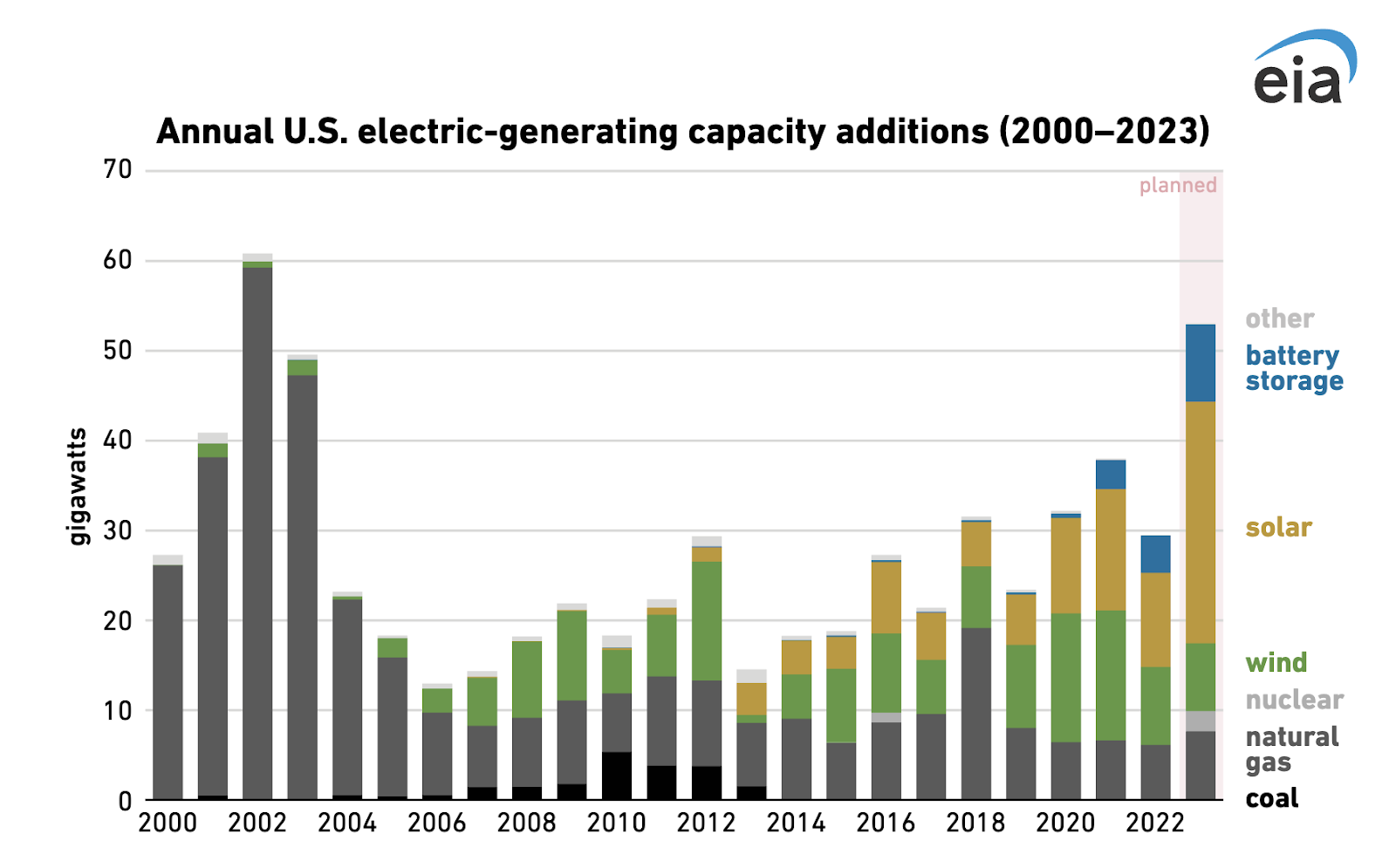 Source: U.S. Energy Information Administration. (2023, March 6). Wind, solar, and batteries increasingly account for more new U.S. power capacity additions [Original image]. Retrieved from https://www.eia.gov/todayinenergy/detail.php?id=55719. Adapted/Modified by New Consensus
Despite the IRA’s achievements, the level of investment it catalyzed was still insufficient to meet our clean energy goals.188 And now, with its core incentives gutted, the gap has widened. A 2029 MFA president must either restore what was killed or replace it with something more durable.
The federal government faces three key challenges in increasing investment in clean energy projects:
Enticing private capital to invest in clean energy generation via appealing financial incentives.
Financing and investing in projects that private capital is too scared to invest in.
Ensuring investments in clean energy are benefiting all Americans.
The rest of this section will detail these three challenges in greater detail.
Enticing private capital: Private industry has already begun to embrace clean energy as an investment opportunity, and the federal government must merely accelerate a process already in motion. Granted, the required acceleration is beyond what many in private industry will initially want to do. To accelerate private investment the federal government should prioritize reducing both the cost and perceived risk of energy generation investments. Policymakers will need to pull many different economic policy levers to make both things happen.
Policymakers have the opportunity to reduce the up-front costs of new clean energy projects through expanded subsidies and increasing the supply of new technology. The Inflation Reduction Act introduced new tax credits for clean energy investments, but even before the OBBBA curtailed them, the credits did not go far enough. A future Congress must restore and expand these incentives — increasing the base payout rate and making all tax credits directly refundable — to unlock their full potential and incentivize further investment in clean energy. Reforms introduced in other sections of this national mission, such as expanding the domestic manufacturing of clean energy technologies, will also lead to price reductions by increasing the availability of more affordable technologies.
The federal government can derisk clean energy investments by providing cheap financing to investors and guaranteeing demand for new generation. The RFC, in particular, is poised to provide this cost-effective financing, enabling investment in more ambitious clean energy projects than those typically pursued by private investors. Other parts of the national mission for clean power and the Mission for America will help provide guaranteed demand for new energy generation. The Clean Energy Standard will provide greater demand certainty by requiring utilities to expand their procurement of clean energy for at least the next decade. The electrification of various sectors of the economy will further boost demand for clean energy.
Additional risk mitigation could come from shortening project timelines to provide investors with faster returns and greater confidence that projects will be finished. However, this will be achieved primarily through regulatory reforms, as outlined in Solution 5.
Investing in the projects no one else will: Certain projects are essential to the decarbonization process but are either too risky or offer too low of a return on investment for private industry to invest sufficient capital. Next-generation energy technologies are the quintessential example of projects that struggle to attract private capital because of their perceived risks. Many new technologies find it challenging to attract investors in their early stages of development because of the high likelihood that the project will fail. There are a few announcements every year for flashy new projects run by well-connected leaders that win the support of big-name investors. Unfortunately, these projects are outliers. Most investors are skeptical about investing money into unproven technologies. Not only because a project may fail but also because it can take years to turn a significant profit even when it succeeds. Many promising projects never get the funding they need because of the private sector’s distaste towards risky, long-term investments.
The federal government must invest in the projects the private sector is too afraid to invest in themselves. The federal government is not accountable to the short-term whims of shareholders and, as a result, can operate on a longer timeframe than private industry and can take much riskier bets. The RFC will be the primary actor tasked with identifying and supporting promising new energy projects years in their early stages of development.
Ensuring Equity: A rapid transition to clean energy has the potential to kickstart a period of significant wealth accumulation — but policymakers will need to ensure that all Americans can benefit from this process. Historically, not all Americans have experienced the full benefits of large public investments like the one we advocate for in this national mission. Non-white Americans, particularly black Americans, have not had the same access to energy jobs or clean energy generation that white Americans have. The same is true for many lower-income Americans relative to their middle or high-income counterparts.
Policymakers will also need to pay close attention to communities that are currently home to fossil fuel projects. In many areas of the country, a local fossil fuel power plant is the economic bedrock of a whole community. These sites often provide jobs, contribute significantly to the local tax base, fund public services, and shape the socioeconomic fabric of the community. Transitioning away from fossil fuels without adequate policy measures risks economic vulnerability, reduced local revenues, and loss of skilled workers, reminiscent of the detrimental impacts of deindustrialization.
Policymakers can learn from the past and ensure that Americans of all socioeconomic backgrounds feel the full benefits of new clean energy generation. However, one key lesson these policymakers must learn is that this will not happen on its own. Private industry will invest in the projects that make them the most money, without care for the racial, class, or economic history of the communities they invest in. While private industry naturally gravitates towards the most profitable projects, the government can influence these investments. By offering additional incentives for investments in marginalized communities, the government can align private sector interests with the broader goal of equitable development. Such a move would help align the short-term interests of clean energy investors with the long-term interests of marginalized communities, who will benefit from new jobs and clean air for decades.
What Congress Must Do
Restore and expand the Clean Electricity Investment Credit. The Investment Tax Credit (ITC) for solar energy projects was the backbone of the federal government’s solar deployment strategy from its implementation in 2006 until the OBBBA effectively killed it. At its peak, the ITC offered a 30% tax credit to residential and commercial entities for new solar installations.189 For commercial entities, the credit went to the installer or the developer.190 The ITC was one of the most effective tools in deploying new clean energy infrastructure.
The Inflation Reduction Act extended the existing ITC through 2024 and then replaced it with a new technology-neutral Clean Electricity Investment Credit (CEITC, Section 48E), which took effect on January 1, 2025. Unlike the old ITC, which was limited to specific technologies like solar, fuel cells, and geothermal, the CEITC applied to any zero-emission electricity generation. The payout rate was 30% for qualifying projects meeting prevailing wage and apprenticeship requirements, with projects qualifying for two separate 10% increases if built in energy communities or meeting Buy American standards.191 The credit was designed to run until the later of 2032 or when U.S. power-sector greenhouse gas emissions fell to 25% of 2022 levels — but the OBBBA imposed a July 2026 "begin construction" deadline for wind and solar projects, effectively terminating the credit for new projects in those categories just six months after it took effect.
The CEITC was a primary driver of the 2024–2025 solar and storage boom. While credits for technologies like geothermal and long-duration storage remain until 2033, the gutting of solar and wind incentives creates a massive gap in our ability to build new generation. A new MFA administration in 2029 must make a day-one priority of either restoring a long-term CEITC or replacing it with direct public investment via the RFC. We have three recommendations on how to improve a restored Clean Electricity Investment Tax Credit:
The first and easiest way to speed up clean energy deployment is to increase the base payout rate for a restored credit. The CEITC's 30% payout was an improvement from the previous ITC level, but it still was not enough to guarantee heightened levels of investment for the duration of the energy transition. Raising the base payout rate will shield developers from any potential recession or supply chain shock that could suddenly raise the cost of deploying clean energy. An expanded payout also prepares developers for the possibility they may have to build increasingly complex projects as the country gets closer to 100% clean energy. If for some reason, transmission and storage deployment significantly lag behind clean energy generation, then developers may need to begin building generation projects in areas that are less naturally suited to energy generation. This might entail higher upfront costs or lower returns on investments. A higher payout will ensure that these projects are still attractive to investors.
Second, Congress should also make the credit directly refundable for all recipients. Currently, the ITC can only be credited against existing tax liability; applicants whose existing tax liability is smaller than the total value of the credit either have to accept a smaller payout or take their credit to the complex tax equity market. The Inflation Reduction Act did expand direct pay to tax-exempt entities such as nonprofits or cooperatives under the CEITC, but not to any tax-paying individuals and organizations.192 While this was an improvement on the original ITC, it did nothing to help to solve the inequities faced by small businesses and many individual taxpayers with no direct payment option. Those taxpayers will not be able to participate in the clean energy transition to the fullest extent, and will thus be less likely to invest in clean energy products. Refunding the credit directly makes the full financial benefits of the credit available up front, making the impacts of the credit more equitable, and helping to deploy more clean electricity.
Third, make the phaseout contingent on utilities completing their CES goals. One of the most significant features of the original CEITC was that it did not immediately begin to phase out at a specific date. Rather, the credit was designed to phase out when the latter of two conditions were met: the end of 2032, or when U.S. power-sector greenhouse gas emissions fell to 25% of 2022 levels. A restored CEITC should retain this emissions-based trigger rather than an arbitrary date, but set a more ambitious threshold. The credit should not phase out until all electricity in the United States is generated from clean sources.
These three changes will make the CEITC a powerful direct payment program that will ensure elevated levels of investment in clean energy for decades to come. These measures offer an easy way for Congress to encourage the further development of new renewable projects, and help stimulate local economies through direct infusions of targeted cash.
Create a “Clean Energy for Environmental Justice Communities” grant program. Congress should create a new grant program that provides direct funding to new clean energy projects in environmental justice (EJ) communities. EJ communities in this context will refer to low-income communities, majority POC areas, communities that are currently failing to meet their Clean Air Act requirements, and communities that have historically relied on fossil fuel jobs for their local economy, or have a recently retired fossil fuel generation site. New clean energy generation and new clean energy manufacturing projects will be eligible for this grant. To qualify for these grants, these projects not only need to be placed in an EJ community, but a significant amount of their staff need to be from the community the project is in or from another nearby EJ community. Grants will be given to projects that best meet the following goals: increasing employment, decreasing emissions, helping communities meet their Clean Air Act requirements, and leading to the retirement of a fossil fuel generating site.
This program will be funded by congressional appropriations, but it will also receive funding from any fines collected through the Clean Energy Standard. This will help guarantee that the harms created by utilities not meeting their CES goals, which will most likely be disproportionately felt by EJ communities, will directly lead to more money being invested in the communities that need it the most. Policymakers may find it tempting to make the entire budget come from CES fines, and thus reduce the amount of money that Congress needs to spend on the transition, but this would be a very poor decision. The amount of money collected as fines will vary from year to year and would make the budget for the program unpredictable. This would limit the number of new projects that would benefit from the program and deter investors from getting involved in new projects at all. The rest of the policies in this National Mission will, ideally, make the fines within the CES irrelevant, as utilities will be able to meet their clean energy goals with ease. The congressional appropriations to this grant program will set predictable minimum funding that applicants know will be available every year. Any additional funding from the fines will simply be bonus funding so the program can fund even more projects.
The Inflation Reduction Act contained a scheme to support clean energy projects in environmental justice communities through a bonus tax credit. This incentive was part of the broader tax credit structure that was dismantled by the OBBBA in July 2025. We believe that our new program has unique benefits over what existed. The IRA contained a “bonus credit” of 10–20% that complemented the Clean Electricity Investment Tax Credit for projects built in low-income communities, on Indian land, or as part of qualified low-income residential or economic benefit projects.193 The bonus credit helped deploy more clean energy in EJ communities, but its limited scope minimized its impact. The program was capped at only 1.8 GW of projects per year, a relatively small number compared to the scope of the problem. Having the incentive be an addition to the tax credit was a tolerable approach, but it limited the program’s reach as not all projects qualified for the CEITC, and many that did qualify nonetheless did not qualify for the direct pay component. The bonus credit was also strictly for new energy generation and not manufacturing.
Replacing the “bonus credit” with a grant program resolves many of these issues. The CEEJC program will run for the full duration of the mission, creating a longer-lasting incentive for deployment in EJ communities. The program will also have a yearly budget rather than a gigawatt cap. This should make it easier for developers to plan for how much money they will apply for, as well as make the program’s impact more predictable on a yearly basis. Expanding the program to include both new generation and new manufacturing facilities will have a significant impact on the number of jobs created in EJ communities.
What the President Must Do
Executive Leadership
Put a respected industry leader in charge of the clean power mission team in the RFC who will be in charge of financing large-scale clean energy projects. As with all national missions, the clean power teams at the RFC, and all the other corporate and local leaders involved, will only be able to succeed if the president steps in to clear bottlenecks and free up resources when necessary. The president will have to personally use their authority to clear bottlenecks and to coax deals to completion where necessary.
The RFC clean power team will need the president’s full public and enthusiastic backing to broker deals between clean energy developers and landowners to build thousands of new projects over the course of ten years. Many of these battles will be caught up in protracted negotiations or permitting processes that will threaten the mission’s goals. Projects will also inevitably be caught up in issues with local utilities, and officials at the RFC may need to help resolve those issues. The team must constantly identify bottlenecks too big for it to clear on its own and seek out the president’s support to clear them.
RFC Leadership
Invest in new clean energy projects. The RFC must ensure that investment in new clean energy projects remains high enough for the country to reach its 100% clean energy goal within a decade. The RFC has many tools to ensure investment in new clean energy projects remains high. The RFC can directly invest in new energy projects through loans, loan guarantees, and equity stakes in new projects. The RFC Clean Power Team, along with the CEO of the RFC, will decide which projects to invest in and how to do so. The RFC will identify energy projects that need investment by fielding pitches from private investors and working with the DOE to proactively seek out investors for energy projects in communities failing to meet their CES goals. Although we anticipate that the CES and the financial incentives introduced in this national mission will lead to a flood of new private capital into the deployment of clean energy, it will be up to the RFC to make sure that the government and private investors are not falling behind the goals laid out in the CES and that investment in new energy projects is taking place in all utilities across the country.
The RFC Clean Power Team leader will need to occasionally mobilize private capital by serving as a cheerleader for the RFC’s investment strategy and the Mission for America’s overall decarbonization and industrial goals. There may be a time when private investors become too skittish to invest in clean energy at the pace necessary to meet the country’s CES goals because of some external issue. Perhaps there is a minor recession, the federal reserve raises interest rates, or local utilities fail to process interconnection requests in a timely manner. In any of these hypothetical scenarios, the RFC Clean Power Team leader will need to assuage investors’ fears and encourage investment. The RFC leader will need to promise investors that the administration can handle whatever bottleneck has occurred and that the RFC is willing to step up their investments in new energy projects, with or without the investors too scared to leave the sidelines. The RFC team leader’s role as an ambassador for the president is why the president must choose someone well-respected within the industry to lead the team. Investors may not respond well to a perceived outsider attempting to calm them down or threatening to move on without them, but they will be more likely to accept the opinion of someone from within the industry.
The RFC’s role in a project does not end when the loan is dispersed. Once the RFC invests in a new project, it will use its role as an investor to see that all projects are built to completion and fully integrated into the grid. If a significant bottleneck were to occur, the RFC would be responsible for helping overcome it through whatever means they have available. The RFC could do so by increasing their investment in a project or by alerting the president of the problem so they can craft a solution. The RFC must act like any other investor would if their project were in jeopardy and do whatever it takes to see the project through to completion. Except in this case, the investor is a federal agency with the full support of the president of the United States. This is one example of why a continuing line of communication between the RFC Clean Power Team leader and the president on the status of the RFC’s clean energy investments is vital to the success of the RFC and the energy transition.
Overcome any bottlenecks in the deployment process that are preventing utilities from meeting their CES goals. The Clean Power Team at the RFC must regularly check in with the DOE to determine which utilities are chronically failing to meet their CES goals. The RFC will then work with both the DOE and the local utility to understand why the utility is failing to meet its goals and determine how the RFC can help overcome these issues.
If the utility is genuinely attempting to deploy the clean energy it needs but is struggling to raise enough capital to do so, then the role of the RFC will be to help raise the necessary capital. The RFC could do this by directly investing in new clean energy projects or helping identify private investors willing to invest their own money. Perhaps the bottleneck emerges further up the supply chain, and local projects are struggling to purchase the necessary equipment for a new project. The RFC would identify solutions to supply chain shortages in such an instance. The RFC might choose to invest in new production facilities for the equipment here in America and, in the interim, could make a large purchase order from a foreign producer and then lease the equipment to developers until domestic manufacturing has scaled up. This is merely a hypothetical example of one action the RFC could take in that scenario. The exact course of action will vary depending on the circumstance, but what is important is that the RFC and the president have a plan in place for when such an emergency occurs. Various strategies and tools the RFC can use to invest in domestic clean energy technology manufacturing can be found in the RFC Leadership subsection of Solution 3.
The second part of the RFC’s mandate is to help coordinate the transition, and thus the RFC’s role in removing bottlenecks and expediting clean energy deployment goes beyond investment. It may be that the utility isn’t struggling because of an economic issue, but rather some other bottleneck is preventing them from meeting their CES goals. There might be a bottleneck in the interconnection queue, local political rivalries might be stifling a new project, or perhaps a local community group has successfully prevented the development of a project by abusing environmental protection laws. The RFC must serve as the eyes and ears of the president, alerting them to any issues that may require attention from the president or executive agencies. For example, if the RFC and the DOE find that new energy projects are consistently struggling to get through the interconnection process and get connected to the grid, then they need to report that to the president and the Clean Energy Committee so they can begin work on a solution. While resolving this issue, the leader of the clean power team at the RFC will be responsible for representing the administration to other relevant stakeholders and ensuring that the bottleneck is cleared so that project development can resume.
Line up multiple “day one” investments to unveil to the American people at the mission launch. As with other parts of this national mission, the RFC must have a “day one” investment lined up to present to the American people during the launch of the national mission. This investment will likely epitomize the mission for Americans, so the RFC must choose one that is likely to succeed but also important enough to be perceived as a big win by voters and the media when it is finished. The ideal project would likely be a solar or wind farm in rural America that has clear consumer savings benefits and would lead to a noticeable job increase in a local community. Seeing this project through to completion will be an important step for the RFC to establish credibility with voters and private investors.
Invest widely in as many different types of clean energy projects as possible. The range of clean energy projects available to the RFC to invest in is staggering. Many of the national missions in the Mission for America focus on the manufacturing and deployment of a specific product, such as EVs, in which there may be two to three types of investment opportunities available to the RFC. The clean energy national mission differs from others in that multiple different types of products - in this case, energy generation sources - are available and all play a role in reaching our 100% clean energy target. The RFC should invest in as many different types of clean energy projects as reasonably possible.
The first benefit of this approach is that it keeps America from becoming dependent on one clean energy source. Were the RFC to heavily favor investments in solar energy deployment, a potential bottleneck in solar panel manufacturing would halt the energy transition and threaten the viability of the RFC’s investment strategy. If the RFC diversifies its investments across many different clean energy generation sources, the transition will be less likely to be derailed by sector-specific bottlenecks. The RFC diversifying its assets provides the same financial, and in this case climate, security that an individual investor would receive from diversifying their stock holdings.
The second benefit is that investing in a wide array of technologies allows the RFC to support promising technologies that may struggle to find private investors or have yet to be widely deployed. One example, out of many, of such a technology is next-generation geothermal. Next-generation geothermal has shown promising results in demonstration projects and in the few areas where it has been deployed for commercial use, but it struggles to attract private investors because of high upfront costs and a lack of experience with the technology itself. The RFC can break through this hesitancy by providing financing or taking ownership over a few advanced geothermal projects throughout the country. If they are successful, it will prove that there is a usecase for the technology and private investors will be significantly more likely to invest in future projects.
There are many other examples of promising but young projects that investors are too afraid to take on but would be ideal for the RFC to spearhead. The Clean Power RFC Team director should actively seek out these opportunities and invest in the ones with the highest chance of success or whose success, even if improbable, has a chance of fundamentally changing the direction of the energy transition for the better. This will likely involve the RFC investing in some small but promising startups. These investments made in these startups will likely draw attention and further investment from private investors, further increasing the total amount of investment in potentially ground-breaking technologies.
Use the Upgrade America Loan Program to help homeowners engage in the energy transition. The Upgrade America Loan Program (UALP), introduced in the National Mission for Homes and Buildings, is a financing program run through the RFC that offers American taxpayers a combination of grants and low-interest rate loans to decarbonize their homes and vehicles. Every American is entitled to a small amount of grant money per year, with the total amount dependent on their yearly household income. On the other hand, loans are not dependent on household income and are available to all Americans at the same rate. All loans will be offered at a low interest rate so that families of all income levels can afford to participate. The grants and loans can be used to make qualified purchases contributing to home or vehicle decarbonization. In the context of the clean power national mission, homeowners can use their UALP financing to install rooftop solar and home energy storage technologies and undertake any home retrofits necessary for those technologies. For further information on the program’s details and a comprehensive list of purchases that qualify, please refer to the chapter on the National Mission for Homes and Buildings.
Homeowners can use the financing available under the Upgrade America Loan Program to build rooftop solar. The Residential Clean Energy Credit — which offered a 30% tax credit for home solar — was repealed by the OBBBA, with the last eligible installations completed by the end of 2025. Without any federal tax incentive for residential solar, the RFC's financing model becomes the primary mechanism for home solar deployment. Through the UALP program, the RFC can provide the long-term, low-interest financing that makes home solar accessible without requiring upfront wealth or tax liability.
Increasing rooftop solar installations is an important part of the process of getting to 100% clean power fast. Rooftop solar reduces the burden on the grid’s transmission and distribution systems by producing energy where it is used. Distributed energy sources such as rooftop solar allow utilities to spend less on additional utility-scale power generation, transmission lines, and distribution equipment. Rooftop solar also produces the most electricity during peak energy demand hours in many use cases, making rooftop solar very effective at lowering peak energy loads. Even modest decreases in peak energy demand could lead to grid-wide reductions in energy prices and lessen the need for expensive dispatchable energy sources.
Rooftop solar provides many advantages to homeowners. On average, rooftop solar helps households save between $1,000 to $2,500 a year.194 Compounded over 25 or 30 years, this can result in $25,000 to $75,000 saved over the lifetime of a residential solar installation. Household savings from rooftop solar uniquely benefit the local economy, as every dollar saved is more likely to be spent within the community rather than sent to a utility or fossil fuel company. Of course, the economic benefits go even further if it is American workers who are building the solar panels.
Another benefit of rooftop solar is that it provides a direct way for the average person to engage with the Mission for America. Homeowners who install rooftop solar will be reminded of the Mission for America every time they look at their home or receive their monthly utility bill. This level of direct engagement will help bolster public support for the Mission for America and make it easier for the president to push for reforms that may be less visible to the average voter.
Furthermore, rooftop solar installations make the grid more resilient to cyber-attacks or natural disasters because a vast network of decentralized energy sources reduces the impact of any single point of failure. Rooftop solar paired with bi-directional home batteries can provide energy back to the grid during periods of uniquely high demand or in cases where an unexpected event takes grid-scale energy sources offline.
The adoption of rooftop solar is already on an upward learning curve, which could further accelerate with increased deployment. As rooftop solar becomes more common, it drives technological advancements in solar panel efficiency and battery storage solutions. With more individuals investing in solar, economies of scale reduce the cost of these technologies for everyone. Consequently, as prices drop, more consumers will likely use their UALP loans to purchase home solar systems. Under the best-case scenario, this could create a self-perpetuating cycle leading to widespread rooftop solar adoption across the nation.
Solution 5: Reforming Clean Energy Permitting
The Challenge
America’s permitting system is broken and deeply inefficient. When new clean energy projects are in development, many need permits from different federal agencies before beginning construction. The issuance of these permits is almost always preceded by an Environmental Assessment (EA) or, for projects with significant environmental impacts, a full Environmental Impact Statement (EIS) - two review processes mandated by the National Environmental Policy Act.195 Even after a study is complete and projects receive their necessary permits, they are often prone to extensive litigation surrounding the EIS.196
Under the best-case scenario, these laws help protect the natural environment and marginalized communities from exploitation. Under the worst-case scenario, groups can exploit these well-meaning laws to delay new clean energy projects indefinitely. Unfortunately, the latter outcome is far too common.
The policies introduced in this national mission will further heighten the contradictions between America’s permitting system and the practical needs of a 100% clean energy grid. The Clean Energy Standard will necessitate a comprehensive transformation of the electrical grid over just ten years, and the RFC will crowd billions of new investments into energy infrastructure. The corresponding rush of new clean energy permit applications would overwhelm the already broken system. The results would be catastrophic. Projects will get delayed, the RFC and private investors will waste billions on projects that may never get built, and America will fail to meet the goals of this national mission.
Permitting reform has become the center of the climate policy conversation following the passage of the Inflation Reduction Act.197 A growing number of policymakers and climate advocates believe that the current clean energy project permitting system doesn’t align with America’s climate aspirations.198 However, proposals on how to fix this problem have been controversial and divided the climate movement.199 Most groups and policymakers exist on a spectrum of how willing they are to soften or reform existing environmental protection laws in the name of fighting climate change. The goal of this solution section is to provide a framework for compromise, introduce a few specific reforms Congress must make, and discuss the role of the president in brokering a new consensus on clean energy permitting.
Before discussing what must be done by Congress and the president, it is essential to understand the intricacies of the permitting and review process before discussing how to reform the system. The rest of this challenge section will discuss the legal and political challenges in greater detail. We will divide this section into three parts: an explanation of the permitting process, how projects get delayed in litigation, and the inherent tension between a desire for maximalist environmental protection and clean energy deployment.
How the permitting process works
New clean energy projects that trigger federal review must undergo an environmental review under NEPA and receive permits from relevant federal agencies. The scope of the review depends on the project's potential environmental impact. Most federal actions qualify for a Categorical Exclusion (CE), which applies when a project has no significant environmental effects. For projects with uncertain impacts, an Environmental Assessment (EA) determines whether a more comprehensive review is needed. If significant impacts are likely, the project must complete a full Environmental Impact Statement (EIS) — a comprehensive document that describes the potential environmental impacts, identifies possible alternatives, and proposes mitigation measures to minimize negative effects. Generally, a project triggers federal review if it is built using federal funds, on federal land, or if it requires a permit from a federal agency under an environmental protection law such as the Clean Water Act or the Endangered Species Act.
However, NEPA is often just the tip of the permitting iceberg. If an agency such as the U.S. Fish and Wildlife Service (USFWS) – responsible for administering the Endangered Species Act – is involved, the project must complete a NEPA review and a separate consultation process to obtain a permit from the agency in question.200 Considering that there are over 60 different permitting bodies within the federal government catering to new infrastructure projects, this can become a labyrinthine process.201 In this chapter, we will generally refer to the entire process of completing all relevant reviews and obtaining all necessary permits — encompassing NEPA and any other relevant permits and reviews — as the permitting and review process.
Even figuring out which permits a project requires can be a confusing endeavor. For example, a project built entirely on private land, with private money, that does not affect a protected aspect of the environment does not need to undergo the permitting and review process. A project built on private land with private money that is potentially harmful to an endangered species would need to complete a NEPA review and receive a permit from the USFWS. Furthermore, a project built on private land and doesn’t trigger an existing environmental review law, but uses a federal government loan to partially finance a project would have to undergo NEPA review due to the use of federal funds. Most new energy projects in the United States must obtain at least one federal permit and undergo the NEPA review process.202
The permitting and review process is incredibly time-consuming. The average timeline to complete an EIS is 3.8 years.203 However, that statistic likely downplays the amount of time a project spends in the permitting and review process, as it only counts the time it takes to complete the EIS mandated by NEPA. The process can go even longer when projects must complete multiple reviews with different agencies. The reports themselves are dizzyingly complex. The average EIS is also around 600 pages long, not including appendices.204 The agencies tasked with carrying out this work are almost always underfunded and overworked — further contributing to delays.205 It is common for projects of all sizes to end up in permitting purgatory for years on end.206
How litigation delays projects
The permitting and review process is not over once the studies are complete and permits are issued, as projects are susceptible to years of litigation after receiving their permits. The process for post-approval litigation stems from the Administrative Procedures Act, which provides a broad definition of standing and allows plaintiffs to sue for an injunction if they believe the government did not conduct a sufficient review of a project.207 The standards for an injunction are vague and subjective, making litigation a complicated, years-long endeavor.208 Projects must halt construction if an injunction is issued, adding years of delay to a project’s timeline. Approximately 100 projects are legally challenged under NEPA every year.209 However, again, this statistic downplays the severity of the problem, as most agency-specific reviews necessary for specific permits can be challenged in court under similar pretexts.210
Legal advocacy groups of all backgrounds have become experts at delaying projects for as long as possible. The broad and subjective standards introduced in the Administrative Procedures Act make it easy to file a lawsuit and just as easy to keep the case tangled up in court for years.
Some defenders of the status quo point out that the government has a relatively high success rate in these cases — as most EIS reports and permits stand up to legal scrutiny — but they ignore the ways that losses can harm future projects. When a developer or the federal agency loses in court, agencies respond by conducting longer, more arduous reviews on all future projects to ensure they don’t lose again.211 The effects of these losses compound over time and ultimately lead to progressively longer timelines for reviews. This process does not result in better reviews but just makes reviews broader and more inefficient.212
Legal challenges can hurt the clean energy landscape even when they fail in court. Government agencies may have a high win rate in court, but it can take years for a case to finish. Investors are naturally hesitant to invest in projects that will almost certainly get delayed for years in litigation. Therefore, even the threat of prolonged litigation has a chilling effect on investment in clean energy projects. It is also not unheard of for investors to get frustrated and pull their support from a project while it is stuck in litigation.213
Several different types of groups and individuals challenge clean energy projects in court. Fossil fuel front groups and NIMBY organizations are classic examples of organizations weaponizing environmental protection laws for their own self-interest. The fossil fuel industry has dumped millions of dollars into astroturfing opposition to clean energy projects and initiating bad-faith lawsuits.214 NIMBY groups have become experts at using their litigation powers to fight against clean energy projects for self-interested reasons, such as to preserve their property values or for purely aesthetic reasons.215 These groups are not very sympathetic, and it is easy to imagine how the Mission for America president would rally against their cause.
The tension between environmentalism and the rapid deployment of clean energy
Not everyone who tries to prevent clean energy projects are doing so in bad faith or out of their own self-interest. There have been many examples of environmental advocacy groups using legal tactics to delay or prevent clean energy development.216 We’re not saying all of these projects should have been built. In fact, there are countless examples of environmental groups preventing bad clean energy projects from being built. Unfortunately, there are also times where environmental groups have prevented the construction of projects that would have been net-positive for the environment and climate.
The tension between some environmentalism and the need for a rapid build-out of clean energy projects should not be a surprise. There is some inherent contradiction between the desire for maximalist environmental protection and the practical necessities of fighting climate change. The solution to the climate crisis entails building new infrastructure at an unprecedented pace and scale. The size of the power grid will need to double, and yearly clean energy deployment will need to increase by a factor of three to six.217 Millions of acres of land will be needed for wind turbines, solar panels, transmission lines, and other technologies. The finite amount of land available will entail some of these projects being built in or passing through protected areas. The vast majority of these projects must be built in the next 10-15 years, necessitating shorter periods of public comment and oversight for new projects.218 The magnitude of the solutions necessary to prevent catastrophic climate change are simply not achievable under a legal framework that prioritizes slow-moving proceduralism above all else.
The president must find a way to resolve this contradiction. The urgency of the problem and its divisive nature will make it one of the more difficult tasks the Mission for America president will have to face. Not only will the president need to challenge bad faith actors and members of the opposition party, but they will also need to craft a new consensus on permitting reform within their party and voter base.
This will be a painful but necessary process. It was a painful but necessary process for President Roosevelt to forge the New Deal consensus among Democrats in the 1930’s. No one will leave the table with everything they want. Still, thoughtful leadership by the president can forge a new understanding of how to balance the need to build new energy infrastructure and the need to protect the natural environment.
What Congress Must Do
Establish an Office of Clean Technology Permitting within the DOE. Congress must streamline the review and permitting process by consolidating all federal environmental reviews and permits for qualifying clean energy projects into a new Office of Clean Technology Permitting within the DOE. The primary job of the OCTP will be to create and administer this new single federal environmental review process and to issue permits for qualifying projects. This new study and permit will replace all existing federal studies and permits for qualifying projects from agencies such as the U.S. Army Corps of Engineers and the U.S. Fish and Wildlife Service. We recommend that the following project types be considered as qualifying clean energy projects:
Utility-scale solar,
Utility-scale on-shore and off-shore wind,
Utility-scale energy storage,
Utility-scale geothermal,
Hydrogen production,
Carbon drawdown.
The OCTP will not permit new fossil fuel, carbon capture, and nuclear projects. No new fossil fuel projects should be built, and no policy introduced in this national mission should make it easier to build fossil fuels. We believe carbon capture is not yet ready for widespread deployment and has been excluded from the program. However, as with the CES, we are open to changing this pending technological advancements. We opted to exclude nuclear not out of a distrust of the technology but because we believe that permitting authority should remain within the Nuclear Regulatory Committee (NRC), as unique expertise is needed to permit and approve nuclear energy projects. We intend to introduce significant NRC reforms in our national nuclear energy mission.
Consolidating federal permitting and environmental reviews into a single environmental impact study conducted by the OCTP will reduce redundancies in the regulatory process and lead to faster approval times. Developers and bureaucrats will no longer have to waste time on duplicative studies and can instead concentrate on perfecting a single study.
The Office of Clean Technology Permitting (OCTP) must uphold the established values and goals of environmental review and permitting processes. Despite its focus on clean technology, the OCTP must not become a ‘rubber stamp’ entity, unquestioningly approving every project without thorough investigation. It must maintain the rigorous standards of environmental accountability established in existing environmental reviews and ensure minimal impact on biodiversity, water resources, and overall environmental integrity. This includes assessing potential impacts on threatened and endangered species, wetlands, historical and cultural resources, and any other previously mandated environmental considerations. The OCTP must also maintain a public comment period so that good-faith actors can advocate for their communities and provide input on new projects. This balancing act between speed and thoroughness will be the key to the OCTP’s success.
Establishing the OCTP and creating a single comprehensive review and permit will require extensive time and resources. The new environmental review and permitting process must encompass the essential components of existing processes, such as those administered under the Endangered Species Act or the Clean Water Act. This will necessitate transferring and consulting key bureaucrats from other agencies to ensure that the new review maintains the essential functions and goals of existing reviews. Staffing the new office, securing a workspace, and creating a procedure to handle the incoming wave of clean energy permits will also be costly and time-consuming. We recommend that Congress establish this office as part of the first legislation passed during the Mission for America presidency. Creating the agency early in the Mission for America presidency will allow the office more time to get established before clean energy investments peak.
The OCTP will require significant funding from Congress and the president’s full support to succeed. Consolidating the permitting process into one agency will present a complex bureaucratic challenge, involving the transfer of numerous personnel from different agencies into the new program and likely hiring hundreds of new workers so the agency can process a significant volume of permits simultaneously. An underfunded and understaffed OCTP would not only be a missed opportunity but could potentially backfire and make the energy transition more challenging. If the OCTP is underfunded or poorly run, it could create a bottleneck at the permitting and review stage that could be even worse than the current situation. However, if executed correctly, the OCTP will represent a much-needed investment in American state capacity that will significantly facilitate the construction of new clean energy projects.
Set strict deadlines for OCTP reviews. Congress should mandate that the OCTP complete all environmental reviews within one year of receiving a proposal. This timeline would decrease the average review time by 75% from the current four-year average for NEPA reviews. If the OCTP cannot approve or deny a project within this timeline, they can request an additional 90-day extension from the relevant court. If the OCTP still can’t approve or deny the permit within those 90 days, the project will automatically receive a federal permit. A properly funded and staffed OCTP could successfully meet this deadline without sacrificing the quality of the reviews. Other reforms introduced in this section, such as expanding categorical exclusions and programmatic reviews, will make this deadline more achievable by further simplifying the approval process for many projects.
Limit the timeframe for legal challenges. Congress should set a 90-day deadline for all legal challenges to a project once the OCTP publishes an EIS and approves a project. This change will limit the number of superfluous lawsuits late into a project’s development while still leaving time for good-faith objections to a project.
Expand categorical exclusions. Categorical exclusions are a specific exception under NEPA that allows certain projects to bypass the review process if they have minimal environmental impact. Each agency maintains its distinct list of categorical exclusions tailored to their respective environmental review procedure.219 Having multiple permitting agencies, each with their own set of categorical exclusions, creates a complex legal landscape for developers.
Congress has an opportunity to simplify the categorical exclusion process and expand the definition to include certain types of clean energy projects when they create the OCTP. Congress must create a definitive list of categorical exclusions for clean energy projects when they design the environmental review process for the OCTP. Congress can start this process by applying existing, relevant categorical exclusions and using them in the OCTP review process. After that, Congress should go a step further and explore the possibility of adding new categorical exclusions for entire types of clean energy projects.
Although we do not intend to provide a comprehensive list of such projects in this national mission, we want to highlight one example of a potential new categorical exclusion.220 We recommend Congress create a new categorical exclusion for any clean energy project directly replacing an existing fossil fuel generation site. The transition to a 100% clean energy economy will result in the decommissioning of over 3,400 fossil fuel power plants, many of which are on sites that would be well suited for a new clean energy project. Utilizing these sites for clean energy projects has multiple benefits, including using preexisting grid connections and roads, and any clean energy project would be better for the local environment than the previously existing fossil fuel plant. A categorical exclusion for such projects is easily justifiable from an environmental protection standpoint.
Allow for the president to set priority projects. Another worthwhile reform introduced in Senator Joe Manchin’s failed Building American Energy Security Act of 2023 was a proposal requiring the president to create a list of 25 “high-priority energy infrastructure projects,” which will receive priority permitting.221 The president can periodically update this list as projects are approved. The proposal required that the president choose projects from the following categories: critical minerals, nuclear, hydrogen, fossil fuels, electric transmission, renewables, and carbon capture. This proposal is flawed but will be beneficial with a few adjustments. We recommend the following changes to the proposal:
Require the president to designate a new slate of priority projects every six months. The president should be statutorily responsible for drafting a new list of 25 projects every six months to ensure the OCTP continues emphasizing the projects most important to the Mission for America. When deciding which projects to prioritize, the president can choose any project that has applied for a federal permit from the OCTP.
Only projects permitted by the OCTP, FERC, BLM or NRC will be eligible for the priority list. Fossil fuel and carbon capture projects will not be eligible for priority permitting. Interstate transmission lines and nuclear energy projects, overseen by the FERC and the NRC, will qualify for the priority permitting process.
Giving the president the power to prioritize permitting for specific projects will make it easier for the federal government to respond quickly to the country’s changing energy and decarbonization needs.
Increase renewable deployment on public lands. Congress should pass the Public Land Renewable Energy Development Act, which provides generous funding and guidelines for renewable energy deployment on public lands. The BLM has approved over 33 GW of clean energy generation on public lands, surpassing Congress's 25 GW permitting target ahead of schedule in 2024.222 But permitted capacity is only a fraction of what is possible. A 2012 Bureau of Land Management study identified hundreds of thousands of acres of suitable land that could host up to 100 GW of clean energy deployment.223 If the United States is to capitalize on this potential, Congress must increase its investments in deployment and develop proactive leasing strategies for new projects.
Congress will need to make some changes to the legislation before passage. First, Congress must extend the bill’s timeframe; it should set the minimum deployment rate for the full duration of the mission to align the bill with the Clean Energy Standard timeline. Second, the bill authorizes new solar, wind, and geothermal deployments but is silent on the qualification of energy storage projects. Congress should clarify this ambiguity and clarify that energy storage projects are eligible for investment and proactive leasing — both standalone projects and those accompanying generation sites. These storage projects should have access to the same financial and regulatory processes as the renewable generation projects they serve.
Congress will also need to expand the size and bureaucratic capacity of the Bureau of Land Management to expedite the permitting process for new renewable projects on public lands. The enormous scope of projects that will need to be approved and deployed over a relatively short time is beyond the capabilities of the BLM’s current capacity. In their 2021 report to Congress, the BLM said they need 56 new employees to implement their climate goals and permit new renewable energy projects.224 This number is already a conservative estimate and will only become more inadequate after implementing the policies introduced in this section. It is essential that Congress and the BLM reassess their needs in light of the more ambitious targets set by the Mission for America and that Congress give the BLM enough capacity to meet these goals.
What the President Must Do
Executive Leadership
Use the push for clean energy to break America’s “can’t do” culture. America has been overcome by a “can’t do” culture. For the MFA to succeed, the president must use some of its projects to lead a deep cultural change throughout society. We discussed at length in the introductory chapter some of the ways in which this might be done. Clean energy will not only be one of the most important sectors in which this attitude needs to be broken, but it can be one of the best tools to break it. Getting to 100% clean energy will be a necessary prerequisite for most of the other national missions to succeed and for the country to reach net-zero emissions. The president can credibly point to clean energy deployment being the lynchpin of a new wave of American economic development and frame opposition to its deployment as working against a much broader economic revival.
Make the case for clean energy deployment and its benefits to the communities in which it is built - and take on bad faith actors directly. The president must proactively visit the communities where clean energy generation is being built to make the case to the local voters that local projects benefit the environment, economy, and public health of a community. This is especially important when local interest groups are fighting projects. Many groups who fight to delay projects are often just confused about the facts of a project, and many of them are likely supporters of a pro-climate agenda. Using the bully pulpit of the presidency to make the case for clean energy projects directly to the communities themselves will likely help ease these fears and rally potential supporters in favor of development. When the community has genuine concerns over a major project, the president should ensure their voices are being heard and make sure that the OCTP is addressing those concerns. The president should also not hesitate to say when they have reason to believe that bad faith actors - such as fossil fuel companies - are funding misinformation or astroturfing local opposition. In this case, the president should publicly state that fossil fuel companies are placing their self-interest over the good of the local community and the country as a whole. The president should not hesitate to try to polarize the local community against external interests that wish to keep the community reliant on expensive, unsafe energy sources that poison local communities.
Emphasize the harm fossil fuels have on Americans - especially Americans in marginalized communities. An essential part of crafting a pro-clean energy development political environment is educating Americans directly on the harms of fossil fuel generation in their community. The president should make a point to frequently discuss the public health and economic harms to a community that stems from fossil fuel generation being in their backyard. Americans are aware of the climate harms of fossil fuels, except for those who live in willing ignorance of it, and the Mission for America presidency presupposes that the average American voter is already motivated by the issue. However, voters are often less aware of the harms fossil fuels have on their health and economic well-being. The president must bring the harms of fossil fuels from the level of the abstract to the personal. The president should note that marginalized communities bear the worst burdens of fossil fuels, but emphasize that no American is entirely safe from the adverse effects of fossil fuel generation.
Appoint bold leaders at the OCTP. The president must find ambitious and experienced leaders to lead the OCTP. The president should begin scouting out these leaders during their transition period, even if that is before legislation to create the office is passed, so that they can get to work day one of the new administration. This level of urgency and speed may sound antithetical to America’s slow moving bureaucracy, but it is precisely how most war-time agencies were created in the first and second world wars. We believe it is paramount and possible to move at the same speed today.
It is vital that the people the president appoints understand the intricacies of the permitting and review process. Inexperienced leaders will lead to an inadequate review process that will be susceptible to litigation and extensive delays. At the same time, these appointees must understand the urgency of the moment and the need to do quick reviews. This will likely be one of the most important but challenging appointments the president makes during the Mission for America.
White House Leadership
Executive agencies should have a proactive strategy for deploying renewables on public lands. Once Congress authorizes new funding and targets for renewable deployment, the Bureau of Land Management will assume oversight of licensing individual projects. The Bureau should engage local stakeholders to set clear, realistic targets for the number and scope of projects to be licensed each year. Some projects will take far longer to complete than others. Geothermal power plants, for example, can take five to 10 years to come online.225 These should be licensed early so that they will become operational within the mission's timeframe. Auctioning off new geothermal projects on public land immediately after congressional authorization will make hitting the 10-year target possible. This is one example of how careful planning by an executive agency can increase the pace at which renewables are deployed. A coordinated policy focusing on quick deployment should be prioritized over an ad-hoc strategy that simply approves or rejects projects as they come in.
Here again, consistent and assertive executive leadership will be needed. Since most of the permitting will need to be approved by federal agencies, the president must appoint cabinet members willing to initiate ambitious projects and see them through. The president’s 100% Clean Power team should help oversee this process and should report back regularly to the president.
Solution 6: Deploying New Energy Storage
The Challenge
Deploying energy storage technology across the country will require a multifaceted approach, with different policies targeting different types of energy storage and duration periods. To accommodate these differences, we have divided this challenge and solution section into two different subcategories: one for short- and long-duration storage, and one for seasonal storage.
Short- and Long-Duration Energy Storage
The deployment of utility-scale battery storage has been one of the most dramatic energy stories of the decade. Total U.S. battery storage capacity was negligible before 2020. By end of 2024, it had reached 26 GW. Then 2025 shattered every record: more than 13 GW of new utility-scale storage was added in the first eleven months alone — exceeding the entire previous year's total — bringing operational capacity past 40 GW by the third quarter, with an estimated 45 GW by year's end.226 Battery costs continue to fall — the levelized cost of storage hit $65/MWh globally in 2025 — and EIA projects another 22 GW of additions over the coming year.227 Over the next five years, Wood Mackenzie forecasts more than 90 GW of new storage installations. This trajectory has survived the OBBBA largely intact: energy storage retained full tax credit eligibility through 2033, and Wood Mackenzie's five-year utility-scale forecast actually increased 15% after the law passed.228 The RFC's role is not to subsidize storage — the economics already work — but to finance the transmission and grid infrastructure that allows this storage to be deployed where it's needed most.229
The urgency of the storage buildout has intensified. AI data centers are driving an unprecedented surge in electricity demand — accounting for roughly half of projected U.S. power demand growth this decade — making grid-scale storage essential not just for integrating renewables but for maintaining grid stability under rapidly growing loads.
While the progress of the energy storage industry holds promise, the federal government needs to put its foot on the accelerator for the industry to be able to meet our decarbonization goals. Four major roadblocks stand in the way of widespread deployment of new short-duration energy storage capacity:
High costs.
Preparing EVs and utilities for bidirectional charging.
Uneven geographic distribution of storage capacity.
Supply chain constraints.
The economics have shifted decisively. In many parts of the country, new solar paired with battery storage is now cost-competitive with new natural gas generation — and in some regions, cheaper even without subsidies. This is why 92% of all new generating capacity in 2025 came from solar, wind, and storage.230 When will clean energy storage costs become competitive? The answer depends on the type and variety of renewables on the grid, transmission capacity, and the presence of alternative forms of dispatchable energy to address the intermittency problem. The final goal of our policies, as with the transmission sector and for total renewable deployment is not a concrete number. The only genuinely correct national renewable energy and storage goal is “more.” The aim is to bring costs as low as possible to ensure that battery storage technology is widely accessible to both utilities and private citizens across the country, and to make sure that our renewable and clean energy goals are met within 10 years.
The domestic supply chain for energy storage has rapidly matured, reversing the supply constraints of the early 2020s. By the end of 2026, U.S. manufacturing capacity for energy storage cells is projected to reach 50 GWh annually, creating a potential 10% oversupply relative to forecasted demand.231 The demand for lithium-ion batteries continues to grow from two industries: energy storage and EVs, and the policies introduced throughout the Mission for America will further accelerate demand.232 Policymakers will need to create policies that speed up the procurement of essential materials and that support strategies to reduce the number of lithium-based batteries needed for short-duration storage, both by investing in alternative battery types and by ensuring that EV batteries are bidirectional so the same batteries can fulfill both transportation and storage needs.
Preparing utilities, EV manufacturers, and charging manufacturers for vehicle-to-grid bidirectional charging is a challenge on its own. There are very few EV chargers that are currently capable of bidirectional charging, and those that are available tend to cost more than traditional chargers.233 Bringing down the cost of bidirectional EV chargers will be a necessary step to get EV owners on board with the concept. The federal government will also need to ensure that auto manufacturers build all new EVs with bidirectional capability and that these EVs become cheaper than internal-combustion engine vehicles.
Federal policy will need to make sure that short-duration energy storage is deployed across the entire country and not just in select states. Currently, deployment of energy storage technologies is concentrated in a few states. Five states account for over 70% of battery storage capacity. California alone accounts for nearly half of total battery storage, and the vast majority of small-battery capacity.234 The rest of the country has minimal battery storage capacity. To meet their clean energy targets, those regions may have to rely heavily on transmission, sacrifice grid stability, or construct more renewable generation than would otherwise be necessary. This arrangement is especially unacceptable because short-duration batteries have very few geographic constraints on their use. This disparity is because of a lack of investment in battery storage in large swaths of the country. Part of this problem can be solved by decreasing costs which will align market forces to encourage the adoption of energy storage technologies, but the federal government should also develop targeted policies to hasten the transition in areas where adoption is lagging.
Seasonal Energy Storage
Two major roadblocks stand in the way of the widespread deployment of new seasonal energy storage capacity:
Making seasonal storage economically viable during periods of inactivity.
Accelerating the commercialization of new technologies.
The first problem is that seasonal storage owners will need support to remain economically viable during potentially long periods of inactivity. The economics of operating a seasonal storage facility will vary greatly, depending on the length of time and the frequency of access to the storage. Seasonal storage will primarily be used during the winter months and during rare episodes of high demand at other times of the year. At all other times, storage facilities will not sell power, but will still need to be maintained and ready for immediate use. This means that considerable expenses will need to be incurred to keep storage facilities operational, but they will only be able to sell their energy during select times. Just how often these plants are operational will vary from year to year and region to region, adding even more uncertainty for storage owners. These unknowns could make it very difficult for seasonal storage facilities to remain operational relying on energy markets alone.
These conditions are not unique to seasonal storage. Natural gas peaker plants fill a similar niche in current energy grids, providing power only during peak hours of demand. Most natural gas peaker plants have a capacity factor below 15%, with many being well below that low benchmark. Despite their infrequent use, natural gas peaker plants are operational across the country. There are two reasons why natural gas peaker plants are able to stay operational. The first is that local utilities pay them “capacity payments”. Capacity payments are collected from fees on a consumer’s utility bill, regardless of whether a peaker plant was used in that billing period, and then paid to the peaker plant operators. This provides them with a guaranteed income stream to maintain infrastructure and other costs even during periods of low activity. The second is that even though peaker plants rarely sell electricity, when they do, it is during the periods of time when utilities are willing to pay the most for it. So the rate they can charge for electricity during this period is much higher than what a generator would charge during a normal day.
Seasonal storage operators can likely assume that their facilities will receive the same capacity payments as natural gas peaker plants, but the specifics of those arrangements will be left to local utilities to decide. Nevertheless, clean seasonal storage options such as green hydrogen will still need further incentives and subsidies before being widely deployed, even when assuming that they will receive the same benefits from utilities that natural gas peaker plants receive. Subsidies will need to be paid to owners using clean storage methods like green hydrogen to make them cost-competitive with natural gas, and expanded payment schemes should be developed for periods of uniquely prolonged inactivity.
The other problem is getting promising seasonal storage technologies from the lab to the grid. Hydrogen storage can fulfill a large portion of America’s seasonal storage needs, but new technologies will be necessary to fill in the gaps. In particular, America is in need of seasonal storage technologies that are geographically neutral, and which can be widely deployed almost anywhere. Molten-salt batteries, discussed in the context section on storage, are one example of a seasonal storage technology that meets this criteria but is in need of further R&D.
What Congress Must Do
Expand the Investment Tax Credit for standalone storage. The standalone Storage Investment Tax Credit — with its 30% payout — represents the most significant surviving clean energy incentive. While the OBBBA gutted credits for solar and wind, the storage ITC was preserved with a phaseout not beginning until 2033. This bipartisan consensus on storage investment validates the MFA's storage-heavy strategy and demonstrates that the political coalition for energy storage is broader than for other clean energy technologies. The credit applies to projects of any size, covering everything from home backup batteries to large utility-scale storage, and to energy storage forms of all durations. Nevertheless, there are still areas where the credit can be expanded to ensure that the benefits are large enough to meet our 100% clean energy goal, and that they are felt by everyone equally.
First, in order for all developers to be able to access their investments’ full potential, the credit needs to be fully refundable to all recipients, rather than being applied to a company’s existing tax liability or being transferable for nonprofits. That way, money isn’t left on the table when the credit amount exceeds a company’s yearly tax liability. A fully refundable credit means that decisions about which projects to invest in aren’t driven by a company’s tax situation.
Second, the credit should have an increased payout rate for seasonal storage facilities. Seasonal storage solutions are often more expensive to develop, before taking any subsidies into account, than short- or long-duration storage, and an expanded payout for seasonal storage can help close this price gap. Already available seasonal storage techniques, such as green hydrogen salt cavern storage, will immediately benefit from an expanded payout. Technologies that may not be available for commercial use now, but might be within a few years, will grow significantly faster once they are on the market, thanks to the expanded payout.
The pace of storage deployment has obliterated earlier projections. In 2021, the EIA projected 14.5 GW of storage would come online over three years; the U.S. added 12.9 GW in the first three quarters of 2025 alone.235 The storage ITC’s survival ensures that this momentum can be sustained — but tax credits alone cannot guarantee continuity across political cycles. The RFC provides the institutional backstop that keeps storage investment flowing even when the credits are inevitably contested.
Equip local and state governments with money to fund the deployment of energy storage. New grants should be made available to state and local governments to equip schools, fire stations, local government buildings, and other public facilities with small-scale energy storage technologies. Public schools in particular would serve as effective sites for pilot programs deploying distributed renewables with energy storage technologies, and would help communities decrease their long-term electricity costs. Block grants aimed specifically at localized energy storage would create momentum in states where there is minimal usage, and help familiarize citizens and local regulators with the benefits of energy storage in their communities. Equipping essential state and local facilities with energy storage could help preempt the blackouts and grid failures that follow increasingly common severe weather conditions. Small-scale storage combined with distributed solar panels has seen the most growth in areas like California or Texas where climate change-related blackouts have caused fires and freezes.236 As climate change makes these events more likely, equipping states with the funds they need to deploy small-scale energy storage technologies will help them keep the lights on during catastrophic weather events, and simultaneously help slow the root cause of warming itself.
The DOE should be tasked with administering these new grants. The agency has a proven track record for administering programs like the Energy Efficiency and Conservation Block Grant (EECBG), which disbursed over $2.7 billion dollars to states and local governments in 2009, and was recently allocated another $550 million in the Infrastructure Investment and Jobs Act.237,238 However, we don’t recommend folding these new grants into existing grant structures such as the EECBG. The focused intent of this recommendation will be better served by setting it up as an independent program.
Require new vehicles and chargers to have Vehicle-to-Grid bidirectional capabilities. Congress should pass new vehicle standards mandating that all EVs produced after 2029 have vehicle-to-grid (V2G) bidirectional capabilities. Our proposals insist that this capacity come with intelligent controls that allow owners to determine when and how the power in their batteries is used, and allow them to be compensated for it. Ensuring that EVs come with V2G as standard, and that utilities and homes are ready for it, is an important step toward building a 100% clean power grid, while dramatically increasing power delivery. Hundreds of millions of EV batteries connected to the grid bidirectionally is exactly the energy storage solution needed to make this possible.
What’s important is that the legislation that Congress passes enshrines the principle of customer control: That with every EV charging connection — whether plugged in at home, work, or a retail parking lot — the EV owner should be in control. For example, ideally, a driver should be able to adjust their battery’s parameters to retain a certain percentage charge at specific times — say 50% in time to go to work at 7:30 a.m., and in time to go home at 5:00 p.m.. If the driver has a charger at home and at work, then the local utility could add to the driver’s battery when there is a surplus of power — for example, at night when the wind might be blowing hard and usage is low — and draw it down from EV batteries when demand is high. Drivers should be able to set a minimum price for the power drawn from their battery, as well as both minimum and maximum percentage charges allowed for their batteries, as EV drivers usually avoid charging to full capacity to preserve battery life.
For a longer discussion on bidirectional charging and our broader plan to convert the American auto industry to EVs, please refer to our National Mission for Electric Vehicles.
Create a Long-Term Capacity Tax Credit for seasonal green hydrogen storage facilities. Congress must create a new tax credit that can be claimed by owners of hydrogen seasonal storage facilities to ensure that they are compensated for their storage capacity even during long periods of inactivity. The credit payout will be determined by identifying the average kilogram amount of hydrogen stored over the course of the year and multiplying that by a dollar amount set by Congress. This credit should complement, not replace, any capacity payments that storage providers may receive from utilities. Facilities must only use hydrogen produced using clean energy to qualify for the credit. This new credit will reward storage operators who are able to store large amounts of hydrogen for considerable amounts of time, helping create a reserve of excess power that utilities can call upon in times of need.
This credit will make hydrogen-based seasonal storage an accessible and affordable method of seasonal storage. Keeping the credit exclusive to clean storage technology will give investors a unique reason to invest in the technology, even if they may be more familiar with the fossil fuel alternatives. The credit, especially if the payout is designed generously by Congress, should mitigate any fears about whether the seasonal storage of green hydrogen will be profitable for investors. Designing the credit to reflect the average amount of hydrogen stored throughout the year should help incentivize developers and operators to invest in the largest facilities possible in a given area. Storing as much hydrogen as possible, for as long as possible, will no longer be a financial burden, but will, instead, be in the financial interest of storage operators.
Natural gas powered peaker plants, which currently fill this role in the U.S. energy system, also receive similar subsidies. For example, a 2020 analysis of New York’s gas peaker plants found the plants were used only 6% of the time on average and that the 16 plants received $4.5 billion in capacity payments over a ten year period.239
Create a Strategic Hydrogen Reserve. Congress should create a Strategic Green Hydrogen Reserve (SHR), modeled off of the Strategic Petroleum Reserve (SPR), to supply the country with electricity during times of national crisis or elevated demand. The SHR will consist of salt caverns across the country that store green hydrogen that can be quickly converted to electricity when needed. The federal government will own the salt caverns and any necessary on-site facilities required to produce the green hydrogen. The SHR is not meant to replace the SPR, and the government will continue to operate both for as long as necessary. The Department of Energy currently manages the Strategic Petroleum Reserve and will be tasked with overseeing the new Strategic Hydrogen Reserve.
Some form of strategic energy reserve is a necessary institution to support the power grid during severe weather events or other national crises. Recent events driven by extreme weather, such as the Texas winter storms of 2021 which resulted in 246 deaths across the state, have shown how vulnerable the power system is to extreme weather.240 Extreme weather events such as winter freezes, wildfires and hurricanes can all temporarily knock out local generation and energy storage capacity. These events will only continue to become more prevalent as the effects of climate change are accelerated.241 A strategic energy reserve will mitigate the impacts of these crises by creating a large pool of government-owned and operated energy storage facilities across the country that can be called upon to fill any gaps left by the loss of local generation and storage capacity.
We have chosen hydrogen to be the backbone of our strategic energy reserve because hydrogen is currently the densest form of energy storage capable of holding large quantities of energy for months on end, and which can be easily called upon in emergencies. The amount of hydrogen that can be stored in a salt cavern is dependent on the size of the cavern, but most caverns can store relatively large amounts of energy. Hydrogen also has a much lower self-discharge rate than most other forms of energy storage, which means it loses very little of its stored energy, even if left inactive for long periods of time.242 This allows the government to fill the SHR when it is cheapest to do so, and then store the energy for as long as necessary before an emergency occurs. Most other forms of currently widely available energy storage, such as lithium-ion batteries, have much worse self-discharge rates and are not well suited to act as long term reserves of power.243 Hydrogen storage also has the benefit of being easily turned back into electricity for quick consumption, making it easy for the government to tap into its reserves whenever an emergency arises.
There are a few major actions that the federal government will need to take in order to make the SHR a success, the first of which is guaranteeing that the SHR is full or nearly full at any given moment. This will require the government to either make deals with the private sector owners of energy generation or to own on-site generation themselves. We recommend the government pursue a plan to own as much on-site energy generation as possible to reduce dependence on private industry for such a vital strategic institution. Energy generation is already frequently co-located with hydrogen storage, so this should not be difficult for the government to achieve, as long as the funding and authority to do so is in place. Government owned on-site generation also opens up a new opportunity for the federal procurement of American-made clean energy components, which provides an additional source of income for American manufacturers.
The second action the government will need to take is to create enough transmission capacity to connect the SPR with key areas of each interconnection. Since salt caverns are not equally dispersed across the country, this will involve building a considerable amount of long-distance transmission lines that will span many states and localities.
Increase DOE investment in research and development of new Long-Duration Energy Storage (LDES) and seasonal storage technologies. Congress and the DOE have allocated some funding over the years towards new LDES projects and demonstrations. Yet, until the creation of the Office of Clean Energy Demonstrations (OCED) in 2021, there was no permanent home or long-term structure dedicated to LDES research.244
The Infrastructure Investment and Jobs Act allocated $21.5 billion to fund OCED, which has awarded funding to demonstration projects including long-duration energy storage.245 However, OCED is slated for dissolution under the current administration, with zero new funding recommended for FY 2026 and no clear plan for overseeing awarded projects. The LDES Demonstration Program is specifically at risk of termination. An MFA president must re-establish dedicated clean energy demonstration funding — or direct the RFC to fill this gap.
The country needs a robust research and development base for new technologies. We should have a domestic manufacturing base equipped to begin production when technologies are ready for market. We recommend that Congress dramatically increase its existing R&D funding for new LDES and seasonal projects, focusing on projects that can quickly become market-ready. Funding for the office needs to be generous, with divisions focused on different technologies, and a strong, continuing emphasis on storage.
What the President Must Do
Executive Leadership
Introduce Americans to the concept of energy storage through the theme of “energy storage is energy security”. Energy storage systems feel more complex and less relatable to the average American than new manufacturing facilities or clean energy generation. Most Americans view home energy storage as too expensive to even think about, and there is a general lack of public knowledge about different utility-scale storage solutions. The president can overcome this lack of public awareness by creating a direct connection between energy storage and something almost all Americans care about – energy security. Every time the president discusses energy storage, they should immediately frame it as a solution to the fears Americans have around energy security. Whenever the president discusses home energy storage systems, they should directly frame it as a cure to natural disaster-induced blackouts. If the president is giving a speech about utility-scale energy storage, they should talk about how the technology can keep the lights on for entire communities in case of an emergency. The strategic hydrogen reserve should be framed as an explicitly nationalist investment in American energy independence. Fostering this emotional connection to energy storage will be essential if the president wants this to be an issue average Americans understand and care about.
The president should visit communities recently impacted by grid insecurity and promise them that they are going to make home energy storage widely accessible to every American - whether it be through a home battery or a bidirectional EV. It is important that the president make the case for the importance of home energy storage directly to the communities who need it the most. This would likely involve visiting two states in particular, California and Texas, who have experienced notable widespread grid failures in the last few years. Voters in these communities will already be aware of the importance of energy storage technologies, having already felt the impacts of grid failure first hand, but most will believe that the high cost of buying a home battery puts it out of reach for them. For the most part, they are not wrong to think that home energy storage is currently a luxury reserved only for high-income households. Therefore, the president must make a direct promise to those communities that the policies introduced in the Mission for America will make home energy storage accessible to all Americans regardless of their economic status.
The president should use these visits to educate Americans on the different types of home energy storage and how to access them. These visits will likely be the most high profile events on home energy storage the president will do during the duration of the Mission for America. Therefore the president must capitalize on this moment to educate Americans about exactly how the policies introduced in the Mission for America make energy storage accessible. The president should stress that the majority of home energy storage will come from bidirectional EVs, but that home batteries will still play a big role for grid security and the decarbonization process. The president should take this opportunity to walk Americans through the process of applying for an Upgrade America Loan and the benefits of choosing to use their loan or grant money to invest in energy storage technologies, whether that be a new EV or a home battery pack.
Put someone in charge of financing new energy storage projects - as part of the RFC’s clean power team - and support them. The president should publicly appoint a member of the RFC’s clean power team to spearhead the organization’s energy storage investments. As with every big goal in the Mission for America, it will be important for the team led by someone who has the experience, network, and determination to pull it off. This will likely mean that the person in charge of the energy storage investments will have to have some type of background in the energy storage industry.
As with all national missions, the clean power team at the RFC, and all the other corporate and local leaders involved, will only be able to succeed if the president steps in to clear bottlenecks and free up resources when necessary. The president will have to personally use their authority to clear bottlenecks and to coax deals to completion where necessary. The president could assist the clean power team in a variety of ways. One potential scenario might involve the president meeting with a governor impeding an energy storage project in their state. Another may involve the president stepping in to help secure new investments in American battery manufacturing from an international company. The specifics of how the president will need to support the RFC will likely change throughout the duration of the Mission for America, but what matters is they provide consistent political support for the RFC team from day one until the end of their term.
White House Leadership
The president’s 100% Clean Power teams should ensure that storage remains a White House priority. Widespread energy storage for renewables is still a relatively new technology. The president’s 100% Clean Power team must make sure that storage is part of the national conversation and remains a focus for the White House. It should regularly monitor and report on any bottlenecks that may slow adoption. Storage should be on the list of regular check-ins with utilities as part of meeting their CES requirements.
Retrofit executive branch buildings with on-site storage systems. To bolster both the deployment of battery storage and the domestic manufacture of battery packs, the president should issue an executive order to retrofit federal buildings with small-scale energy storage capacity. This proposal would operate in tandem with our proposal to equip federal buildings with distributed renewable energy. The build-out should prioritize battery packs made in America, even if it involves a modest price premium, in order to support American battery manufacturing.
RFC Leadership
Finance the deployment of new energy storage systems - both large and small. RFC financing should be made available to help finance energy storage projects across the country, offering them the low-interest rate loans and other forms of financial assistance they need to succeed. The RFC must invest in a wide range of different storage technologies including short-duration, long-duration, and seasonal storage systems.
While the majority of the RFC’s storage investments will likely be in utility-scale storage systems, they should not shy away from offering loans to companies looking to buy small scale storage systems for their property. The RFC can lend to companies explicitly for the purpose of purchasing new energy generation technology or they could include storage as part of a comprehensive decarbonization loan to businesses looking to build on-site distributed energy generation or who want to retrofit a building to make it more energy efficient.
Invest in the manufacturing and deployment of next generation energy storage technologies. The RFC must regularly engage with the DOE throughout the energy transition to identify promising new storage technologies and begin investing in their manufacturing and deployment. There are a wide variety of different energy storage technologies who could revolutionize the energy storage industry. Many of these technologies, even if proven viable in multiple demonstrations and studies, will take years to go from the lab to the field. This delay is often because new projects cost significantly more to build early in the deployment process, as industry leaders do not want to take a bet on an unproven technology and manufacturers have not yet achieved economies of scale. The RFC is in a unique position to overcome these challenges. The RFC is able to take large industrial bets on new technology because it operates on a significantly longer timeline than a typical private investor. The RFC does not have to accommodate the short term interests of shareholders, who are mostly preoccupied with a company’s quarterly earnings report. Rather the RFC is accountable only to the long term industrial policy goals outlined by the president and Congress. The RFC still must make a profit, but their timeline to do so on any specific investment is significantly longer than that of a private investor. The RFC’s long timeline and ability to access significant capital will make it easier for new storage technology manufacturers to reach economies of scale, as the RFC can finance large investments or even place purchase orders for new technologies if they are particularly confident in a technologies future. Under this framework, the RFC can begin investing in the manufacturing and deployment of a new energy storage technology as soon as both the RFC and the DOE are confident that the new technology could serve an important role in the decarbonization process.
The RFC, private industry, workers, and the national security of the United States are all benefited when the RFC makes bold investments in new energy storage technologies. Batteries, and energy storage at large, will be one of the most important technologies of the 21st century. The RFC could potentially be an early investor in a battery type that would rival the lithium-ion battery, or perhaps one of the first widely accessible seasonal storage technologies. This would surely allow the RFC to recoup their initial investment through interest payments on their initial loans, or the RFC may even be a significant equity holder in the next LG. Either outcome would allow the RFC to reinvest their earnings back into American industry or public works projects. Private industry of all types would benefit from such an investment because of the technological advancements new energy storage could bring. A new battery type, one theoretically with a significantly longer life or one with longer range, would provide obvious benefits to America’s growing EV manufacturers. Better utility-scale energy storage would positively impact thousands of electricity intensive industries through cheaper electricity prices. Workers would immensely benefit from new manufacturing jobs in building the storage technologies of the future. America’s international position would be strengthened should it be the one building next generation storage technologies. No longer would the country rely on foreign imports for such an important technology.
Energy storage, more so than almost any other industry, is a perfect example of why the RFC must go big and make bold investments in new technologies. Energy storage technology is changing rapidly and the future leaders of the industry are unknown. America has an opportunity to lead the world, but it needs an economic institution capable of delivering on that opportunity. The RFC, working in close collaboration with the president and the broader federal government, has the potential to be that institution. As with all components of the Mission for America, It will only work if there is an ambitious RFC and president willing to lead the country on this mission.