Chapter 01
The Reconstruction Finance Corporation
Introduction
This chapter describes a national mission to revive the Reconstruction Finance Corporation (RFC), the federal institution that dragged America out of the depths of the Great Depression and to victory in World War II. The RFC has all but disappeared from popular memory, but its legacy has never been more important. As America faces new crises that threaten its security and democracy, it's time to resurrect the RFC to transform our economy once again.
Almost every highly industrialized country except the United States uses several large public investment and coordination institutions (ICIs) that play the role the RFC did for the U.S. Germany, for example, has large national public investment banks such as KFW, state-owned public banks (landesbanks), and countless local non-profit banks (sparkasse) and cooperative banks whose mission is to invest in local small and medium-sized businesses (SMEs) and farms.1 These public investment institutions are seen as compliments to the private financial sector, responsible for making investments that are too small, slow, or risky for private banks. They also play a role in coordinating structural changes in the economy when needed, reorganizing and upgrading industries that have fallen behind to make them internationally competitive once again. Investment and coordination institutions are a standard piece of every healthy capitalist economy.
The United States has a long history of destroying its public investment and coordination institutions, only to scramble to restore them when they are needed in a crisis. State-owned public banks and the public Bank of the United States aided in the development of large infrastructure projects in the early republic.2 ICIs played a role in early advances in mass manufacturing, which put the U.S. on a trajectory for global industrial dominance. Over time, however, private bankers succeeded in convincing state legislatures to dismantle state banks, which they viewed as unfair competitors. At the national level, the Bank of the United States became one of the biggest symbols of the conflict between the two primary factions of American politics. The bank was created, dismantled, recreated, and finally dismantled again, leaving the United States without a national currency until after the Civil War.3 During the high-growth Civil War period and the explosive growth of the Gilded Age, the federal government pumped vast amounts of public capital into the private industrial economy through war spending and a system of public land grants that gave out enormous quantities of free capital to industrial startups and incumbents.4 However, the lack of ICIs during this period meant that its growth left large parts of the country behind and was characterized by chaos, waste, corruption, and a sharp rise in inequality, setting the stage for the Great Depression.
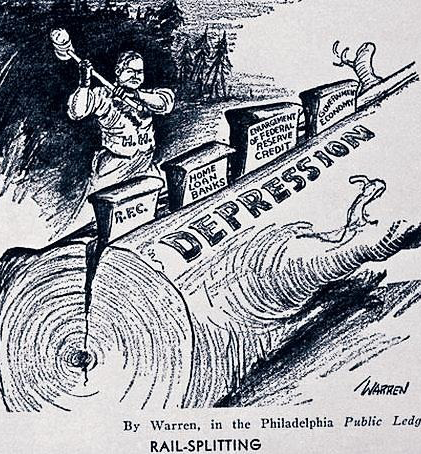
The United States would not have another truly national ICI until the Reconstruction Finance Corporation. The Reconstruction Finance Corporation was created in 1932 by President Herbert Hoover to respond to the Great Depression and was later greatly expanded by Franklin Roosevelt.5 The RFC played a central role in renewing the American economy by providing both financing and coordination for projects large and small, spanning every sector of the economy. It was a publicly-owned corporation, created with an initial grant from Congress of up to $2 billion in capital.6 It quickly became the largest corporation in the world in terms of outlays and income, and it earned a profit for the U.S. government every year of its existence as it grew and upgraded U.S. industry and infrastructure from coast to coast.7 It was the embodiment and the proof of the idea that a national economy is not a zero-sum system.
The RFC's primary role was to make things happen that the private sector was unable or unwilling to - either because they were not immediately profitable enough, they were too risky, or simply due to a general lack of confidence in the future among private investors. When the attack on Pearl Harbor threw America
into World War II, the RFC took the lead in financing and coordinating the wartime economic mobilization.8 The RFC not only solved America's dual crises of war and economic decline but also laid the groundwork for an era of unprecedented domestic stability and economic growth.
The Reconstruction Finance Corporation is the core institution that makes the Mission for America possible. In most other industrialized countries its role would be played by a collection of pre-existing institutions. That we have to create a new institution from scratch comes with both advantages and disadvantages. The primary advantage being that the institution can be created with a built-in culture of urgency and will not be bogged down by decades of accumulated bureaucracy.
The Mission for America is a plan for a president to lead a sweeping mobilization of communities, workers, businesses, and state and local governments to resolve the dual climate-economic crisis together. The Mission for America comprises many separate but mutually reinforcing national missions, each focusing on its own sector of the economy. The national missions build industries and infrastructure that will compose a new clean economy, creating tens of millions of new high-wage jobs along the way and significantly increasing general profitability and national income. Examples of national missions include creating a 100% clean energy grid, transitioning the entire U.S. auto industry to EVs, building a hydrogen industry, building millions of green homes, and much more.
Each national mission will be led by its own dedicated team at the RFC. Federal agencies, state and local government, and the private sector will also play major roles, but the RFC team is charged with the responsibility of accomplishing the mission. That means that the RFC team will make up for any shortfall in private financing, provide leadership, investment, and direct payment for performance and product to engage the private sector and coax competitors to work together when necessary. It will even make venture investments in startups and launch new companies as needed to fill gaps left by private investors.
What unites each national mission is that they can only be accomplished through intense levels of real investment in the American economy for a sustained period. Real investment mobilizes money and labor to create physical products and services that change the material world.9 For example, building a clean power grid will require enormous real investment in clean energy generation to produce electricity, batteries to store it, long-distance transmission to move it across the nation, and substations to distribute the electricity to homes and businesses. Every step of that process requires countless smaller technologies and services to be built, distributed, and deployed.
Unfortunately, the private sector is unwilling to make these investments on its own. Private capital inherently favors low-risk and/or high-reward investments. Decades of American cultural norms and legal precedents have prioritized the short-term whims of shareholders above all other economic considerations. The federal government has only encouraged this bad behavior by dismantling its incentives for long-term real investment and legalizing an array of new speculative financial practices.10 Unfortunately, many of the investments needed to maintain and continually upgrade a national economy are low reward and often high risk. Some required investments are, in addition, enormous. Amid two existential crises of its own making, the American private economy does not have the wherewithal to save itself.
The only way to compensate for the private sector's inability to invest in ambitious nation-building projects is through the use of investment and coordination institutions such as the RFC. Currently, the U.S. does have some small industry-specific programs that resemble ICIs. For example, the Department of Energy Loan Programs Office (LPO) provides financing for many clean energy and manufacturing projects.11 Another example is the Small Business Administration, itself a spin-off from the original RFC, which offers a variety of loans to small businesses of all kinds.12 These programs are important and have a long track record of success. They are, however, limited in their scope. America's existing ICIs lack the heft to make wholesale changes and upgrades to the economy. Under the Biden administration, the LPO received up to $412 billion in lending authority - the first attempt since World War II to provide loans at an adequate scale.13 It was a promising step: proof that a government lending institution could catalyze major investments. But the LPO's future is now uncertain, and even at its peak it did not have the staff or authority to go beyond responding to loan requests to operating on the scale of transforming entire industries.14
The new RFC must be equipped with a wide range of tools to accomplish its mission. Many of these tools were discussed in the Introduction to the Mission for America and will be expanded upon in greater detail in this chapter. However, it must be clear that the RFC is not merely a bank whose sole purpose is to provide loans and loan guarantees. The RFC will provide companies with loans and guarantees when appropriate, but its capabilities go far beyond that. The RFC will be empowered to take equity stakes in the companies it invests in, acting as a true partner in projects and giving American taxpayers a return on their investments. The RFC will be able to initiate procurement contracts with private companies, which can either be sold to private buyers or be used to build strategic stockpiles. The RFC will even be able to create new spin-off corporations and build Government-Owned Contractor-Operated (GOCO) facilities as the RFC did in World War II.15 Many of these tools will sound alien to some readers - though several have recently been employed by the current administration - but they were all used frequently by the original RFC and are still used by many other capitalist democracies every day.
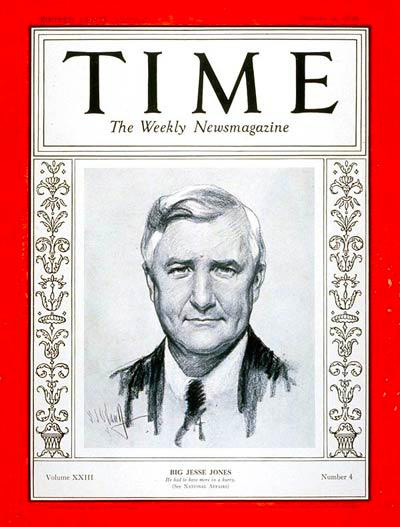
The RFC's success hinges on it being led by qualified leaders who understand the goals of the Mission for America and have both the experience and credibility in private industry to succeed. Choosing who will lead the RFC and its many teams will be one of the most important decisions that the Mission for America president must make. President Roosevelt understood the magnitude of this decision when he appointed Houston entrepreneur Jesse Jones to lead the RFC in 1932.16 Jones fully agreed with Roosevelt's vision of the RFC, understood the economy as both a public servant and a businessman, and was committed to seeing through every investment made by the RFC. Jones was so involved in the day-to-day operations of the RFC, and the RFC so vital to the American economy, that the phrase "you better see Jesse" became a common refrain when someone in Washington wanted something built.17 Whoever leads the modern RFC must demonstrate a similar level of leadership and acumen.
In this chapter, we will discuss the roots of America's chronic real investment shortfall and the nature of real investment itself. Because many of these ideas will feel unfamiliar or unorthodox, we will cover the arguments for and against the positions we take, providing examples from U.S. history and from other present-day economies in an attempt to show readers that what we are proposing with the RFC is normal, safe, and essential.
Why America needs a Reconstruction Finance Corporation
The following sections of this chapter lay out the "why" of the RFC, after which we give our proposal for resurrecting the RFC and making it an integral part of the U.S. economy, including details of the legislative, political and business strategies for launching the new RFC.
Political leadership and social movements play a key role in driving economic development, particularly industrialization, and in modern societies, political leadership relies largely on investment and coordination institutions (ICIs) to transform and grow economies. Today, the U.S. has only a small handful of weak ICIs. By comparison, most other industrialized nations have well-established networks of large and small ICIs constantly working to modernize and upgrade their national industries and infrastructure. Nations with economic histories and traditions as different as those of Germany, France, Japan, and China all benefit from the work of this type of institution. We argue that ICIs are the difference that allows countries with far fewer resources and other advantages than the U.S. to provide living standards on par or better than the U.S. for their working and middle classes.
The United States has a history of periodically dismantling its ICIs, leaving it without the support necessary for investment when it needs it the most. When economic emergencies arrive, the U.S. then scrambles to rebuild these institutions, usually resulting in the creation of a single, massive entity, such as the Reconstruction Finance Corporation (RFC) which served as the nation's central ICI during the Great Depression and World War II.18 Once again, the establishment of a new central ICI is now essential to provide the stability and coordination required to advance U.S. economic interests and to accomplish the Mission for America. For this purpose, we call for the revival of the RFC.
The U.S. currently possesses some small ICIs, mainly lending programs in government agencies, which play vital roles in various sectors. These institutions contribute significantly to economic development, but their impact is limited by their size and scope. Altogether, they account for a small proportion of the national economy and of the investment and coordination capacity needed.19
In light of the history of major ICIs such as the first two U.S. national banks and the RFC all being cut down in political struggles, we propose an approach that will ensure that even if our modern RFC were disbanded, it would leave behind a resilient network of ICIs to support the American economy over the long term. Under our proposal, the RFC will spin off public corporations for specific purposes as needed, which will function as permanent and independent ICIs. This was done by the original RFC as well, and many of its spin-offs live on today as important public and private corporations and financial institutions. This strategy will create a more robust public financing and coordination infrastructure that can withstand political and economic shifts, ensuring that America remains equipped with the necessary institutions to drive innovation, investment, and growth for years to come.
Investment, financial vs. "real"
Rapidly transitioning to a fully sustainable economy requires an extremely high level of nationally coordinated investment for a sustained period. The conventional wisdom regarding investment, including ideas about the appropriate role of the state in investment, is undergoing a profound transition within U.S. academic and policy circles. Therefore, it is appropriate to begin this chapter by explicitly defining our assumptions about investment in general and in the context of the Mission for America in particular, and about the role that the state must play in coordinating, financing, and driving investment.
In the United States, as the center of the economy has shifted away from industry and toward the financial sector and financial speculation specifically, investment has come to be understood primarily as a financial or monetary process - for example, individuals investing in the stock market or a bank investing in mortgage-backed securities. Investment, in this sense, changes nothing in the physical structure of the economy, but merely rearranges the ownership of money and assets. To accomplish the transition to a sustainable economy, nations must physically dismantle and replace billions of polluting machines and transform entire industries and sectors of the economy. Therefore, financing and coordinating investment in the context of the Mission for America refers to the process of mobilizing labor and resources to transform and build the industries and infrastructure needed to create both prosperity for all and a fully sustainable economy. Our challenge is to move atoms, not money.
Because most of us are personally distant from physical economic processes such as manufacturing or construction, it makes sense to back up for a moment to think about the nature of investment from a physical, as opposed to a financial, perspective - in other words, what happens when families, companies, and societies put time and effort into building new structures, systems, capacities, and technology. For our purposes, we will call this "real" investment.
What is real investment? Although the word "investment" is usually reserved for the domains of business, industry, finance, and economics, the same general process is observed in biological and social systems whenever energy and resources are added or diverted away from routine functions into making improvements or other changes to the structure of an organism or society. In this sense, investment is a phenomenon existing across many domains and can be defined as any process that mobilizes energy and resources over a period of time to make changes to systems that transform their function, presumably in ways that better achieve some set of outcomes. In the context of the Mission for America, the outcomes we're seeking are prosperity for all with true environmental sustainability.
How exactly does real investment work as a physical process in modern economies? Even in the case of a Silicon Valley internet start-up, which might seem purely virtual, an investor's action does change the physical structure of the economy: A new group of people along with new equipment are brought together, and they work to create new software that allows customers to work or play in new ways. Although the software they create primarily exists as information, that information is physical in nature, existing on physical devices, changing the way they operate. The software they create, if successful, makes physical changes across the economy and society. Think, for example, of how software such as email, database systems, or video products change how people interact with each other in the real world, or how supply chain management software changed how goods are transported and warehoused.
When it comes to investments into manufacturing industries and infrastructure, the physical changes to the economy are much more tangible: earth is moved; metals, fuel, and other raw materials are extracted and gathered; new buildings and machines are built; and workers are hired and trained in new skills to work in those buildings and operate those machines. This process then supplies ordinary products more efficiently, or it may even produce a new kind of product that changes how billions of people in the world live and work. The mobile phone and the automobile are good examples.
Making physical changes to the structure of the economy in these sorts of ways is inherently more difficult than simply moving money around, and it's usually perceived to be riskier than pure financial investments such as speculating in implicitly government-backed financial bubbles. Therefore, there is a natural tendency for societies to drift away from making real investment happen in favor of financialization.
Today, in democratic, capitalist societies, the mechanism for mobilizing labor and resources into real investment usually is money, which can come in the shape of cash or credit. Throughout history, however, democratic and capitalist societies, and every other type of society, have used combinations of other modes of mobilization, including social and political mobilization, tradition, recruitment of volunteers, slavery, corvée labor, and more. Even today, the kinds of investments we seek with the Mission for America won't be accomplished using money alone. Successfully making a difficult change to the economy - whether creating a new subway line in a busy city or launching a new automaker - requires not only money but also a compelling vision and leadership passionate and tenacious enough to push through endless obstacles and barriers. Right now, for example, several new electric car and truck startups are struggling to get off the ground despite receiving many billions of dollars in investment capital.20
To reorient a society back from financial speculation to real investment requires disruptive leadership that gets people and businesses out of their short-term perspective and into alignment with a more profound and beneficial long-term reward. Politicians and policymakers have begun again to see a role for the state in providing money to finance investment in industry. The Inflation Reduction Act of 2022 mobilized hundreds of billions of dollars in private investment and created over 400,000 jobs - proof that government incentives can trigger massive real investment.21 But the IRA's key provisions were killed by the One Big Beautiful Bill Act in July 2025, demonstrating that programs built on tax credits alone are politically fragile. Politicians have not yet, however, embraced the other side of the equation: the role of political leaders in providing vision and leadership to break through all the barriers and opposition that inevitably stands in the way of transformational national projects. The changes required by the Mission for America are so disruptive that they will certainly face enormous opposition. Therefore, it is crucial that our leaders understand both sides of their role in mobilizing the labor and resources of the nation. That is why the Mission for America deals with both the financing and coordination of investment as well as the political and social strategies required for economic mobilization.
The Mission for America is, in part, a proposal for getting the state back involved in investment on a massive scale. The Reconstruction Finance Corporation is the primary tool for doing this. This raises the question of how the state, through the RFC and other programs and institutions, will know which investments will be beneficial and which will be wasteful or counterproductive. In other words, how can the state, even with the help of an institution such as the RFC, possibly accomplish something in the private economy that our current arrangement of private investment institutions cannot?
The investment required by the Mission for America
Before discussing how the Reconstruction Finance Corporation can be relied upon to choose beneficial investments, we need to define what type of investments would be beneficial in the context of the Mission for America.
The two-sided goal of the Mission for America is to create an economy that is fully sustainable and that can provide prosperity for all. Its plan to achieve that goal rests in part in building industries that will help supply the global transition to full sustainability. While a significant portion of this project involves transitioning away from fossil fuels, its scope is much broader: rebuilding American industrial capacity, modernizing infrastructure, reviving domestic manufacturing, and creating the industries that will employ millions of workers for decades to come.
Taken as a whole, the Mission for America will require investments that achieve the following and more:
Create new industries or expand existing industries to fill in missing capacity where needed. The U.S. is already attempting this in certain sectors, such as vehicle batteries and semiconductors. As promising as these first steps are, current policies are nowhere near big enough to make the difference that's needed.
Establish new industries to replace those that are disappearing due to their unprofitability or unsustainability. The RFC will work to identify and support the creation and growth of new, fully sustainable industries that are high on the global value chain to ensure that every American can earn a living.
Transform harmful industries, wherever possible, to minimize their environmental impact and promote sustainability. The RFC will provide funding and coordination to help industries upgrade to sustainable technologies and production processes.
Wind down industries that are fundamentally incompatible with a sustainable economy. The RFC will step in when possible to provide capital and coordination to transition these industries toward cleaner alternatives. Dismantling harmful industries in a way that ensures stability and fairness for affected workers and communities is absolutely necessary to reduce the nation's total greenhouse gas emissions in a just way.
Develop new infrastructure across various sectors, including energy, transportation, and communications, to support a sustainable economy. The RFC will play a crucial role in facilitating and financing new infrastructure projects.
Upgrade outdated, polluting, or otherwise harmful infrastructure to meet modern standards of environmental responsibility. The RFC will identify and support the redevelopment of infrastructure projects that need updating.
Launch large-scale "Manhattan projects" to develop innovative technologies that address pressing environmental challenges. The RFC will work with government agencies, academic institutions, and private companies to fund and coordinate the development of breakthrough technologies that can help address environmental issues on a global scale.
Support pure research initiatives not currently covered by either the private sector or the government. The RFC will fill the gaps left by private companies, ensuring that essential research projects receive the funding and resources they need to succeed.
Finance and coordinate efforts for consumers to undertake projects such as electrifying and upgrading homes for energy efficiency. The RFC will provide financial support to homeowners to make environmentally friendly upgrades, reducing energy consumption and lowering greenhouse gas emissions.
Finance and coordinate work to modernize commercial and large residential buildings, improving their energy performance and reducing their environmental impact. The RFC will help fund and guide the necessary renovations, promoting the use of energy-efficient materials and technologies in the process.
Help finance a large-scale national workforce development program. The RFC will collaborate with educational institutions and industry leaders to develop training programs that equip workers with the skills needed to fill the millions of new jobs the Mission for America will create.
Assist farmers in reducing greenhouse gas emissions, soil erosion, and water pollution, while maintaining or increasing agricultural productivity through the adoption of new technology and processes. The RFC can support research, development, and implementation of sustainable farming practices, helping farmers contribute to the nation's environmental goals while maintaining a thriving agricultural sector. The RFC will also take on big food monopolies and free farmers from restrictive, predatory contracts, while providing all Americans with access to healthy, affordable food.
The Mission for America's investment strategy encompasses a wide range of sectors and initiatives, ultimately aiming to comprehensively transform the U.S. economy toward sustainability. This holistic approach will require sweeping coordination and investment on an unprecedented scale. The RFC is designed to be able to handle both requirements.
Why nations and companies let real investment lag
Building new productive industries, upgrading old ones, and making big improvements in national infrastructure require difficult and powerful exertion. Just as it is easier to lie on the couch watching TV than to go outside and exercise, it is easier for a nation to let business continue as usual than to build new industries. Sometimes nations get stuck on the couch.
Intuitively, it's easy to understand why it is more difficult to start, for example, a new electric truck company, or a lithium mine, than to simply move money into an index fund that tracks the stock market; or why it's easier for a corporation to make money through financial speculation rather than investing in risky new products. That's why companies like Google and Apple increasingly use their enormous cash piles to buy and sell bonds rather than invest in new products.22 Making something new in the world that works and that is better than all competitors is difficult simply because of all the things that can go wrong or fail to materialize. Moving money into a financial bubble that the Federal Reserve is helping to grow, however, or buying bonds that are guaranteed to pay a fixed interest rate, is easy.
The economy-wide shift toward easy, short-term financial investments and away from investments in the real economy becomes apparent when analyzing how companies make and spend their money. American corporations receive over five times as much money from purely financial activities than they did in the post-World War II era.24 In total, financial activities make up around 30% of corporate profits in America.25 Companies reinvest this money in further financial activities. Non-financial corporations spend around half of their investable funds on shareholder compensation, such as stock buybacks and dividends.26 On top of direct payouts to shareholders, corporations spend billions of dollars every year on other financial activities, such as trading bonds and even cryptocurrency. All of this has occurred alongside companies slashing their investments in fixed assets and other components of the real economy.
On the level of individual firms, several factors work to prevent companies from making real investments and encourage them to make financial investments. One of those is resistance from shareholders. Shareholder primacy is not merely a social norm - it is enshrined in law, as we will discuss later in this chapter. Shareholders powerfully influence and often inhibit a company's decision-making process, not only because they technically own the company and often include its executives and directors, but because legal frameworks compel corporate leadership to prioritize shareholder returns above all other considerations. Pressure from shareholders is one of the reasons that publicly traded companies are significantly less likely to make long-term investment decisions than private
Most of these actors have a strong natural interest in receiving gains in the form of dividends and stock buybacks in the short run over waiting for long-term gradual increases. This dynamic is intensified when the larger economy is dominated by financial speculation. The temptation to spend on short-term financial instruments is too much to ignore when you have shareholders breathing down your neck.
This phenomenon is referred to as "short-termism," and it is frequently found to be one of the biggest drains on private investment in the U.S.27 The problem is so bad that 80% of CEOs have said they would not make an investment that would fuel 10 years of growth if it meant they missed one quarterly earnings report.28 It is hard to justify patiently waiting for a company's long-term investments to pay off in the form of moderate but consistent earnings increases while the rest of the stock market, real estate, and other speculative assets are going to the moon.
Throughout the history of capitalism, the founding generations of industries often keep real investment high as long as they are in charge. Generally, they are leaders who began with a long-term vision to build something new on a grand scale, and they often retain that long-term orientation throughout their career, much to the chagrin of their shareholders. In the U.S., famous examples include Gilded Age tycoons such as Andrew Carnegie, Jay Gould, J.P. Morgan, and Henry Ford.
Henry Ford so enraged his shareholders by constantly investing the lion's share of profits into his beloved factories that they famously sued him. The resulting judgment helped to establish in U.S. law the principle of "shareholder primacy," which requires corporations in many jurisdictions to be run for the financial benefit of shareholders above all other concerns.29
More recently, Steve Jobs, Jeff Bezos, and other famous tech titans stand out as leaders who openly favored long-term investment over returning earnings to shareholders.30 Mark Zuckerberg has invested tens of billions of dollars in the hope that virtual reality will be the next big thing, and that Facebook can become a leader in that field. Part of the reason shareholders don't like these kinds of big, long-term gambles is that they often fail. And at least up until the time of this writing, Zuckerberg's Metaverse gamble is looking like it will be one that doesn't pay off.31 It is in the nature of building something new, large, and complex that it might not work.
Historically, once the founding generation of an industry passes on, the "bean counters" who take over usually begin returning more earnings to shareholders and operating on a more short-term basis.32 In the United States, now that the government has set a precedent to re-inflate speculative bubbles when they crash and bail out any big companies that fail in those crashes, there is a great incentive to view previously risky investments in asset bubbles as being a safe way to earn high returns. In this environment, it's a wonder that any money flows into relatively risky industrial investments at all.
Because private firms on their own are typically unable to maintain healthy aggregate investment across an entire economy, nations must step in with various policies and actions to ensure it. When they do, however, resistance arises from all directions. Just like the voices in someone's head that try to talk them out of going to the gym on a rainy Saturday morning, countless social and economic factions work to protect the low-investment status quo. Why? Fear of change. The most powerful and influential people in a society are usually doing very well. From their perspective, why fix what's not broken? Politicians are naturally and understandably unlikely to fight for economic change as well. Voters crying out for big and expensive investment projects is an extremely rare event. Voters becoming enraged by news reports of money wasted on a failed investment - or a successful one! - is a very common scenario. So why risk it?
But there are many other specific reasons why various interest groups will oppose a public push for greater real investment. For example, building new domestic industries often means protecting them from foreign competition until they become competitive. That can create higher prices for some businesses and consumers, who therefore have a short-run interest in opposing industrial policy. The Civil War is the quintessential example. Southern planters wanted to trade their cotton with England for cheap, high-quality manufactured goods.33 They wanted to be able to continue the slave economy. The North wanted to put tariffs on imports which would force the South to buy goods from new, often inferior and more expensive Northern industries, while retaliatory tariffs would lower the price of their cotton.34 The Civil War was fought in part to ensure that the U.S. would take the path of industrialization.
During the rise of capitalism and when the world filled with new post-colonial nations, every emerging modern nation was the site of conflict between old elites whose power was based on agriculture and resource extraction and who wanted to keep everything as it was, and those who wanted to take the path of industrialization. In most countries, the old elites won, committing billions to live in poverty.35 Only in countries where some sort of revolution broke the back of the old elite was the path of high-investment industrialization taken. For example, as discussed in the previous chapter, the U.S. occupation forces in Korea and Japan forcibly redistributed the land of the old elites to create extremely equal and entrepreneurial societies in which many families suddenly had a little capital and income with which to start businesses.36 In part, that move is what allowed Japan and South Korea to rapidly industrialize without debilitating friction from an old and corrupt agricultural elite.37 But even then, the governments of both South Korea and Japan had to constantly push and pull their major corporations into agreeing to take big risks. Many of the big global brand names like Mitsubishi and Samsung had to be bribed and coerced into taking on their global roles by strong national leaders.38
Even in states that launch sweeping nationalist industrialization projects, however, when the flames of the movement die down, there is a natural tendency for national governments to ease off their investment agendas. Outside of the context of a national development movement that insists on investment and validates a "developmental mindset" among elites, there is no force powerful enough to get politicians to make disruptive and risky decisions around national investment.39
Another general principle that works against national-scale, long-term investment is that it is difficult to accomplish compared with other things that government money can be spent on. During the COVID crisis, the federal government handed out trillions of dollars to individuals and businesses with no strings attached.40 Some of that money could have been paid in the form of investments that put people and businesses to work, improving their capacities. But how? Even just talking about it would have attracted a lot of political heat, and it would be difficult to devise such a plan under short notice in an emergency. Likewise, in the 2009 financial crisis, some economists with the ear of the president urged him to direct stimulus at least partly toward long-term investment that would increase national wealth and security. In the end, however, the White House directed almost no funds toward long-term investment in favor of "shovel ready projects" such as repaving roads.41 This reason nations neglect investment boils down to "investment is hard." And in normal times, investing tends to find its way to the bottom of the priorities list.
Ideological opposition to the state participating in business investment decisions is another powerful force acting against public investment. Several different kinds of ideological opposition to large-scale, state-led investment are usually in play. Perhaps the two most important are: (1) that state intervention in investment decisions will cause dangerous distortions in an otherwise efficient private marketplace, and (2) that excess investment must necessarily create dangerous levels of inflation. The first objection was dealt with in the previous chapter. The second will be addressed in the following sections.
How can a society know what to invest in?
In their book Concrete Economics, economists Brad Delong and Steven Cohen use the analogy of the human body creating muscle and fat to help readers understand healthy vs. unhealthy patterns of national investment.42
Creating new muscle cells is a very expensive biological process for the body, requiring a lot of energy as well as precious materials which have many other important roles in the body. "Investing" in fat cells, however, requires relatively little energy and fewer nutrients. The body predictably defaults to creating fat cells instead of muscle cells unless the signal of strenuous exercise causes it to build muscle. Delong and Cohen use this analogy to give context to the historical pattern in the U.S. of oscillating between periods of heavy investment in productive areas ("muscle") and periods of over-investment in domestic services and financial speculation ("fat").43 Delong and Cohen prescribe a new industrial policy regime that would roll back some of the incentives for investing in services and speculation and would create incentives for investing in productive activity.
But how can political leaders and the ICIs they direct or influence know exactly what qualifies as an investment in productive activities that will increase the wealth and independence of their nations? The fact is there is no way to draw a fine line between what qualifies and what does not. Economists have tried for centuries unsuccessfully to draw a fine line between productive and unproductive economic activity. The dominant "physiocratic" school of economics in the 1700s believed the only productive activity was farming, where the mysterious power of the sun and soil created new life, and that everything else was just rearranging and reshaping the products of the land.44 Adam Smith challenged the physiocrats by arguing that human labor was the source of all value in economies.45 His definition of value included anything that created, improved, or added to a product or structure in the physical world. Services, entertainment, and many other sectors of economies were not included. Later, when it seemed that industrial capitalism was becoming so automated that it would be difficult to provide full employment, economists such as Keynes advocated against distinguishing between productive and unproductive labor, arguing that nations needed to create and honor mass employment in sectors such as services, entertainment, and the arts.46
All of these schools of economists, however, became tongue-tied and confused when they tried to draw a fine line between productive and unproductive labor. The worker who puts seeds in the ground is clearly a productive farmworker according to the physiocrats. But what about the one who makes and repairs the plows? Factory workers who pour molten steel into molds are creating value, according to Adam Smith, but what about their managers?
For our purposes, we are not concerned with trying to define an abstract division between productive and unproductive labor. The Mission for America is attempting to achieve the practical goal of building an economy that is sustainable and that provides prosperity for all. We are therefore interested in financing and coordinating investments in all activities, industries, and infrastructure that can help achieve that goal. The investments we need to reach the goal will span the full range of types of economic activity, including "unproductive" services, pure research, design, engineering, as well as bricks-and-mortar infrastructure and manufacturing.
However, after decades of deliberate deindustrialization, neglect of infrastructure, and over-investment in domestic services and financial speculation in the United States, there is no question that the vast majority of our investment must be directed to industry and infrastructure - the kind of investments Adam Smith was concerned with.
What's so special about manufacturing?
For the past forty years, the most influential economists taught our political leaders that manufacturing was an outmoded way of making a living. They preached that, in the age of globalization, manufacturing would migrate to where wages were lowest because anyone could do it. Therefore, a high-tech, well-educated country like the United States must find its future in the kinds of jobs where no one's hands get dirty, such as computer programming, financial analysis, or even customer service.47
The experts believed it was fine to move all our manufacturing to other countries because we would trade our services for their manufactured items. It was a great idea, in theory. In practice, however, we never found a way to produce enough valuable services to exchange for all the goods and services we needed but no longer could provide for ourselves. Many highly paid industrial workers who lost their jobs were forced to take low-paying service jobs in industries such as retail, fast food, health care, and the informal economy.48 Since de-industrialization began, working-class wages have mostly fallen in real terms, and have dramatically fallen when measured against productivity increases across the entire economy - something we'll discuss in more depth later in this chapter.49
"A modern economy is a service economy." We've heard that for so long and from so many respected economists and leaders that it can be difficult to think about this question clearly. It feels self-evident that making things with our hands in factories is the kind of work that belongs to the 19th century.
One remedy is to think about an extreme hypothetical: Imagine if everyone in our society became a barber. Would we be able to survive as a nation that way? Obviously not - but think about exactly why not. We would not be making or doing most of the things we need to live, such as producing food, clothing, and other goods. Moreover, we would not be making or doing anything we could trade with other nations in exchange for the things we need.
In such an economy, we would be totally dependent on workers in other nations to make the things we need to survive. But since workers in other countries won't come to the U.S. to get their hair cut, we would therefore have nothing to trade with them for all the things that they make and that we need.
It is also hypothetically possible for a full-service economy - one that manufactures nothing - to be broadly prosperous, as long as it produced enough tradable services that trading partners valued highly and could employ their whole population in providing those services. Unfortunately, the reality of the U.S. economy is that our exportable services output has never come close to replacing our lost manufacturing output - not in terms of total value and even less in terms of good jobs provided.
A country that, as in our extreme example, spends its work time on nothing other than non-exportable services would not survive a day. But what about the U.S., which still makes a lot of things, just not enough to meet its needs? Because we want and need more things from other countries than they want and need from us, we run a trade deficit every year. That means that when all the trading in both directions between the U.S. and other countries has been tallied at the end of the year, there is an imbalance, in which the value of goods flowing into the country is greater than the value of good flowing out of the country. Since the 1970s, the U.S. trade deficit has grown from billions of dollars to hundreds of billions of dollars, reaching even more than $900 billion in 2022, up from $845 billion in 2021.50
All this is to say that even though the line between non-productive investments and productive investments is blurry, there is a vast and unambiguous area in which to invest in production. For the purposes of the Mission for America, the kind of investment we seek to increase - and to increase on a massive scale - is anything that mobilizes labor, capital, and resources to create, scale, or upgrade enterprises and industries that have the potential to build the wealth of our society. As we have said, that includes making and doing things that are valuable for ourselves, or for other nations, or for both. This is not limited to manufacturing but also includes any non-manufactured but tradable and valuable products (e.g., films, art, software products) and services (e.g., software development, business consulting, design, and engineering). Any industry qualifies, regardless of whether it produces goods or it produces services; however, it must produce goods or services that American would have to buy abroad if those goods or services were unavailable here, and that could be internationally traded for the necessary goods or services we don't produce ourselves.
Additionally, the types of investment we seek to increase include investments into infrastructure that make the rest of the economy and our entire means of making a living more productive. These investments are also mobilizations of labor, capital, and resources to create, scale, and upgrade our physical economy: roads, bridges, power generation and transmission, communications infrastructure, and more.
What happens when a nation fails to make a living?
When nations fail to invest in their means of making a living - in other words all the industry, infrastructure, and other organizations and structures required to make the things people need and want - they get poorer. As discussed above, if a nation doesn't make and do all the things it needs, it must trade with others who do make and do those things. To meet its needs, it must make and do things that, whether consumed or traded, have a total value equal to what it needs. If the nation doesn't make or do enough valuable things to meet its needs, but continues to live as if it did, then it runs a trade deficit. Let's explore the consequences of this situation for a nation such as the United States.
To get our heads around what this means, let's first think about what happens when a family fails to make a living - that is, when its income falls below expenses. Such a family has four options to make ends meet:
Spend their savings
Sell their assets
Borrow
Seek assistance from friends, family, charities, and/or the government
A family that earns less than its expenses for long enough will eventually spend down all its savings, take on debt if it can, and sell everything it can sell, whether that's tools, a car, or even their house. When all else fails, it can seek assistance from others, including government aid programs. Once all those paths are exhausted, then it will have to start reducing its standard of living.
In practice, a family will usually reduce its standard of living before going through those other measures. In the case of nations, however, political leaders tend not to champion cutting government spending (at least when they are the ones in power) or other policies that would reduce living standards.
When a large, rich nation such as the United States makes and earns less than it consumes, it has all those same options as a family except the last one, as there is no one out there to offer charity to the United States. For the past several decades, that is exactly how we have funded our trade deficit: Americans have spent down their savings; families, companies, and every level of government have taken on massive quantities of debt; and we've been selling assets to foreign nationals, companies, and governments, including assets as diverse as luxury real estate, toll roads, and securitized credit card and mortgage debts.51
The way this plays out on a national level looks very different from how it looks to a family, of course. In the case of a nation, the equivalent of selling a car at a dealership or selling knickknacks at a yard sale is called "foreign investment." When foreign investors, corporations, and governments buy property, businesses, stocks, bonds, or any other sort of asset, that is money flowing into the country which ultimately makes its way to help even out the balance of payments between the nation and the rest of the world.
The nation as a whole can take on debt in many different ways, including government borrowing, corporate borrowing through banks or from issuing bonds, and individuals taking out bank loans such as mortgages and spending on credit cards. Foreign entities buying all these kinds of debt is another way that the balance of payments evens out, allowing the nation to run a trade deficit indefinitely.
Families, state and local governments, and companies can all spend down their savings, or surpluses, as a way of making ends meet. When all these types of entities do this in unison over a long period, the nation is impoverished, even if its people's living standard does not necessarily fall. For decades, the U.S. has been spending down its savings. The personal savings rate, defined by the Bureau of Economic Analysis as "Personal saving as a percentage of disposable personal income", is near an all-time low.52 In fact, the personal savings rate is less than half of what it was for much of the 1960's through 1980's. Some of these savings are paid out of the country, for example to foreign debt holders.
The offshoring of American manufacturing is one of the main reasons why working-class wages have been stagnant for decades, but it is ironically also one of the main factors that made this stagnation feel tolerable for some time. Offshoring manufacturing to developing countries is almost always deflationary. Companies move manufacturing to developing countries because labor, land, and capital costs are generally lower in those countries than in the United States. Developing countries also tend to have significantly weaker labor and environmental regulations, allowing companies to save money by underpaying workers and ignoring environmental concerns. Companies use these cost reductions to produce more goods for less money than if they were produced in America.
This arrangement initially blunted the pain Americans felt from declining wages. For a time, Americans could buy more goods even with a stagnant or declining income. Lower prices helped increase consumer spending and GDP, all while giving workers the illusion that their life was getting materially better because they owned more stuff. This arrangement may not have been sustainable in the long run, but its short-term effects were palpable enough for many Americans to tolerate offshoring.
The rise of easily accessible personal credit was another way policymakers and economic elites could obscure wage stagnation and decline in American workers. Most Americans today have either a credit card, an auto loan, or a student loan. Many have all three. Widely used personal credit is often presented as an eternal aspect of the American economy, but it is a very modern occurrence. Most Americans did not own a credit card until the 1980s. Student loans and auto loans have been around for decades, but their use exploded over the last 40 years. Almost all forms of bank lending were heavily regulated and restricted before the late 1970s. It wasn't until the American economy was dealing with high inflation and the beginning of mass offshoring that policymakers made all forms of credit widely available to Americans.
The rise of the credit card in American life demonstrates this process. The earliest modern credit cards were introduced in the 1950s, but very few households used them, and those that did had credit limits that would be considered exceptionally low by modern standards. It was not until the early 1980s that most Americans used credit cards and that higher credit limits became the norm. Although banks pitched credit cards as a way for Americans to pay off big purchases over time, the unfortunate reality is that many Americans rely on them just to get by. Of all major industrial economies, the United States has the highest average credit card debt, at over $6,000.53 In 2023, U.S. credit card debt hit an all-time high, surpassing one trillion dollars for the first time.54 It is abundantly clear that Americans are not using credit cards to finance large purchases but that millions have become reliant on easy credit to finance their day-to-day existence.
One final example of how the United States propped up GDP and national income during deindustrialization was by selling its assets, such as land and buildings, to foreign entities. The amount of U.S. land, buildings, and resources bought by foreign nationals and corporations has substantially increased in the last few decades. Foreign entities hold interests in over 3.5% of all privately held agricultural land in America - roughly 45 million acres - an 85% increase since 2010 alone.55 That may seem small in percentage terms, but those holdings were valued at over $74 billion as of 2021, and the figure has only grown since.56 In other words, even as U.S. assets are sold to foreigners, this represents capital inflows that help us as a nation live beyond our means.
If America's real investment has been so bad, why does it keep getting richer?
One consequence of U.S. failure to invest in manufacturing and other industries that allow us to meet our needs or to trade for what we need is that tens of millions of workers have lost their claim on the profits of American companies. This has eroded or stalled the earning power of a majority of American workers, even as corporate profits have soared and the professional and managerial classes have watched their incomes rise dramatically.
Only workers who produce valuable goods and services, or who can help capture value that others produce, can negotiate for a fair share of the value they create and have that add up to a prosperous living.57 Workers who create or capture less value than they need to live can achieve a living wage only if subsidies are offered. In the United States, federal and state governments provide enormous subsidies to low-wage employers via the earned income tax credit, food stamps, public health insurance programs, and more. As high-value jobs have left the country, such subsidies have played a greater and greater role in helping to sustain American workers' standard of living.
Before deindustrialization began, millions of workers in manufacturing organized to demand high wages and rich benefits. Their pay raises benefited workers, managers, and professionals across the economy by raising the general standard of pay. In the WWII and postwar era of U.S. industrial dominance, the balance of power between labor and capital was far more even than it is today because the U.S. industrial base was so large and integrated that it was difficult for employers to replicate the same levels of efficiency and profitability in other countries.
Contrary to common perception, industry was not primarily enticed to move to other countries by low wages. If it was as simple as that, then industry would rapidly spread across all parts of the world, starting with the lowest-wage nations. But the nations with the lowest wages in the world remain largely unindustrialized. Rather, certain locations in the world followed the lead of already-industrialized nations and invested heavily in their own manufacturing ecosystems until they became competitive internationally in a few niches or broadly across the full range of manufactured goods. Because the U.S. followed a deliberate policy of deindustrialization while allowing its basic infrastructure to atrophy, it increasingly began to make sense for companies not only to move older, low-tech production overseas, but also to plan new, more advanced investments overseas as well.
Many other high-value, productive, non-manufacturing jobs, such as software development, design, or engineering, also allow workers to bargain for high wages. Those types of jobs do not come in the quantities required to employ a nation as large as the United States, and they are beyond the capacity for workers who have no advanced degrees or specialized skill sets, which is the majority of the workforce in the United States. Only manufacturing can provide vast numbers of working-class people with an opportunity to create goods that are valuable enough to pay high wages.58
The result of the loss of millions of manufacturing and other value-adding jobs has been that most people in the U.S. have experienced a powerful, prolonged downward pressure on their real incomes and standard of living. Real wages for the bottom four quintiles of Americans have stayed virtually flat for the past
40 years, often falling for many years in a row.59 Compared with productivity increases, however, real wages have fallen behind dramatically.60
As we have said, part of what made this path viable for American leaders was that import-based consumption brought down the prices for many goods and introduced many new kinds of consumer goods that helped buoy perceived standards of living even as workers' share of the pie decreased. At the same time, many working-class Americans took on debt to pay for not only the new imported gadgets that were becoming essentials of life, but also for the spiraling costs of major expenses like healthcare and education. Although living standards are difficult to measure and compare across decades, there is ample evidence to show that whereas improvements in productivity, technology, science, and healthcare should all have given American workers a massive increase in quality of life, living standards have, in fact, barely held steady. And to maintain them, Americans have had to spend down savings and take on debt.
But the question remains: If it is true that most Americans are worse off than they would have been if we had continued investing in our means of making a living, then why has America's GDP and GDP per capita grown so much over the same time period? The answer is, in a word, inequality. As it turns out, a nation spending down its savings, selling its stuff, taking on mountains of debt, and suppressing the standard of living for most of its people is entirely compatible with its rich people - and its managerial and professional classes - getting much, much richer.
To better understand how these dynamics function in day-to-day life, think of a real estate developer building a luxury condo building in which many of the units are bought by foreign billionaires looking for a safe place to park their money. This is a real phenomenon that has played a small role in driving up prices of real estate in many U.S. cities.61 Although this phenomenon represents an outflow from the U.S. in the ownership of U.S. assets, and though it may contribute to the rising cost of housing, thereby hitting general U.S. living standards, it can enrich many high-income Americans. Not only does the wealthy local real estate developer make a lot of money from these inflated transactions, but so do many other professionals and entrepreneurs involved in making and executing the deals, managing the buildings, managing the companies that service the buildings, and so on.
The same goes for the process of closing a manufacturing plant in the U.S. and opening one in Mexico or China: Not only does the corporation that owns them benefit from exchanging a newer and more efficient plant for an old one, but so do shareholders and all the managers and professionals who facilitate the transfer. Yes, after that kind of transfer is complete, some U.S.-based managers could find themselves out of a job. But overall, for nearly 50 years, the process of spending down U.S. savings, selling our assets abroad, and taking on massive quantities of debt has provided full employment and constantly rising real wages for the professional-managerial class - at least so far.
To be clear, we are not arguing that trade and foreign investment are inherently bad. We are not recommending that foreign investors should be banned from buying American assets. There's nothing wrong with foreign investors buying assets in the U.S. The problem is that capital and ownership of capital have been flowing out of the country for decades in a one-way destruction of American wealth. This imbalance is causing instability in the world economy. It was the root cause of the 2009 financial collapse, and it is fueling instability in U.S. politics - for example, by contributing, as we argued in the introduction, to the rise of xenophobic and racist populism as represented by Donald Trump.62
One of the premises of the Mission for America is that to leave behind four-fifths of the American people is both morally unacceptable and politically unsustainable. America's political system and its traditions give the working class a way to exact revenge for being left behind. Unfortunately, it does not give the working class a way to take over and steer the nation in a good direction. The system we have allows political parties to make proposals for new directions to the people in attempts to be elected. When the American working and middle classes feel they're being left behind, they exact their revenge by voting in increasing numbers for protest candidates who promise destruction. It is our view that if a political party, or a presidential candidate leading a party, offered a constructive plan to restore income and health and a secure place in the economy to the working and middle classes, then that party would be elected. The Mission for America is a plan for the party or candidate who will hopefully emerge to do that.
One common wrong way to think about real investment
One widespread mistaken way of thinking of economic systems has made it extremely difficult for leaders, policymakers, and the public to think clearly about investment in the national context. This is the tendency to understand economies as mechanical systems. Mechanical systems are more or less fixed in their structure. Human economies, however, are comprised of human beings, human organizations, and human societies. They are, therefore, constantly growing and changing in ways that mechanical systems cannot.
In a machine, a given amount of energy must be split among all the functions of the system. If you do more of one thing, you must do less of another. Think of driving a car on a hot summer day: When you blast the air conditioning, you force energy to be diverted from powering the engine to powering the air conditioner.63 With the air conditioning blasting, you won't be able to drive as far on one tank of gas or one charge of your battery.
Seeing economies as mechanical systems leads people to think that they are static, zero-sum systems, like the car in the previous example. This has dire consequences for leaders and policymakers when it comes to thinking about investment. If the economy is a zero-sum system, then every dollar invested in improvements must take away from other needs. Spending a billion on clean power infrastructure, for example, means a billion less for education or health care. Given such a choice, as discussed above, leaders will usually decide against investment.
But economies are not mechanical systems. They are biological and social systems, because they are made up of human beings, and because those humans are connected not in a fixed mechanical structure but in a fluid social structure.
From a certain perspective, a body or an economy can also be thought of as a zero-sum process. A finite amount of energy and nutrients that enters the body must be split between all of the body's different processes. The same can be said of economies in any given moment: Given a fixed set of infrastructure and equipment, and a fixed quantity of labor and energy, an economy is, in fact, a zero-sum system. The difference, however, is that bodies and economies are not fixed, but can change dramatically in how they operate over time, even in a very short time span.
There is a huge amount of slack in living and social systems. Our bodies, for instance, expend lots of energy and resources on undesirable activities: an autoimmune response can attack healthy tissue, and the human mind can conjure a massive stress response just by worrying about things that can't be changed or that don't exist. Moreover, our bodies store energy in fat and muscle cells and can even recycle almost any type of tissue to find the energy and resources needed to function. Economies and societies have similar dynamics of waste, storage, and redundancy. Our bodies and economies can change radically over time in how they use energy and how they function in many other ways given stimuli such as changes in physical activity levels, diet, and other behaviors. Economies are, in fact, far more flexible in the short run than organisms because economies can change their superficial and even fundamental structure in ways that organisms cannot.
Therefore, even given a fixed input of energy and nutrients, bodies and economies can have non-zero-sum outcomes that are either positive or negative depending on what they do with the available energy. In other words, unlike the electric car in our analogy above, we can turn up the air conditioning to max, drive faster, and double our range, all at the same time. Given the exact same inputs, a person or an economy can become less healthy, and another can become healthier, just by behaving differently. What this means for the Mission for America is that we will be able to live better while investing in an upgraded and sustainable means of making a living - just as we are currently living far below our potential, because we are simply not putting our people, capital and resources to use.
It is important to emphasize that with living systems such as an organism or an economy, performance improvement is achieved not by doing less, for example, by "turning down the AC", but by doing more, such as by exercising or investing. People and economies improve by doing difficult physical work and sometimes incurring painful stress. The right kind of stress to the body is healthy. For instance, putting strain on muscles sends a signal that causes the body to "invest" energy and nutrients into building new muscle tissue. Without that activity, the body would store extra energy and nutrients in the form of fat. An economy, on the other hand, improves by doing the hard work of building infrastructure and industry.
The kind of work that nations need to do to improve their economies is usually difficult in many different ways. As with a body, the activities that improve a nation's economy usually require strenuous and hard-to-achieve effort by the nation as a whole. For example, upgrading the national power grid in the U.S. is infamously difficult. Inertia at every level of government and across our entire national energy industry and infrastructure pushes back against any effort to add a new power line to the grid - just as our bodies resist embarking on the expensive process of building muscle tissue.64 In our bodies, muscle-building will commence only once a very strong signal is sent to the muscles, the nervous system, and other systems. It takes great effort and a lot of disruptive activity to send that signal.
Investing in new power lines, and most other necessary improvements to our economy, also requires very disruptive signals that are powerful enough to overcome the political and economic inertia that seeks to block power lines at every turn. What's interesting here is that doing more, spending more - mobilizing more people, capital, and resources as a nation - is what's needed to make our economy more healthy and prosperous. We build our economies to be more productive and prosperous by undertaking great efforts to push through political, social, and economic inertia to add new, more productive processes to our economy.
When pressed, economists usually agree that in any economy, lots of untapped people and resources can always be unleashed by forging new combinations of people and resources, and they know that many economies in history have transformed themselves very quickly to be more productive and efficient. For mainstream economists, however, these examples might as well not exist; they believe that such things can happen only in extreme crises such as a world war. Later in this chapter, we cite examples in history when this has happened, and we explain why we believe it can happen again in the United States during peacetime.
Who currently decides how our nation invests?
For hundreds of years, capitalist societies have oscillated between two visions of how they should manage investment and coordination of the private economy. In one vision, which has been dominant for several decades in the U.S. and most other capitalist economies, there should be as little coordination as possible. Instead, the economy should be allowed to develop organically. In this vision, the role of the state is to establish and enforce guardrails to prevent harm to citizens and the environment, but that's it.
In the other vision, society, using the state, should set a direction for the economy and actively coordinate its development. In this vision, the state plays a more central role in guiding investments and shaping the economy's trajectory. However, it's important to recognize that in societies organized primarily according to the first vision, as ours has been for decades, planning and coordination is happening - but not in a conscious or deliberate way.
In a privately coordinated society, coordination is carried out by asset managers, banks, venture capitalists, and other financial institutions that decide every day where to channel money. These institutions are empowered to decide for the whole society where virtually all of the society's surplus capital, labor, and resources should go. Banks hold trillions in savings deposits. Asset management firms hold trillions more wealth belonging to ordinary people, institutional investors such as pension funds, government, and high-net-worth individuals. Venture capital firms, private equity firms, and hedge funds invest with the capital of the wealthy as well as institutional investors.
How do these private organizations decide where to invest? Generally, depending on their function, such as a venture capitalist vs. a wealth manager, they will look for more or less risky ways of earning returns on their capital. They do this in a decentralized way, generally just looking for places to put the money they're responsible for, though they are guided by trends and groupthink that can often wind up making it look like there is a central planner pulling the strings.
What these decentralized firms can't do, however, is give their nation an entirely new direction by embarking on something like the Mission for America. There is simply no mechanism that would allow them to do that. Despite the fears and fantasies of many on the far sides of the political spectrum, they do not have institutions to allow them to propose and follow through with great plans. Their scattered gatherings and associations serve only to perpetuate their groupthink, which often makes them money but also is the cause of their periodic falls from grace. Sometimes, individual industries or cliques within industries collude to fix prices or to stop competing on innovation. Although this can be very profitable for a time, it also tends to lead to new competitors eventually rising to wipe out the lazy old players.
Therefore, when a great crisis hits, such as the general crisis of economic stagnation that much of the world suffered in the wake of the 2009 financial crash, it is up to society as a whole, usually facilitated by government, to formulate a response. History has very few examples of combinations of corporations or other private interests stepping up to the plate in the absence of leadership by society.
Hence, when nations run into trouble, they tend to switch out of the totally private, decentralized mode of planning over to the public mode. Only in that way can nations chart a long-term vision and mobilize the necessary labor, capital, and resources through investment to accomplish it.
In a capitalist economy like ours, the resources available for investment are represented by money that falls mostly into the following general categories:
Profits from economic activities such as running businesses
Accumulated savings
Lending
Equity sales
Foreign investment
In our society, the people and organizations that control those funds include:
Asset managers (e.g., Blackrock, Fidelity)
Institutional investors (e.g., pension funds, universities, local governments)
Individual big investors
Corporations (e.g., as bond buyers, investors, speculators)
Banks
Venture capital (firms and individuals)
Other financial institutions (e.g., private equity firms and hedge funds)
The general public (e.g., buying shares or bonds)
Government loan and grant programs
Direct government spending
Public venture capital organizations (which barely exist in the U.S. today)
Public banks (which barely exist today in the U.S.)
Private sources of investment capital tend to seek out opportunities with some combinations of high potential returns, speedy returns, and low risk. In certain historical periods, these have included the same kinds of industrial investments that the Mission for America calls for. For example, during the Gilded Age in the United States, the groupthink among private capital held that one of the best bets in the U.S. was to invest in industrial manufacturing, with the aim of catching up to and surpassing Britain. It was the high-tech boom of that era.65 Several developments made this possible, including that the government was massively subsidizing profits through various schemes.66 Then-high-tech industries such as railroads, steel, oil, and chemicals were the vehicles of speculative bubbles in the same way as the stock market is today - a dynamic that generates its own investment capital when the skyrocketing values of speculative assets (e.g., railroad stocks) turn ordinary people into tycoons.67
Unfortunately, the choice of the U.S. business elite in the Gilded Age to lead the way in launching new, large-scale industries is the exception that proves the rule. The bulk of private capital always tends to take the easy and safe road, and it's very unusual for that to be the road of rapid capital-intensive investment in industry.
In other words, in our society today, as in all societies in all eras, we do have a process for making decisions about how surplus capital will be invested. The process we currently use in the United States is unable to make long-term, large-scale investments in certain kinds of ventures and improvements that are critically needed. Understanding the current decision-making process in the allocation of investment capital is crucial for developing new strategies and policies that can help transition to a more sustainable and coordinated economy. The Reconstruction Finance Corporation aims to build upon this understanding and leverage the power of public investment to drive transformative change in the United States.
The arguments against nations coordinating and financing investment
The practice of nations coordinating and financing investment toward deliberate national economic goals has been attacked for decades under the reigning economic orthodoxy. Although that orthodoxy is disintegrating rapidly under various pressures, its arguments still reverberate powerfully across the policy landscape. Therefore, now we'll review the orthodoxy's arguments against state-led large-scale investment, and then discuss our counterarguments.
The long-reigning orthodoxy has three primary warnings against state-led investment practices:
Don't try to pick winners. The first warning is that it is very dangerous for nations to "pick winners."68 Picking winners refers to the process by which governments decide to invest in a particular company or industry as part of a long-term strategy to build up a prosperous and independent economy. The standard argument against doing that is rooted in the belief that free markets, driven by competition, are the best mechanism for allocating resources and fostering economic growth. According to this view, governments lack the necessary information and expertise to identify and support industries that will thrive in the long run. Instead, they should focus almost exclusively on providing a stable business environment. This means ensuring property rights and reducing barriers to entry, thereby allowing the market to determine which industries and companies succeed.
One of the primary concerns regarding "picking winners" is the potential for inefficiency and misallocation of resources.69 When governments intervene to support specific industries or companies, they may divert resources away from more competitive or innovative sectors, ultimately hindering overall economic growth. Governments may also be influenced by political considerations, leading to the support of industries that may be economically inviable. This can result in costly failures, with taxpayers bearing the burden of these misguided investments.
A notable example of the pitfalls of "picking winners" can be found in the British car industry during the 1960s and 1970s. The British government sought to create a national champion by merging several struggling car manufacturers into the British Leyland Motor Corporation.70 Despite significant government support and investment, British Leyland suffered from numerous operational and management issues, ultimately leading to its decline and eventual collapse. The company's failure not only cost taxpayers billions of pounds but also led to a loss of jobs and a damaged reputation for British manufacturing.71
Another example is the case of Spain's investment in renewable energy, particularly solar power, in the early 2000s.72 The Spanish government heavily subsidized the solar industry, aiming to become a global leader in renewable energy. However, the government's generous support led to a rapid and unsustainable expansion of the industry, resulting in overcapacity and a subsequent collapse in solar panel prices. The Spanish solar industry's implosion left taxpayers with a massive bill, while thousands of jobs were lost as solar companies went bankrupt.73
Other examples include the lagging Brazilian auto industry, the collapsed Nordic cell phone industry, and of course the famous failure of the U.S. solar panel maker Solyndra that had received a $535 million loan from the Department of Energy.74 These were all cases where nations attempted to build economic "muscle" and seemingly failed.
The standard neoliberal argument against "picking winners" in industrial policy stems from the belief that government intervention can lead to inefficiency, misallocation of resources, and costly failures. Instead, proponents of the neoliberal view argue that governments should focus on fostering a competitive business environment, allowing the market to determine which industries and companies succeed.75
Debt is bad. Another pillar of the standard argument against nations driving investment is that debt is inherently bad. Debt hawks argue that substantial public debts lead to an array of harmful consequences for national economies:
High levels of government borrowing can crowd out private borrowing due to limited available funds.
Higher interest rates can discourage private investment and increase borrowing costs for consumers.
Reduced investor confidence can lead to currency depreciation, making imports more expensive and contributing to inflation.
Large debts may limit a government's ability to respond to economic crises or fund important public services.
Expectations of future inflation due to high debt levels can lead to a self-fulfilling cycle of rising prices.
Unsustainable debt levels can eventually result in default, damaging a nation's creditworthiness and causing severe economic disruptions.
High debt servicing costs can divert resources from productive investments or essential social programs.
• Large national debts may lead to political instability or social unrest, as governments may need to implement unpopular austerity measures.
• Intergenerational inequality may result, as future generations may bear the burden of repaying the debt through higher taxes or reduced public services.
Overheating the economy, causing inflation. When a nation undertakes a large-scale industrialization and investment effort to build new industries and infrastructure, it can lead to an "overheated" economy and cause inflation.76 The primary mechanisms through which this can occur involve increasing the money supply and creating excessive competition for capital, labor, and resources.
As the government invests heavily in new industries and infrastructure, it may inject a significant amount of money via spending and lending into the economy, leading to an increase in the money supply. This can cause demand-pull inflation, as the heightened demand for goods and services outpaces the economy's ability to supply them, resulting in higher prices. Concurrently, excessive competition for capital may arise, driving up the cost of borrowing and leading to higher interest rates.77 As borrowing becomes more expensive, businesses may pass on the increased costs to consumers, further contributing to inflation.78
An overheated economy may also lead to a tight labor market, with the demand for workers outstripping the available supply.79 This situation can result in rising wages, as employers compete to attract and retain skilled workers. While higher wages can be beneficial for workers, they may contribute to cost-push inflation, as businesses pass on increased labor costs to consumers through higher prices.80
With the resurgence of interest in industrial policy, many economists have been questioning the arguments, just covered, which for so long dissuaded states from organizing investments in attempts to build stronger national economies. We will now give our responses to the three major arguments against state-led investment above.
Why nations must pick winners - and losers
After several decades of deindustrialization in the U.S, and as the very real consequences for workers and society have become clear, the taboo against the state making deliberate investments to build domestic industries, or picking winners, has fallen out of favor.81
Recently, many economists have been resurrecting stories of winners that won and revisiting the records of famous losers. One of the earliest academic voices pushing in this direction was SOAS economist Ha-Joon Chang, who, for example, recounted the story of how Japan picked a winner by investing in its auto industry - which looked like it was going to be a loser for several decades.82 Not only did the Japanese auto industry require massive government subsidies for two generations, but its cars were the laughingstock of the world. Until they weren't.83 Chang tells of how the Japanese economic policy elite almost gave up on its dreams of auto supremacy, but thankfully for Japan stuck to its guns.
Other examples of winners that won include: the South Korean steel industry, which was initiated by a fully-state-owned steel corporation; state-owned and highly-subsidized airlines all over the world; pretty much every industry in China; the German auto industry, and German industry in general, especially its "Mittelstand" sector of small- and medium-sized high-tech manufacturing enterprises; and all the industries that came out of the massive state-led investment programs of World War II in the United States such as aerospace, chemical industries, aluminum, many new kinds of electronics, and others.84
Economists have also been revisiting the record of the losers. Even when an attempt to pick a winning national industry ends in complete failure, it turns out that there are usually significant benefits. Take the case of the rise and fall of the Nordic cell phone industry. Large cell phone manufacturers, and advanced supply chains behind them, rose up to replace low-tech industrial jobs that had become uncompetitive, for example a local shipping radio industry.85 These companies brought enormous quantities of capital into the Nordic countries as they exported billions of cell phones and associated products, technology, and services to the world. That capital enriched Denmark, Sweden, and Finland, and flowed into other new industries that rose up around the cell phone industry.86
Yes, the Nordic cell phone industry was eventually defeated by the Pacific alliance between Silicon Valley and East Asia. But that did not erase the wealth that it had created. Nor did it dissolve immediately into thin air. Its companies continued to earn money from the sales of cell phones and related products for a long time, and many transitioned to become high-end technology and service companies. Even today, Finland's Nokia continues to thrive as a major technology company, providing network infrastructure, cloud services, and licensing its vast patent portfolio, with approximately 80,000 employees and annual revenues of roughly 20 billion euros.87 In a country of 5.5 million people, that's huge. Even though many of Nokia's workers live outside of Finland, much of the profit they are generating makes its way back to the home country.
Moreover, massive investment in the cell phone industry developed new technology, skills, and other capacities among companies, workers, and all levels of government which would later allow Denmark, Sweden, and Finland to replace their shrinking cell phone industries with countless lucrative companies in high-end manufacturing, engineering, design, consulting, and more. When it comes to building industries, even picking losers can be a winning strategy over the long term.
To see what happens, or doesn't happen, when a country attempts to raise living standards without developing industries that produce tradable wealth, we can look at countries that followed the advice of economists who insisted that they not pick winners and not try to build their own industries. For example, Venezuela's government under Hugo Chavez used surging oil revenues to fund massive expansions in social services - healthcare, education, housing - which temporarily reduced poverty. But rather than strategically building new export-oriented industries, the regime nationalized hundreds of existing firms across steel, cement, telecommunications, agriculture, and manufacturing, replacing experienced managers and engineers with political loyalists and stripping nationalized companies of revenue to fund patronage programs.88 The result was deindustrialization: manufacturing's share of GDP fell, oil dependency rose from 80 percent to 95 percent of exports, and when oil prices collapsed in 2014, there was nothing to fall back on.89 The Venezuelan economy stands in stark contrast to Norway, where the discovery of large oil reserves was followed by massive state investment in new industries that would allow the country to profit not only from the sale of oil but also from drilling, extraction, processing, and more. Critically, Norway's state-owned oil company Statoil was run with commercial discipline and technical expertise - the opposite of Venezuela's approach to PDVSA. Norway has earned hundreds of billions of dollars over the past decades from those activities in Norway and in other countries who now hire Norwegian companies to exploit their own reserves.90
Why nations can drive investment higher without increasing external debt
Unlike when individuals, families, or companies borrow, when a large nation like the United States borrows, it can borrow from itself. Around 75% of the debt of the U.S. is owned by its own citizens, companies, and other entities.91 Domestically, the Federal Reserve System and state and local governments own a huge portion of U.S. treasuries, with the rest being held mostly by pension funds and mutual funds.92 Therefore, when the government pays back the national debt, most of that money stays "in the family" - a very different situation from a real family that takes on debt.
Moreover, when the U.S. needs to fund a new large investment program, if it wants to, it is free to issue debt that will be completely held "in the family." The government has many ways to do this. One is with war bonds, a financing mechanism that was used in one form or another to fund the Revolutionary War, the Civil War, and both world wars.93 Since these financial products were bought by the U.S. public, when the war was over and the government began to repay these debts, the nation as a whole did not become poorer as a result of the indebtedness. Moreover, these debts gave the public as well as larger investors an interest in promoting economic stability. This was particularly important after the Revolutionary War when the first Secretary of the Treasury, Alexander Hamilton, used outstanding war bonds to establish a national "sinking fund," or permanent rolling public debt, as a matter of national policy - following the example of Britain, which had used a massive public debt to thrive and grow for the previous century.94 In the case of the Civil War, the "Greenbacks" issued to finance the war eventually became the nation's first official government currency.95 In the case of the First and Second World Wars, war bonds helped ensure that large numbers of Americans would benefit from the massive investment into war production.96 In all these cases, the debt taken on by the government represented not a loss for the nation, but rather a net gain, as the investment activities enriched the nation and U.S. citizens were more or less the sole beneficiaries of that gain.97
Another mode of financing investment on a national level is monetary expansion. This happens when the government simply creates new money to finance investment.98 Monetary expansion played a significant role in all the aforementioned wars, and it has been used recently to handle financial crises. Moreover, for better or worse, it has even become a normal practice to boost financial asset prices even outside of crisis conditions.99 It has been argued that recent waves of monetary expansion contributed to price inflation. We will argue below that whether or not that is true, that investment carried out correctly may not create harmful levels of price inflation and may, in fact, slow price inflation by increasing the supply of goods and services. Monetary expansion should not be understood as "printing money." The modern mechanism for monetary expansion is the Federal Reserve buying Treasury bonds.100 This is another form of keeping debt "in the family"; but in this case, the Federal Reserve buys the debt by simply creating new money, not by borrowing or spending reserve funds.101
Even though monetary expansion is a very simple mechanism, it is hard to understand because it sounds too easy to be true and seemingly goes against all common sense around how money works. In the case of the Federal Reserve buying treasury bonds with money that it creates out of thin air, the national debt still does increase, but the interest paid on this debt ultimately goes back to the Treasury, because that's where the Fed's earnings go. We deal with questions of this kind of borrowing below while discussing inflation.
In our proposal for the Reconstruction Finance Corporation, we are agnostic as to the funding mechanism and offer several options, including any combination of Congressional appropriation, the sale of bonds or shares to the public and the government, and monetary expansion. The president who carries out the Mission for America will have to decide which combination of these mechanisms is the right one for the moment.
Why nations can drive investment higher without causing harmful inflation
Executing the Mission for America will increase the money supply in several ways that we've already discussed, and it will increase demand for capital, labor, and resources. Those are all factors typically associated with inflation. However, the Mission for America is designed so that it will not trigger a rise in inflation but rather counteract the type of inflation America has recently experienced. The basic mechanisms for preventing inflation will be growing the economy at a rate in line with the expansion of the money supply, aggressively avoiding shortages by rapid investment in supply chains, active management of international trade, and avoiding labor shortages by actively bringing tens of millions of new workers into the workforce.
Inflation and hyperinflation used to be frequent problems for nations. Over the past century, however, modern nations have created institutions that now reliably prevent and counteract inflation. Despite most rich nations frequently and recklessly "printing money" to bail out failed financial institutions and to boost asset prices to keep financial bubbles growing, inflation has only recently ticked up when shortages of labor and goods and massive direct cash handouts during the pandemic were added to the mix.102 It's time to stop living in fear of hyperinflation and to start practicing responsible monetary expansion to help finance real investment.
Since the invention of money, high inflation and hyperinflation have frequently struck nations with devastating consequences. Nations diluted their silver and gold currencies with less valuable metals. If this increased the money supply faster than the economy was growing and triggered a loss of confidence, prices would rise, and the currency could be destroyed.103 Wherever early paper money was used, banks, communities, and governments that issued it sometimes couldn't resist the temptation to keep printing it until it lost much of its value. For this reason, many governments from the Middle Ages through the Enlightenment banned the use of paper money as currency.
In the United States, regulation of bank-issued paper money sought to prevent inflation, with varying degrees of success until the creation of the national currency after the Civil War. From that point on, the government tended to stick to a strict policy of monetary conservatism. The dollar was backed by gold for much of its history, except during periods of war. Then, in the Great Depression, Roosevelt decoupled the dollar from gold, even though many of his most experienced advisors told him that doing so would end civilization as we know it.104 Civilization did not end - in fact, the economy began recovering almost immediately. But even Roosevelt couldn't fully break from gold orthodoxy. The dollar was put back on a modified gold standard shortly thereafter.105
By the 1970s, a new consensus had emerged. It held that national money supplies needed to increase alongside the growth of the economy, and that this was usually impossible with a currency tied to a limited metal such as gold or silver. This consensus allowed President Nixon to take the U.S. dollar off the gold standard. Independent central banks came to be trusted with regulating currencies and ensuring that they grew as needed, but not too fast.107 Moreover, a little inflation came to be seen as a healthy thing for economies - with many rich industrialized nations settling on two percent as an acceptable level.108
From Lyndon Johnson through Donald Trump, every U.S. president massively increased the national debt while flooding the economy with borrowed or "printed" money.109 During that span, only Bill Clinton made a concerted effort to slow the growth of the debt. In general, presidents borrowed for every purpose except real investments in the industrial or physical economy. And yet, after a painful bout of inflation in the 1970s, inflation rarely reared its ugly face again.
It was as though both parties in the White House and Congress, with a brief pause forced by Bill Clinton, were conducting an experiment to see how much money could be thrown into the economy before inflation would appear. After the 2009 financial meltdown, U.S. leaders took this experiment to a new level when they handed out trillions of dollars to insolvent financial institutions in various forms. Many experts predicted that, finally, inflation and dollar devaluation would arrive. But it did not. When the COVID pandemic hit, policymakers felt free to release many more trillions into the economy, this time in the form of direct handouts to large and small businesses and to affected workers. Compared with the handouts to financial institutions after 2009, much more of the pandemic handouts went into immediate circulation. Even after all of that, inflation still wasn't triggered until additional special circumstances arrived.
Why has inflation finally hit now after so many trillions of dollars were "printed" and pumped into the economy over so many decades, even in the form of handouts to failed financial institutions? There are four main reasons:
Shortages of goods caused mainly by the COVID pandemic, combined with rising oil prices.110
The Russian invasion of Ukraine caused chaos in energy markets and further disrupted the global supply chain.
The narrative of inflation becoming a self-fulfilling prophecy that allowed corporations to raise prices and caused customers to accept them.111
The three factors just mentioned, combined with massive quantities of money being handed out in the pandemic to businesses and workers that were not tied to the production of goods or services, thus adding money to the economy without adding anything for which that money could be used.
The 2021-2023 inflation was not only spurred by low-probability external factors, but returned to near-normal levels within two years. From a peak of nearly 9% in June of 2022, the Consumer Price Index fell back below 3% - and stayed there.112 Many mainstream economists predicted that the Federal Reserve would have no choice but to plunge the economy into recession to bring down inflation. The Federal Reserve did raise interest rates considerably, but a recession never came. In fact, GDP grew and job growth quickly rebounded.
As mentioned, the plans we propose in the Mission for America will not increase inflation but will actually help reduce inflation through several different mechanisms. First, even before it is formally created, the RFC will aggressively seek to end and prevent shortages in supply chains that have been one of the major causes of inflation. We explain in later sections of this chapter how the RFC will be able to set its work in motion immediately, even before it is formally created and funded by Congress. One of the ways will be by organizing industry leaders to plug existing holes in supply chains, and by employing existing programs to provide financing and other incentives where needed. At the same time, the RFC can proactively prevent new shortages from forming by advising the president on changes to tariffs and border adjustments to allow international trade to provide needed goods.
Additionally, we are recommending that an entire RFC team be devoted to strategically countering inflation with sensitive goods and resources. This team can buy actual commodities, make purchase agreements, or directly buy commodities and resources when prices are low, and then unload when prices heat up in order to stop speculation. Simply knowing that the RFC is performing this role in the economy will discourage much speculation. Over the past few decades, China has set an example of using this strategy domestically to prevent price spikes even as economic growth and demand for key resources and goods are high.
In the long run, the major investment initiatives led by the RFC as part of the Mission for America will not only plug supply chain holes but also create many new products, services, and entire industries. These will all grow the economy in ways that will soak up and employ money in circulation. This responsible and well-planned use of monetary expansion for deliberate economic development will not trigger harmful inflation, as it focuses on increasing the production of goods and services, balancing supply and demand, and keeping the economy growing at a sustainable rate.
Why we believe it's possible to bring new people into the workforce
One of the primary arguments made by mainstream economists against embarking on something like the Mission for America is that we will not be able to bring a sufficient number of people into the workforce to achieve its goals. In this section, we'll address this concern and provide further insight into why we believe it is possible to engage new workers in the labor market.
The feasibility of large-scale investment, as we've discussed, relies partially on the premise that millions of individuals who are currently not part of the workforce can be effectively brought into it. We've discussed how funding mechanisms for large-scale industrial policy have become widely explored and accepted. But the idea that millions of new and former workers can be integrated into the labor market remains a more controversial proposition.
It is undeniable that many Americans have been left out or excluded from the workforce. However, with official unemployment rates near historic lows, any proposal for significant investment programs that depend on mobilizing millions of workers must explain how these individuals will be encouraged to participate in something they currently seem unwilling to do.
Our responsibility, then, is to argue that a vast number of workers are eager to rejoin the workforce or enter it for the first time if suitable jobs with appropriate wages are offered. In our chapter on the national mission for workforce expansion, we elaborate this case. Our plan involves a comprehensive program designed to provide services and support to reintegrate willing workers into the workforce, whether after a period of exclusion or as first-time participants. For such a program to succeed, it is essential to create millions of new high-wage jobs and establish programs that help skilled and highly educated workers transition into better positions as new and unskilled workers take on entry-level roles.
We recognize that it is challenging to imagine a successful "workforce reclamation" program in today's America, especially considering the lack of recent examples of such programs succeeding on a large scale, or even a small one. As with other aspects of the Mission for America, our proposals require that America relearn how to accomplish something it has achieved in the past, and that many other societies have also done, even if not in recent memory. The fact remains that reintegrating people into the workforce is possible and has happened throughout history on a massive scale. For instance, during World War II, roughly 6.7 million women were brought into the workforce, increasing female labor force participation by 50% in just a few years, despite widespread discrimination, a near-total lack of childcare infrastructure, and deeply entrenched cultural norms against women working outside the home.113
In fact, incorporating previously excluded or unavailable individuals is one of the defining features of capitalist development. Depending on the political and social conditions of different times and places, new workers were sometimes attracted by high wages and improved quality of life, while others were forced into the workforce through enslavement or the deliberate destruction of their previous livelihoods.
Regardless of whether the transition was voluntary or forced, the initiation and continued growth of capitalism required vast numbers of workers to shift from rural agricultural life to urban industrial life, or from one nation to another - whether moving from freedom to slavery or servitude, or from poverty to relative wealth. These changes necessitated significant amounts of energy, effort, and social disruption, irrespective of the time and place or whether the transition was beneficial or detrimental to the workers involved. In our proposals, we of course advocate only for positive, non-coercive programs to incorporate people into the workforce. We firmly believe that it is possible to encourage new workers to enter the workforce voluntarily through a variety of programs, including universal childcare, addiction treatment, expanded trade schools, expedited visas, and more. These programs align with the Mission for America's goals of raising living standards, enhancing freedom, and creating prosperity for all.
America's investment and coordination challenge
Rebuilding American industrial capacity, employing millions of workers displaced by economic upheaval and AI, and building the clean economy that will define global markets for the next century - all of this will require extremely high levels of investment. The transition away from fossil fuels is a central component, but the Mission for America's scope is broader: it aims to transform the entire U.S. economy. Consequently, it will require significantly higher levels of investment than the global average. This additional investment will allow the U.S. to gain market share in high-value industries and restore widespread prosperity.
It is impossible and unnecessary to pinpoint the exact amount of investment needed. Attempting to estimate this would be mere speculation. However, we can analyze historical economic mobilizations in various nations to demonstrate the magnitude of investments required. This analysis indicates that we must do everything possible to enhance the nation's capacity to mobilize a much larger quantity of capital for investment than it currently does.
Over the past 20 years, China's rate of investment has remained between 40% and 50% of GDP, compared with around 20% for the U.S. and levels similar to most other OECD countries.114 Although China is undergoing several rapid economic transitions simultaneously, it is unlikely that their current efforts are substantially larger than what the U.S. and the rest of the world must undertake to achieve a fully sustainable, non-fossil fuel economy.
After World War II, Europe and Japan not only rebuilt damaged infrastructure and industry but also doubled or quadrupled their GDPs in a very short time.115 It's challenging to find specific historical rates of investment across multiple countries, but GDP grew in most European countries by over 5% per year from 1950 to 1970, with even higher rates immediately following WWII.116 Manufacturing growth rates averaged around 8% for many European countries during this period.117
America's Gilded Age was a period of intense and rapid industrialization. Industrialists such as Henry Ford and Andrew Carnegie built industries capable of supplying the world with high-quality goods. As a result, the U.S. economy grew regularly at 5% or 10%, with the industrial sector alone expanding even more rapidly.118
The Mission for America calls for investment on a scale that will match or surpass even the economic mobilization before and during WWII when GDP surged, with up to 40% of GDP diverted to war mobilization spending.119
In all these examples, special institutions provided both financing and coordination. These high growth rates were not inevitable. Europe, for example, could have languished for decades after WWII, as many other parts of the world did. Europe had institutions that set goals, provided credit, convened large corporations to accept these goals, and sometimes nationalized them when leadership was deemed incompetent. To achieve even greater levels of investment, we must restore our lost institutions of investment and coordination.
Estimating expected levels of investment is further complicated by the fact that many elements necessary for the transition to full sustainability are traditionally considered consumption rather than investment. Nonetheless, this spending must be financed. For example, families purchasing electric vehicles will not be recorded as investment spending in national accounts. However, for the Mission for America, switching to EVs constitutes a national investment that must be financed accordingly. When families buy EVs, they invest in lower fuel and maintenance costs, and as more families adopt EVs, the nation collectively invests in reduced emissions and a larger share of the future auto industry.
In the past, the U.S. has treated personal consumption decisions as matters of national investment. During the Great Depression, for instance, the Reconstruction Finance Corporation financed consumer purchases of U.S.-made appliances and other equipment through utility companies, which collected payments on customer bills.120 This approach saved numerous businesses from failure and sustained overall consumer demand. We advocate for reviving this method of financing consumer spending on energy-saving appliances, home efficiency upgrades, and home electrical upgrades to connect EV batteries and powered appliances to the grid.
The Mission for America requires an unprecedented level of investment, surpassing historical examples from China, Europe, and the U.S. itself. To achieve our ambitious goals, we must mobilize capital on a massive scale, restore and innovate institutions that facilitate investment and coordination, and reconsider personal consumption decisions as vital components of national investment. By embracing these strategies, we can drive the U.S. and the world toward a fully sustainable, non-fossil fuel economy, ultimately enhancing prosperity and market share in high-value industries.
The limitations of private capital in coordinating and financing adequate investment
In the United States, the capacity for industrial investments has primarily resided with the private sector, save for a handful of relatively small financing programs within government agencies. The Federal Reserve regularly injects enormous quantities of funds into the private sector. These interventions, however, are not investments, but rather bailouts designed to boost asset prices and remove junk from endangered financial institutions.121 Under the Biden administration, the $400 billion in lending authority passed for the Department of Energy's Loan Programs Office (LPO) with the Inflation Reduction Act stood out as a giant step toward the kind of state-led investment on which the Mission for America is based.122 It demonstrated the principle: a government lending institution could catalyze major investments. But the difficulties the small organization staffing the loan program faced in getting capital out the door, and the fragility of its funding under the next administration, are proof that a much larger, permanent, and fully empowered institution such as the RFC is needed.
As we've discussed, U.S. corporations and their financiers have for years directed capital toward projects in countries with strong public support for domestic production and significant economic growth momentum, rather than investing at home. Consequently, the U.S. industrial sector has contracted, weakened, and lost competitiveness in numerous areas.
Investment rates in the U.S. have been in decline since World War II. The yearly growth rate of new investments in private nonresidential fixed assets by non-financial firms averaged 5% between 1948 and 1999, but has fallen to an average of 2.9% from 2000 to 2021 - a decline of nearly 50%.123 Similarly, net private domestic investment as a percentage of GDP has decreased considerably.124
While it is often argued that growth rates must dramatically slow once nations become wealthy, we contend that low investment and growth rates are choices made by industrialized nations once their nationalist industrializing movements wane. We argue that no ironclad law dictates this outcome, and that nations experience cycles wherein previously unsurpassable levels of development come to be seen as backward, sparking new waves of nationalist public investment and rapid growth rates recently thought to be impossible.
Although significant capital is invested in the U.S. economy every year, the allocation of investment capital has shifted away from productive industries capable of employing a large portion of the population since the 1970s. This is partly due to a transition toward "knowledge industries" and away from industries with large capital stocks. As a result, the manufacturing and industrial share of the U.S. economy has been in decline, leading to a consistent trade deficit since 1976 and a cumulative loss of trillions of dollars in capital.125
While the upper echelons of the U.S. economy have profited from these changes, the working class has faced job losses and decreased bargaining power, resulting in stagnant or even declining real wages. This shift can be seen as a movement of capital from difficult investments, such as upgrading domestic industry to remain competitive, to easy investments, such as participating in financial bubbles in stocks, real estate, and other asset classes.
The weak level of investment that followed the 2009 financial crisis, despite massive public funds being funneled into private financial institutions and other large corporations, further underscores the limitations of private investment. Even with virtually free money, major sources of private investment remained reluctant to engage, or they limited their activities to speculation.
Given that our current set of private and public institutions struggle to maintain American industrial competitiveness, it is unrealistic to expect them to support a massive increase in investment without significant reforms and innovations.
Only an ICI can facilitate the high levels of investment needed for the Mission for America
In the previous section on national mobilizations, we highlighted the role of public leadership in industrialization processes. Here, we focus on one kind of institution that is used by leaders to industrialize their nations or otherwise transform economies for any set of goals.
Historically, very high investment levels were achieved only through the use of public investment institutions of one sort or another. Although these institutions are often banks, public investment banks can also play a coordinating role, usually in conjunction with other coordination institutions such as governments and their agencies and programs.
At the dawn of the age of capitalist industrialization, Britain showed the world how a state-related bank could be used to finance industry with world-changing results. Not only was the Bank of England critical for providing capital for large industrial investments but it also provided a place for private capital to earn a safe and predictable rate of return, in interest on Bank of England debt, that was tied to the overall industrial progress of the nation.126 In addition to the Bank of England, Britain established several large semi-public multinational corporations with missions to trade (or steal) profitably and secure access to markets of resources and customers for rising British industry. These corporations, with public subsidies, guarantees, and legislated monopolies such as the East India Company, the Hudson's Bay Company, the South Sea Company, and several others haphazardly created the British empire.
Once the model was demonstrated by Britain, every independent nation with a well-functioning state got to work trying to replicate it - though there were not many such nations at the time. Similar institutions for coordinating and financing investments in industry were launched in all the other members of the tiny club of early industrializing nations, including the United States, France, Germany, Belgium, Sweden, and Japan.
After the American Revolutionary War, the first Secretary of the Treasury, Alexander Hamilton, consciously tried to create an American version of the Bank of England with the Bank of the United States. As we've mentioned, his strategy involved converting the mass of worthless revolutionary war bonds into a reliable national debt that would not only finance industrial development but also give the national financial elite a stake in the success of that development.
Over the years, these public institutions grew and multiplied. As new independent and well-functioning states emerged, they all sought to replicate these institutions, driving industrialization processes in many nations across Europe and a handful of nations elsewhere that managed to avoid or break free from European colonization.
With the outbreak of the First World War, public coordination and financing institutions played a major role in economic mobilization for war. German war planners studied their raw materials reserves and found they had enough to last only the first six months of the war. They created a series of publicly owned corporations called the War Raw Materials Corporations (Kriegsrohstoffgesellschaften) to stockpile and invest in the production of raw materials.127 The U.S. relied on a collection of 10 different wartime agencies to mobilize and coordinate the war effort.128 The most important were the War Industries Board and the War Finance Corporation, both of which directly worked with essential industries to ensure that domestic production could meet the needs of the war effort. The War Finance Corporation invested directly into important industries while the War Industries Board served as a flexible coordinating agency, working as an intermediary between the president and private enterprise.129 The success of public coordination and financing of industry in the period before the war and during the war led to the ascendancy of a postwar consensus behind state-led industrialization and general management of economies.
The interwar period, which included the Great Depression, was a chaotic time for all capitalist economies. In most countries, public coordination and investment institutions played a major role in trying to stabilize economies. When World War II began in Europe, these institutions were used to drive war mobilization on a scale and complexity far beyond what was seen in the First World War.130
After World War II, Europe and Japan used their public institutions to drive exceptionally high rates of investment and growth in the late '40s, '50s and '60s. In that period, many new nations emerged out of anti-colonial struggles and revolutions, and they generally attempted to replicate the investment and coordination institutions that were working so well for Europe, Japan, and the United States. In the most successful new postwar states such as Taiwan, Singapore, and South Korea, institutions played the central role in driving industrialization.
These institutions were not uniform. In their degree of direct public ownership and control, they ranged from government agencies to technically private but mission-driven banks. For example, in postwar Japan, the Industrial Bank of Japan was a private bank that became one of the biggest banks in the world while financing Japanese industry.131 Although it was private, it had an implicitly public mission to support economic growth and industrialization in Japan. The same was true for many other private Japanese banks that were linked to the great "Keiretsu" conglomerates. Germany had a similar system of private and public banks that functioned with an explicitly domestic public agenda of providing credit support for German conglomerates.132
On the other side of the spectrum are fully state-owned banks and planning agencies. Seven of the 20 largest banks in the world today are state owned and take a major role in industrial investments.133 China's state-owned banks at the national levels - which include four of the world's five largest banks - have played an active role in launching entire new industries and driving progress in existing ones. They are also major players in the world economy, helping to secure market share for Chinese products and access to raw materials for Chinese industry. For example, Chinese companies now control approximately 80% of the world's lithium chemical processing capacity and have aggressively acquired stakes in lithium mines across Australia, South America, and Africa - including a controlling interest in the world's largest lithium mine.134
Many planning and coordination institutions lie somewhere in between, however, like the German development bank KfW. Although it is owned by the German federal and state governments, it operates with a high degree of independence. The KfW is a uniquely relevant example of a successful national industrial bank because of the role it has played in Germany's energy transition. In the early 2000s, the German government accurately predicted that solar energy would need to become a core part of Germany's energy supply, but few private investors were willing to invest in the technology. The German government instead worked with KfW to develop a domestic investment plan for the solar industry. From 2007-2009, KfW provided nearly all the investment for domestic solar installations in Germany.135 But by 2010, KfW investments made up less than half of total solar investments. Not because the KfW had decreased their investments, but because they had successfully crowded in private investors through their initial industrial bet.136 The KfW has also helped German families and businesses reduce their carbon footprint through a low interest rate loan program for energy efficiency retrofits.137
When it helped shore up Germany's energy industry following the Russian invasion of Ukraine, KfW has also demonstrated how an ICI can respond quickly during crisis. Following the invasion, Germany had to quickly wean itself off of Russian natural gas imports. The process would require billions of dollars and intense coordination between the private and public sectors. During this process, it was the KfW who stepped up to finance over 40 billion euros in new investments in energy resources and serve as the eyes and ears of the German government.138
The Gilded Age in the United States was the only period of rapid industrialization in the world in which leadership from the national state didn't predominate. In this unusual case, the prospects for a national industrialization project were so lucrative and so clear that Wall Street was moved to throw caution to the wind and make huge, long-term bets. In effect, J.P. Morgan and Company acted as the United States' surrogate central bank. Morgan not only financed investments but also coordinated massive investments and influenced a host of other tycoons to do the same. Morgan even played the explicit role of a central bank when he thwarted what would have otherwise been a catastrophic collapse of the financial system by physically gathering all its chiefs into one room where they could be prevented from calling in their many loans that they owed each other. But even in this example, government capital was necessary on a massive scale, as we explain in the next section. It flooded industries such as railroads, steel, telegraphs, and others with public capital using various mechanisms.
Today, the U.S. has only a handful of small, limited ICI's. The U.S. has some public loan programs run from the Export Import Bank, the Department of Energy, and other federal agencies, but they add up to a tiny fraction of what most other large, industrialized nations have, especially if measured as a percentage of GDP. The U.S. government has returned to its "free money for investors" policy time and time again. This isn't deliberate and intelligent economic coordination; nevertheless, it qualifies as a type of economic coordination provided to American business by the Federal Reserve, America's spasmodic and unthinking ICI.
Only a large and well-financed ICI can facilitate the high levels of investment needed for the Mission for America.
The U.S. tradition of public investment
Public Investment in the 18th and 19th Century
The United States has a long history of public investment in infrastructure, industry, and economic development. Throughout the nation's history, government leaders and institutions have played a crucial role in shaping the economic landscape, often through public-private partnerships and direct government investment. This tradition can be traced back to the founding of the nation, and it continued through periods of major growth and change.
Prior to the establishment of the Reconstruction Finance Corporation (RFC), which we will cover shortly, several key figures and eras in American history demonstrated the importance of public investment in shaping the nation's economic development.
Alexander Hamilton, the first Secretary of the U.S. Treasury, was a strong advocate for government involvement in the economy. Hamilton believed in a strong central government and an economy based on manufacturing and commerce. Hamilton outlined his economic vision for the young nation across a series of landmark reports. These included the creation of a national bank (Report on a National Bank, 1790) and government support for domestic industries through protective tariffs and subsidies (Report on Manufactures, 1791).139
One of Hamilton's most significant contributions to American manufacturing was the establishment of an industrial skunk works in Paterson, New Jersey: the Society for Useful Manufactures (SUM). This focused initially on cotton and textile products but eventually also catalyzed general industrialization in the Northeast and helped the U.S. surpass Britain in industrial techniques much faster than anyone expected.140 The SUM pioneered the model of a planned industrial city - a public-private partnership harnessing natural resources for manufacturing at scale - that would be replicated across the country in the decades that followed.
Hamilton also created the First Bank of the United States, chartered in 1791.141 The bank played a critical role in stabilizing the nation's finances, providing credit to both the government and the private sector, and fostering economic growth through investments in infrastructure and industry. Hamilton's economic policies set a precedent for future government involvement in the American economy.
The Civil War period saw significant public investment in the United States, particularly in transportation, communication, and heavy industries that supplied the war effort. Many of these investments continued long after the end of the war and laid the foundation for America's industrial boom in the late 19th and early 20th century.
The federal government invested heavily in expanding the nation's railroads, recognizing their importance to the war effort and national economic development. The most notable example of this investment is the Pacific Railway Act of 1862,
which provided federal support for the construction of the First Transcontinental Railroad.142 The government granted land and provided loans to the Central Pacific and Union Pacific Railroad companies to encourage the construction of a rail line connecting the East Coast to the West Coast.
It can be challenging to grasp how big the public infusion of capital was into industries of all types through railroad land grants. Between 1850 and 1871, the federal government gave railroad companies approximately 129 million acres of land.143 At the time, railroad companies were similar to today's high-tech Silicon Valley stocks. Prices rose and fell dramatically in speculative booms and busts. At the same time, land speculation was a major portion of the financial economy, similar in many ways to modern cryptocurrency markets, except on a much larger scale. Speculators would buy tracts of land they would never see purely to sell at a much higher price. Owners of railroad companies benefited from this speculation, often deliberately manipulating stocks for greater profits. Through the land grant mechanism, the most prominent industrialists and financiers of the Civil War and post-Civil War periods essentially had hundreds of billions of dollars in today's money of public capital transferred into their hands. Happily, for the cause of American industrialization, these financiers put much of that capital into industry.
In addition to railroads, the government made major wartime investments in telegraph infrastructure. The U.S. Military Telegraph Corps, established in 1861, was responsible for building and maintaining telegraph lines for military communication during the Civil War.144 The USMT operated largely through contracts with private telegraph companies, and after the war these companies absorbed the expanded wartime infrastructure back into civilian use.145 This investment played a crucial role in the Union's victory and contributed to the rapid expansion of the nation's telecommunications network.
The process of manufacturing materials for the war itself was the most ambitious industrial mobilization the United States, or arguably any industrial nation, had ever undertaken. The Union understood that the scope of the war, in terms of both staffing and supplies, would be unprecedented. The country would need to expand its latent defense industrial base at a speed never before seen. To accomplish this, the federal government relied on a mix of publicly owned manufacturing facilities and private contractors to supply everything from arms, ammunition, clothing, and food to the Union Army. Although public and private enterprise often butted heads, both were vital to the war effort and would shape the post-war economy.
The federal government maintained public manufacturing facilities before the war, but significant public investment was required to increase production to meet the needs of the war effort.146 Before the war, large government agencies, such as the Post Office Department, maintained a staff of only around 20,000 employees.147 By the war's end, the Quartermaster's Department alone employed over 130,000 civilians, most of whom were directly involved in manufacturing clothes,
arms, and food for the war.148 A government agency of this size was unheard of in America, and it was achievable only through intense public investment in workers, physical capital, and state capacity.
Critics of large, publicly owned enterprises were skeptical that new state-owned manufacturing facilities would be able to compete with private contractors, but their fears were unfounded. Workers employed by these publicly owned enterprises were often more productive and better paid than those employed by private contractors.149 The crown jewel of the Civil War era's public enterprises was the Springfield Armory in Massachusetts, which supplied over a quarter of all small arms procured by the Union.150
Although public enterprise grew considerably during this period and was a vital source of materials for the war effort, the majority of wartime supplies still came from private contractors who worked intimately with the federal government. Most government contracts during the war went to preexisting large-scale manufacturers who could quickly mass-produce whatever the government needed for the war.151 Most of the direct economic gains from this influx of public spending became concentrated in the hands of a few large corporations. Still, it was a historic investment in private enterprise by the federal government. Many of these same corporations would take the money they made during the war and reinvest it into new industries once the war was over. These new investments would lay the groundwork for the Gilded Age, one of the most important eras of economic transformation in U.S. history, including continued public investment from state and federal governments.
The RFC during the Great Depression and World War Two
The Reconstruction Finance Corporation (RFC) was the central institution of the U.S. economy during its existence from 1932 to 1957. It played a pivotal role in reviving the American economy during the Great Depression and in financing the industrial mobilization during World War II. The RFC's role and its actions in the economy were so sweeping, transformative, diverse, and creative as to be almost unbelievable. And yet the RFC did only ordinary things that any other businesses, bank, or government agencies did every day. The difference was that it did them on a massive scale and for the public purpose of building a new American economy.
The RFC was established under President Herbert Hoover in 1932 as a response to the worsening economic crisis that would come to be known as the Great Depression. Initially, the RFC's mandate was limited to providing emergency loans to banks, railroads, and other financial institutions to keep them afloat. The RFC was viewed only as a lender of last resort, not as a tool to proactively shape the economy.
The scope of the RFC expanded significantly under the presidency of Franklin Roosevelt. Roosevelt understood that the RFC, with its vast sums of money and ability to coordinate across industries, was being criminally underutilized.
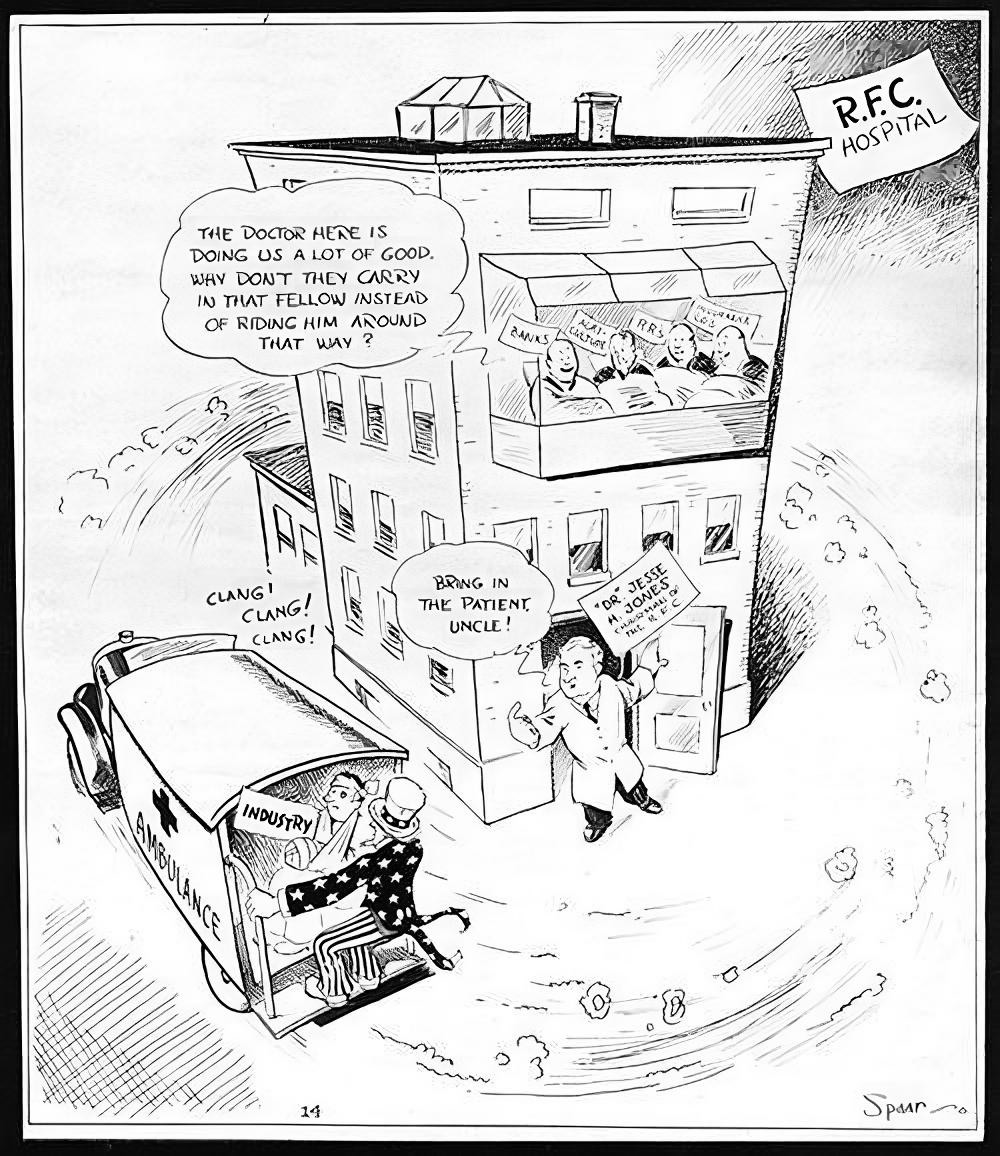
Roosevelt wanted the RFC to actively rebuild and reshape the American economy, not just slow its collapse. Roosevelt expanded the RFC's mandate to include broad investments in American industry, agriculture, the housing market, national
Roosevelt knew that the RFC needed an ambitious leader capable of executing its new mandate, and appointed Houston entrepreneur Jesse Jones as chairman. Jones was a prominent businessman with extensive experience in banking and a reputation for making deals on gut instincts that turned out to be prescient more often than not. Like Roosevelt, Jones understood that the role of the RFC should be to fill the gaps in investment that the private sector was unwilling or unable to address. Under the leadership of Jones, the RFC made aggressive investments in all parts of the American economy and managed to turn a profit every year.
Because the RFC was a corporation charged with making generally profitable investments to reanimate and upgrade the national economy, it was free to launch virtually any kind of program its leaders could think up. It didn't have to wait for Congress to pass a law to tell it what programs to create, and it didn't need to ask for new appropriations for each investment it made. Funded with an initial lump of capital from selling RFC bonds to the U.S. treasury, it operated partly like a bank, making as many loans as it could afford, and partly like a start-up or venture capital fund, spending money on whatever it thought was a good idea. Because many of its loans were quickly repaid with interest - for example, the huge number of loans it made to assist local and regional banks in the Great Depression - it could lend out far more than it raised.
One example of an innovative program that the RFC initiated was the Electric Home and Farm Authority (EHFA). The EHFA was a loan program that helped families purchase home appliances and farm equipment on credit through their utility companies, financed by the RFC.152 By enabling American households to modernize their homes with affordable financing options, the RFC stimulated consumer demand and provided a much-needed boost to the domestic manufacturing sector. All parties involved in this arrangement saw great benefits. Hundreds of thousands of Americans, the majority of whom were low-income, could afford modern appliances for the first time, manufacturers benefited from new demand and could expand their customer base to include the newly electrified south, and the RFC even made a small profit from the interest collected on the loans. The program resulted in over a million new appliances being sold in just a few years.153 The program was an example of the RFC's ability to develop creative, ad-hoc solutions to economic challenges and serve as a catalyst for growth.
In 1937, Jones helped launch the Disaster Loan Corporation (DLC) as a new entity within the RFC. The DLC provided loans to towns, individuals, and small businesses that were impacted by natural disasters. The DLC ultimately distributed around $7 million (over $100 million in today's dollars) in loans to families and communities, with loans as large as $350,000 ($5.2 million) to as low as $20 dollars ($296).154 When the economy entered a brief recession in 1938, millions of Americans quickly found themselves without a job and unable to pay their mortgage. The RFC responded by creating and funding the Federal National Mortgage Association (FNMA), now colloquially known as Fannie Mae, which would provide liquidity to the real estate mortgage market, helping to expand homeownership and stabilize the housing market for decades to come.
Jesse Jones's leadership style was characterized by spontaneity and flexibility. He was known for making quick decisions and forging deals on the spot, often without formal contracts. This approach allowed the RFC to react swiftly to changing economic conditions and seize investment opportunities as they emerged. Jones was also adept at navigating the political landscape and maintaining support from members of Congress. He understood the importance of investing in projects within their districts, which helped to ensure their continued backing for the RFC's activities.
Despite being a staunch capitalist - at a time when the future of capitalism was in question - Jones was frustrated with the reluctance of private investors to confidently do business again after the shock of the early years of the Great Depression. He believed that the RFC's intervention was necessary to kick-start investment and growth. When confronted by critics who argued that the RFC was encroaching on the private sector, Jones often publicly taunted them by pointing out their own unwillingness to invest in the nation's future.
Despite its successes, the RFC was in danger of being shut down in the late 1930s, but the necessity of war gave it a new lease on life. The RFC played a crucial role in financing the industrial mobilization for World War II. It invested in a diverse range of projects, from aircraft production facilities to synthetic rubber plants, which were essential for the war effort. The role of the RFC to finance and coordinate the war mobilization effort was so broad that Jones later wrote in his biography that "we could buy or build anything that the president defined as strategic or critical."155
In many cases, the RFC created new corporations to manage these projects and fill gaps in the economy. The Metals Reserve Company (MRC) is one great example of the RFC creating a new subsidiary corporation to assist in the wartime mobilization effort. The MRC was tasked with procuring and stockpiling metals that were essential to wartime production, as well as financing the domestic production of such metals.156 Once the metals were procured, the staff from the MRC could directly coordinate with other wartime subsidiaries of the RFC and non-RFC executive agencies to ensure that the materials were strategically utilized for the war effort. This ability to establish special-purpose entities demonstrated the RFC's adaptability and its commitment to addressing the nation's needs. In total, the RFC established seven different wartime subsidiaries - all of which played an essential role in the war effort.
Another notable example of the RFC's wartime activities was its involvement in the establishment of factories for the Government-Owned, Contractor-Operated (GOCO) contracts, which were financed through the RFC subsidiary the Defense Plant Corporation.157 These facilities were built and owned by the government but operated by private contractors, allowing for efficient production and resource allocation during the war. This model was also used by other agencies responsible for war mobilization such as the Department of War.

Roosevelt found that he could use the RFC to get critical things done without needing to ask Congress. In just one of countless instances of this, when Roosevelt was confronted by military leaders complaining about wool shortages that slowed the manufacture of many different kinds of essential products, Roosevelt wrote an official request to Jones: "This is to advise you that I have determined wool to be essential to the national defense, and you are, therefore, authorized to provide for the establishment of an adequate reserve of this material."158 The RFC's Defense Supplies Corporation immediately bought 250 million pounds of Australian wool.159
In another example, when Roosevelt was trying to establish new military bases quickly and quietly around the world in preparation for entry into World War II, he turned to Jones to fund these efforts, knowing that Congress would not act in time. For example, in the case of the Galapagos Islands, instead of requesting an appropriation from Congress, the president wrote Jones as if to his own banker: "I wish you would arrange with one of the lending agencies under your supervision to advance to Commander Foster up to $30,000 ($432,000 in today's dollars) to enable him to proceed to the (Galapagos) Islands and there establish himself." Eight months later, the RFC loaned an additional $500,000 ($7.2 million) to develop a trading mission there.160
Much like the original RFC, the new RFC proposed in this chapter will need to be flexible and responsive to the evolving needs of the Mission for America, filling gaps in investment and addressing critical needs. The importance of strong, decisive leadership, as exemplified by Jesse Jones, cannot be overstated. His ability to make spontaneous deals and maintain political support were key factors to the RFC's success. Our new RFC will need a figure equally as bold, confident, and wise. During his tenure as RFC chairman, Jones was alternately lauded and criticized in the media and by politicians - first for moving too fast during the Depression, then later for being too cautious during war preparations. His leadership was by no means perfect, but on balance, he achieved the goals of the RFC in a spectacular fashion.
The original Reconstruction Finance Corporation serves as a powerful precedent for the proposed modern version may look like. The RFC's innovative approach to financing, diverse investments, and strong leadership under an empowered CEO who worked closely with a president provide valuable lessons for the modern RFC. By adopting similar strategies and maintaining a focus on long-term national goals, the RFC can become a transformative force in building a clean, sustainable, and economically vibrant future for the United States.
Our Proposal for a Modern RFC
We've discussed in political and economic terms why an institution like the Reconstruction Finance Corporation is needed for our economy simply to function in a normal and healthy way, and how essential it is for the nation to be able to accomplish something as big as the Mission for America. Now we will lay out our proposal for the RFC. First, we'll discuss what exactly the RFC will do, the roles it will play in our society, how it will be structured, and how it will operate. Then we'll follow up with the political and legislative strategies needed to create and lead it.
What the RFC Will Do
In one sense, the RFC is an ordinary organization that will fit alongside other financial institutions and corporations in the U.S. economy, doing some of the same things they do, such as making investments, providing loans, and organizing deals to start new companies and transform old industries. What sets the RFC apart from existing corporations is that it will have the capacity to act on a very large, national scale and will make the investments and deals that private companies will not or cannot make because they are too big, too risky, and may not offer high enough short-term returns. In addition to that more ordinary role, the RFC will provide bold economic leadership in a way that neither the private sector nor political leaders currently do - though they have at key moments in our history.
As a corporation, the RFC will have several functions that resemble those of familiar financial institutions in our society, such as:
Investment banks
Private equity firms
Venture capital firms
Each function, however, will be exercised with a public purpose, distinct from their profit-driven counterparts. In these roles, the RFC will operate much like its private counterparts but in service of the national missions of the Mission for America. RFC teams will be free to explore promising deals in any industry, partnering with companies, governments, or organizations to fulfill their objectives.
As an investment bank, the RFC will assist major corporations and local, state, and federal governments with financing through direct lending, equity investments, and issuing bonds. This support will mirror the services provided by traditional investment banks but with a focus on serving the public and building strategically important industries.
The RFC will sometimes look like a private equity firm acting in reverse. Instead of buying companies to sell their assets and milk them for cash, the RFC will do deals to grow existing industries and create new ones. RFC teams may take stakes in, or even purchase, companies to facilitate economic changes that private owners might not prioritize. Theoretically, private equity firms sometimes acquire and merge companies to realize economies of scale or provide access to capital. The RFC will pursue similar actions but always with the national mission in mind.
Other times, the RFC will act as a venture capitalist firm, but on a massive scale. The RFC will invest in early-stage companies and start-ups that align with its national goals, providing them with resources and guidance to grow and succeed. Instead of looking for a small investment that will pay off 1,000-fold as quickly as possible, the RFC will kick-start entire industries private VCs aren't interested in. These will include mundane, low margin, but critical missing industries such as electrical steel, low-tech semiconductors, EV battery parts, and many others. It will also include bets that are too big and long-term to entice private VCs. In this sense, the RFC will play the role that various federal programs have played in the past when funding and organizing research and development of projects that were too risky for private capital.
Furthermore, the RFC will serve a national planning and aid function, setting it apart from ordinary financial firms. In its national planning role, the RFC will not merely seek profitable deals; instead, its teams will pursue long-term plans designed to achieve the national missions for which they are responsible. This approach may occasionally facilitate deals that a typical profit-driven bank would avoid. For example, there may be instances where the RFC must fill low-tech, low-margin gaps in the supply chain. The RFC can execute such deals due to its immense size, allowing it to absorb necessary losses and because it was not required to prioritize the highest possible profits.
Here are some of the practical approaches and activities that the RFC will employ in the course of playing the roles just outlined:
Convene leaders across industries to drive new developments that would benefit private companies and society, but that market forces can't accomplish on their own. This is the most fundamental and important function of the RFC. Convening does not include only brief meetings with CEOs in front of the news media, such as the "Made in America" roundtables held by the Trump administration, or the roundtables President Biden held with various industry leaders. The RFC convening processes will be sustained efforts to hammer out national-scale deals that will change the direction of industries in the U.S. We recommend that the president begin with the auto industry and the national mission for EVs. With a public mandate from and direct participation of the president, the RFC auto team will bring together the auto manufacturers who operate in the U.S. and those that hope to, and arrange to provide everything necessary to convince them to invest in new capacity in the U.S. This will mean bringing together auto industry leaders and managers with leaders from the other sectors necessary to provide what's needed to ramp up auto production in the U.S. to the levels required by the national mission for EVs. This includes leaders from industries such as steel and energy, the RFC teams associated with those industries, local and state political leaders key to supplying infrastructure and training capacity, and private financing.
Make simple loans to support businesses, infrastructure projects, and other initiatives aligned with the Mission for America. In this role, the RFC will act simply as a bank - but will provide financing to promising projects that would have difficulty finding financing for whatever reason. An example of this kind of government loan is the $465 million that Tesla received from the U.S. Department of Energy's Advanced Technology Vehicles Manufacturing (ATVM) loan program.
Provide guarantees to reduce risks for private investors and encourage investment in sustainable projects. Providing guarantees against losses in large investment projects can give investors the courage they need to jump, without costing the guarantor anything in most cases.
Provide purchase agreements to guarantee demand and encourage innovation. Purchase agreements can allow companies to win financing for large projects by ensuring a profitable market. An example of this arrangement is when a government or company agrees to purchase a certain quantity of renewable energy generated by a renewable energy project. Often, such a guarantee makes the difference between a project obtaining financing or failing to find funding. In many cases, a government providing a guarantee does not need to pay anything in the end because plenty of private demands exist.
Make investments like a venture firm, taking an ownership stake like any other investor to drive innovation and growth. In this way, the RFC will operate as a "venture capitalist of last resort."
Buy companies to merge or reorganize them like a (public) private equity firm. While the private equity industry is known for its focus on maximizing returns for investors, often through strategies such as asset stripping and financial engineering, the RFC would use its position as a "public equity" investor to build up the capacity of U.S. industries and promote long-term growth and sustainability. By employing some of the same strategies used by private equity firms but adapting them to serve the public interest, the RFC can play a crucial role in achieving the goals of the Mission for America.
Launch new corporations to take on necessary challenges that no private actors want to take on, driving change and innovation in strategic areas. In modern economies, there are situations in which the private sector may be reluctant to invest in certain industries or projects due to high risks, long time horizons, or insufficient short-term financial incentives. In these cases, creating state-owned corporations becomes essential to address market failures and pursue long-term strategic objectives that align with national interests. In its history, the U.S. has frequently resorted to creating public corporations to accomplish essential goals that the private sector was unwilling or unable to achieve. These include many low-profile and un-glamorous corporations such as tin smelters (when we needed tin for World War II), uranium processors, the FDIC, the Commodity Credit Corporation, and, of course, the U.S. Post Office.
Stabilize prices by participating in markets in sensitive resources and commodities.
Establish partnerships with educational institutions to promote research, development, and workforce training programs that align with the Mission for America.
Collaborate with local and state governments to develop and implement sustainable urban planning and infrastructure projects.
Fund technical assistance and resources for certain categories of small- and medium-sized businesses and organizations - for example, small utilities - to ensure they have the resources to implement their part of the Mission for America.
Foster international cooperation and partnerships to promote knowledge exchange and joint sustainability and environmental preservation initiatives.
Develop and implement public awareness campaigns to educate and engage citizens on the importance of sustainability and the goals of the Mission for America.
As a corporation, the RFC will act in the economy freely, entrepreneurially, and creatively to achieve the goals of the Mission for America. In the sections below, we will elaborate on the structure and operations of the RFC that will allow it to do this. The RFC's work will be done by teams, with each team pushing through the completion of one national mission while working in collaboration with all other RFC teams where missions overlap. It will be crucial that the president takes steps to publicly give the RFC team leaders the mandate, credibility, and flexibility they need to do their job.
By undertaking these activities and engaging with a diverse range of partners, the RFC will play a critical role in driving the transformation of the American economy toward sustainability, innovation, and prosperity. By leveraging its unique capabilities and filling gaps in the market, the RFC can help ensure the success of the Mission for America.
The Role of the RFC in U.S. Society
Throughout American history, progress in society and the economy has often been driven by cooperation among leaders serving in national executive roles. These roles include presidents, governors, mayors, and CEOs of large corporations and financial institutions. Legislation and funding from Congress and state legislatures have often played an important but secondary role in national economic development, joining after executives had already set projects in motion. Creating the RFC is one major step in resurrecting this mode of social and economic action.
In periods when the United States undertook massive economic development projects and was rapidly industrializing, the state was heavily involved, but leadership usually did not originate in legislative bodies. Presidents, governors, mayors, and business executives led the way, with legislative bodies usually needing to be begged, cajoled, or bribed into helping. On occasion, legislative bodies were simply bypassed. In the construction of the Erie Canal, for example, Governor DeWitt Clinton was the main instigator.161 The great railroad projects that transformed the nation in the second half of the 19th century were financed and coordinated by tycoons such as J.P. Morgan, who were among U.S. history's rare private actors consciously carrying out a long-term national development plan.
A similar dynamic was present in the lead-up to World War II when President Franklin D. Roosevelt engaged with industry leaders to prepare the economy for the vast increase in production necessitated by the war effort. Despite minimal support from Congress, private industry leaders, whom FDR had recruited to lead the economic war mobilization, negotiated deals with their former colleagues to rapidly expand production capacity, often relying merely on verbal and handshake agreements.162 As we have discussed, the Reconstruction Finance Corporation acted as Roosevelt's development bank and fixer, allowing the president to set deals in motion without having to wait for Congress. This proactive strategy enabled rapid mobilization of resources and industries much faster than Congress could have done.
None of this should be seen as supporting a public vs. private dichotomy in which public bodies such as Congress are seen as slow while private corporations are fast. Nor are we accusing democratic legislatures of being inefficient and indecisive by nature. Democratic deliberative bodies should not be expected to play an executive function in building and transforming industries and the economy at large. That is not the job they are designed for. We are simply talking about adding back a capacity that is essential to the survival of all societies. With the Mission for America, we are trying to revive the memory of two things. First, that it is possible, necessary, and normal to make intentional and proactive changes to the economy, even sweeping ones. And second, that making those changes is the job not of Congress or legislatures but of mayors, governors, and presidents, all working with executives in industry.
After the U.S. reached its total industrial ascendancy at the end of World War II, it commenced a "Great 70-Year Nap". During the Great Nap, U.S. leaders decided that its economy was so dynamic that it no longer needed anymore leadership or financing from the government and no longer needed to be intentionally and proactively upgraded to retain international competitiveness. The job of government with regard to the economy became to actively restrict and regulate it. The idea that government executives would take a leadership role in making big things happen in the economy, rather than to primarily prevent them from happening, became strange and taboo.
In sum, the RFC's job is to make things happen across the economy by leveraging both public and private resources, utilizing whatever kinds of tools are available. The RFC will make investments just like a bank, a venture capital firm, or a private equity firm; it will convene major industrial leaders to make things happen in and around industries - just as FDR and the RFC did in the run-up to World War II.
Structure of the RFC
Our proposal calls for structuring the RFC as a set of teams, with each team responsible for one of the national missions that make up the Mission for America, plus additional teams as needed to oversee certain sub-projects of the national missions. Teams will report to the CEO of the RFC but will also sometimes work directly with the president in special moments with the most important missions. Teams must be self-leading and able to work independently, with a senior, experienced leader in charge of each team, staffed by many other experienced industry leaders. At the same time, these teams will be able to accomplish their missions only if they are publicly imbued with authority, credibility, and urgency - first by the president and eventually also by Congress.
As we will elaborate below, most RFC teams will begin their work even before Congress formally creates the RFC. They will begin as teams of senior volunteers who have quit their jobs in industry or other areas to help lead the Mission for America. If the record of the original RFC is any guide, ultimately some of these teams will grow to several thousand staff, mainly drawn from the ranks of industry, finance, academia, and government.
As an example, let's take the team for the national mission for electric vehicles - a plan to reclaim a third of global auto sales with U.S.-made electric vehicles and trucks. That team will be led by a major figure from the auto industry and staffed by other former executives from the same industry and other industries. Perhaps the EV team would decide to base itself in Detroit instead of Washington, D.C. Teams must have the autonomy to fulfill their missions.
The designation of "teams" instead of something more traditional like "divisions" or "departments" is intended to help keep both the staff of the teams and the public at large in the mindset that they have been created to carry out a time-bound mission. It is also intended to promote flexibility in thinking and action. New teams can be created or spun off of larger teams to get something done quickly, something that might take only several months or a year - for example a team to fill a narrow and specific gap in a supply chain.
To achieve their missions, RFC teams will need to enlist the enthusiastic participation of corporations, state and local governments, labor unions, and many other types of organizations. To accomplish that, RFC teams will have access to enormous quantities of investment funds, but they will need more than money. All of society must be aware of the RFC's mandate and view achieving it as an objective that is both common sense and patriotic. This can be accomplished only through strong leadership by the president, who must publicly charge team leaders with responsibility for completing their missions. The president will need to spend a lot of time in the beginning of their administration establishing the credibility and urgency of the RFC teams. For the first missions that will be introduced - we suggest EVs and clean power - to succeed, the president must make the team leaders household names.
Success requires that these missions and their leaders become as famous as major elected officials or business leaders such Tim Cook, Elon Musk, and Mark Zuckerberg. This will give the team leaders the public mandate to make big and difficult things happen. When the EV team leader is meeting with auto execs, for example, they must know the stakes. In the same way the public reads news stories about how many advertisers are supporting or abandoning Musk's X, it will be important for the public to be aware of which automakers are embracing vs. rejecting the moonshot goals of the EV mission. Only that will create the public pressure that can change their actions. Everyone in the industries and government agencies whose participation will be required will need to know what the team leaders are responsible for achieving. It is important not only to create urgency for the leaders and the teams, but also to give the leaders and their teams clout with everyone who will be essential to completing the mission.
When industry leaders, regulators, and bankers are called to gather and to make plans for expansion by RFC team leaders, participating should be their top priority. This will work only if the president establishes a context through their campaign, transition, and first 100 days that ensures these industry leaders that powerful measures and vast amounts of capital are on the way to make betting on America a winning proposition. When an RFC team leader calls for industry leaders to bet big on their own futures, and sometimes even to make short-term sacrifices for long-term gains, those leaders need to know that they are on a public stage, and that the entire nation is watching them to see what they will do.
Public responsibility and accountability will be important for another reason. If a team leader winds up spinning their wheels for months on end without making a strong effort to make progress, then the president will need to fire that leader and replace them with someone else. While it would be better if that never had to happen, when it does happen, it will send a powerful signal to all the other team leaders, all the people they will need to move, and the American people that failure is unacceptable. Industry leaders need to know that if they stonewall or undermine their RFC team, they will just have to deal with a replacement who is even more driven and empowered.
The RFC will have a team for each of the major national missions that make up the larger Mission for America, including but not limited to the following:
Clean power
Electric vehicles and the national charging network
Buildings
Agriculture
Hydrogen
Clean trucking
Clean shipping
Public transport
Manufacturing, materials, and chemicals
Safely winding down the fossil fuel industry
Nuclear power
Carbon removal
Water infrastructure
Cleaning the oceans and environment
Start building the RFC from the very beginning
As discussed in the introduction and the chapter on national economic mobilization, the Mission for America can be achieved only through extraordinary presidential leadership that begins even before its president enters office - leadership that doesn't wait for Congressional business-as-usual politics.
The president must begin the process of creating the RFC during their campaign. The Mission for America will be a viable program only if a large portion of the American people are won over to it, get excited by it, and vote for it in the campaign. The American people will learn as part of the campaign about the lost national capacity for intentionally developing the economy, and about how the RFC will restore it.
As we discussed in the chapter on presidential leadership, it is not naive to expect that this is possible. Donald Trump demonstrated that presidential leadership could be used to build a political coalition around ideas that were previously considered out of the mainstream. Of course, many of the policies Donald Trump advocated for were actively cruel and inhumane. For example, convincing a significant minority of voters to support mass deportations and a massive border wall. However, one of the few positive changes ushered in by Trump was that he successfully challenged the economic dogma of his own party. Trump was able to force the Republicans to tamper their unquestioning belief in free trade and to dabble in state-driven industrial policy. In his second term, amid the chaos and destruction of his administration, Trump went further - taking an $8.9 billion equity stake in Intel, securing a golden share in U.S. Steel, negotiating revenue-sharing arrangements with Nvidia, and invoking the Defense Production Act for mineral production. His tariffs demonstrated that protectionist trade policy is politically feasible - though tariffs without coordinated domestic investment simply raise prices, with estimates of household costs increasing by $1,700 to $3,800 per year. These are, inadvertently, some of the very tools the RFC proposes to institutionalize. But as ad hoc executive actions tied to a single president, they will die with this administration - just as the IRA's tax credits died with the last one. The RFC makes these tools permanent, accountable, and part of a coherent strategy rather than a grab bag of deals. The Mission for America president will need to accomplish a similar feat of political coalition-building - but in the name of prosperity and justice, not cruelty and division.
During the campaign and the subsequent transition, the president must identify a CEO for the RFC and the key RFC team leaders who will be responsible for the separate national missions that make up the Mission for America. Because the RFC teams will mostly be charged with creating, scaling, and transforming industries, the RFC team leaders and their staff will mostly be drawn from the ranks of business - a topic that will be controversial to some and that we will speak to later. As we have outlined previously, the drama around this recruitment can drive interest among the media and the public toward the RFC. As in the example we used of our imaginary presidential candidate working to recruit the CEO of a major automaker to lead the RFC team for EVs, that kind of "will she or won't she" drama will engage the media and allow the president to connect with the American people about the Mission for America and about how the RFC fits in.
During the months of transition, the president-elect must set the RFC in motion by announcing whom they will appoint to lead the RFC and its teams, introducing them to the public one by one, and letting them begin the parts of their work that can be completed without legislation.
Beginning with the campaign and into the presidency, the president must make the case for the Reconstruction Finance Corporation by stressing the following ideas as often and as powerfully as possible:
• The RFC belongs to the American people. When the RFC invests in a company and takes an ownership stake, those shares are owned by the American people. Profits generated by the RFC will be either returned to the American people or reinvested in new ventures.
• The RFC provides revenue to the government and reduces the need for taxes. Some of the profits from RFC investments will flow back to the treasury, contributing to government revenue.
• The RFC builds the nation's wealth. By investing in productive industries, the RFC will contribute to the real wealth of the United States, enabling the production of essential goods and services and creating opportunities for American workers.
• The RFC takes risks that private investors and companies won't. The RFC is designed to support projects with potential long-term benefits, even if they carry higher risks or operate on longer time frames that private entities might avoid.
• The RFC operates on a large-enough scale to ensure overall success. By investing in a diverse range of projects, the RFC can leverage its resources to maximize the chances of success across its entire portfolio.
• Some failures are inevitable. As with any venture capital firm, not all RFC investments will yield returns. However, these failures are a natural part of the investment process and should not deter continued efforts.
• Betting on America will pay off. The RFC's investments demonstrate a belief in the potential and capabilities of the American people and industries. Ultimately, these investments will lead to long-term success and growth.
During the transition and the first weeks of the presidency, the president must introduce the RFC's CEO and national mission team leaders to the American people as sensationally as possible. The president must publicly charge these leaders with the responsibility of carrying out the Mission for America. The leaders of the high-profile national missions, such as electric vehicles, clean power, and others should become household names. Expectations should be set high, and the president must make it clear that failure is not an option.
Don't wait for Congress to start building the RFC
One consequence of the ideas covered in the previous sections is that after the election, the RFC doesn't need to wait until Congress approves and funds it through legislation for it to begin its work. The most important things that the president will accomplish with the RFC can be done by showing leadership and by organizing other leaders to take actions in the direction of building industries and infrastructure. The president will show the nation why the RFC must be officially created by showing what it can do unofficially, with only a fraction of the power it will eventually have.
A great example of this from the World War II experience is the effort to ramp up machine tool production capacity. Machine tools are the tools, equipment, and machines needed to make other machines. It took nearly two years to ramp up machine tool production to the levels that would be needed by all-out war production.163 If that work hadn't started far ahead of the U.S. entrance into the war, it would have been a disaster with the U.S. unable to significantly contribute to the war effort until it was too late. Yet Congress was unwilling to finance large-scale war production, let alone something as indirect as an expansion of the machine tool industry. Nevertheless, Bill Knudsen, the president of General Motors who quit his job long before the war began to lead the effort by FDR to ready the economy for mobilization, was able to convince the leaders of the machine tool industry to invest in expansion using their own resources and private financing.164
That is exactly the kind of thing that the president can and must do with the RFC leaders even before Congress approves and finances it. The president must build support for the RFC by talking to the American people about it as though it already exists, and the president must make it already exist by getting its nominated leaders to begin work on major projects.
Like Knudsen, the RFC leaders will need to quit their jobs and come to work in D.C. as volunteers pending the creation of the RFC and their official appointments. They will immediately go to work on tasks that are urgent to the rapid success of their national missions and the Mission for America as a whole. Some of these tasks might include winning access to key natural resources, filling in gaps of the supply chain, as well as planning and identifying these kinds of gaps. Ideally, however, much of the planning will have been done during the campaign.
Specifically, imagine that the leader of the national mission for securing natural resources will be meeting with major financiers, mining companies, diplomats, and other key players to coax major players to put together deals to gain access to lithium supplies. Imagine the leader of the national mission for EVs will be working with auto and battery industry leaders to convince them to launch investments to close gaps in supply chains such as America's missing anode and cathode production.
Why would American industrialists and financiers suddenly want to do things they previously did not just because some people from the RFC came to talk to them at the behest of the president? They will do it if they judge that the Mission for America will actually be attempted, knowing that the Mission will create massive demand for their products and opportunities that will be available only to manufacturers who are investing in the U.S. This will work only if the president and their administration are talented enough politically and if they are elected with a strong mandate.
During the transition period and the early days of the presidency, the president should talk about the work that these leaders are doing and how it is setting the stage for the success of the Mission for America. That will make it more difficult for Congress to oppose by dragging its feet.
With the RFC, the president will initiate engagement with business leaders even before the RFC has office space. These leaders can begin assembling their teams and formulating plans for their work, laying the groundwork for the RFC's operations before it officially exists. This approach is vital because the president has a two-year window before the midterm elections to demonstrate significant progress, which is necessary for winning more seats and gaining the power to secure approval and funding in Congress.
By following the cooperative examples from our history, the president can build momentum and showcase the RFC's value early on. Early success not only helps secure public and political support but also facilitates smoother Congressional negotiations when seeking funding and formal approval. In today's rapidly evolving economic landscape, waiting for bureaucratic processes to unfold is not an option. It's time to revive the spirit of cooperative action that once defined American progress and bring the RFC to fruition.
Ultimately, the creation of the RFC should not be delayed by waiting for Congress's approval. By learning from historical examples and embracing executive leadership, collaboration, and proactive action, significant progress can be achieved within a short time frame. This approach will not only ensure the success of the RFC but also lay the foundation for a stronger, more resilient American economy that benefits all citizens.
In business-as-usual politics, the president would wait until Congress passed a bill to fund an agency or a committee to begin those kinds of activities. The Biden administration was a good example of a White House breaking somewhat from business-as-usual. The administration went to work immediately studying problems and preparing plans on the assumption that maybe at some point they would be able to convince Congress to pass some good legislation based on those plans. That is part of the story of the CHIPS Act and Inflation Reduction Act - both of which demonstrated that industrial policy works. On the other hand, Biden and his team did not publicly call on industry leaders, Wall Street, and other financiers to begin making changes that were entirely under their power to change, instead waiting for Congress to pass legislation that would offer incentives and public funding. The result: major achievements built on tax credits that the next president destroyed. The current administration, by contrast, has shown more willingness to act through executive authority - equity stakes, Defense Production Act invocations, direct deals with industry - but without any institutional coherence or long-term strategy. The RFC combines Biden's policy ambition with the executive speed the current administration has demonstrated, and builds both into a permanent institution that outlasts any single president. The Mission for America calls for a break from normal because that's what's required of America right now.
Legislative strategy for creating the RFC
Legislation is needed to create the RFC and give it the powers it needs to function. Legislation creating major institutions used to be very simple - back when the U.S. still did this sort of thing. It would be good to keep it simple.
Placement within the Federal Government. The first step in establishing the RFC is to define its position within the federal government. Congress must decide whether to make the RFC a government-owned corporation or place it within an existing institution such as the Federal Financing Bank. We recommend that Congress construct the RFC as a new government-owned corporation independent of any existing agency or institution.
Leadership Structure. The legislation should clearly outline the RFC's leadership structure and include key officials' powers, responsibilities, and appointment processes. The legislation should focus primarily on the CEO, RFC team leaders, and the board of directors.
Congress should begin this process by establishing the role and responsibilities of the RFC's CEO. Congress will need to decide how the CEO is appointed, how long they may serve, and whether or not they are subject to term limits. We recommend that the CEO be appointed by the president and approved by the Senate in the same way a cabinet secretary or the chair of the federal reserve would be. We do not have a stance on the length of a CEO's term or whether there should be term limits.
Congress should also outline the process for how the CEO can create teams and spin-off corporations within the RFC. Congress should endow the CEO with a high level of independence in establishing new teams and hiring people to lead them, including the ability to create and abolish new teams or spin-off corporations without receiving congressional authorization or personal approval from the president. This level of independence is key to the RFC's ability to quickly respond to changes in the economy and advance the goals of the Mission for America. However, Congress should have the power to instruct the RFC to create a new team or spin-off corporation if an existing RFC team does not currently address a problem within the economy.
Finally, Congress must establish a board of directors for the RFC. We recommend that the board contain a combination of the heads of relevant cabinet-level agencies, such as the Secretary of the Treasury and the Secretary of Energy, and individuals directly appointed by the president. Congress will then need to decide whether individuals appointed to the board by the president need to be approved by the Senate, how long appointed board members may serve, and whether or not there will be restrictions on how many board members may be from one political party - we are generally agnostic on all of these questions.
Funding the RFC. Congress must provide the RFC with a significant initial endowment so the new institution can immediately begin investing in the American economy. We do not intend to provide a specific dollar amount for this endowment but simply urge Congress to pursue the largest endowment that is politically feasible. Congress then must decide whether this will be a one-time endowment or if the RFC will regularly receive new funds from Congress. We suggest that Congress regularly provide new funding to the RFC every fiscal year to facilitate new and more ambitious investments in the American economy.
Additionally, the legislation needs to explore potential mechanisms through which the RFC can raise additional funds outside of Congress. These could include issuing bonds, attracting private equity, or borrowing from the Treasury. We recommend that the RFC be authorized to issue bonds to private investors and borrow directly from the Treasury. Both options present a low-risk way for the RFC to raise money without asking Congress to undergo the politically complicated task of passing a new spending bill. Both of these methods have worked in the past for similar institutions, as the original RFC raised billions of dollars through bonds and government borrowing.
Financing New Projects. The legislation must clearly define how the RFC can finance new projects. Details to be addressed include the types of investment the RFC can utilize, restrictions on the amount of money the RFC can invest in a specific project or company, and regulations on how long the repayment process can be for a loan.
Policymakers will also need to protect the RFC from businesses that may attempt to defraud the RFC in any capacity. The RFC will need to maintain the full trust of the American people, and any scandals about individuals or businesses defrauding the RFC threaten to undermine that trust. To protect the integrity of the RFC, the legislation should include severe penalties for any attempts to defraud the institution. We recommend strong financial penalties and jail time for anyone convicted of defrauding the RFC.
Congressional Oversight. The legislation must outline the nature and extent of congressional oversight over the RFC. Establishing the exact relationship between Congress and the RFC will require that policymakers undertake a delicate balancing act. Congressional oversight is important to the public perception of the RFC and ensures that the institution stays true to its core mission, but it must not tread on the RFC's ability to act quickly and independently. We recommend policymakers focus on transparency and accountability rather than control when deciding the relationship between Congress and the RFC. One example of effective oversight that doesn't restrict the RFC's day-to-day functions would be requirements that the RFC publicly disclose the details of every investment they make, including the recipient, investment amounts, the goal of the investment, and the repayment details on any loans. Congress could also require that the RFC CEO regularly brief Congressional members on the status of critical investments and national missions.
Liquidation Process. Finally, the legislation should establish a clear process for the liquidation of the RFC. Although it is expected that the RFC will be a long-term institution, it's prudent to include provisions for its potential dissolution to ensure a smooth process if it will ever be necessary.
The corporate form of the RFC
Like the original RFC, our proposed modern RFC should be designed and ran as a corporation. Like other corporations, it will be run by a CEO and other executives under a board of directors, appointed by the president. As a public corporation, its mission is to upgrade the economy to provide prosperity for all while making it fully sustainable. But the RFC will be expected to earn returns as well. It should be expected to be profitable so that it can be a secure and non-political institution, and also because it will be generally investing public resources into activities that will generally earn profits. The American people, who will be fronting most of this investment capital, should earn a return for the risks they are taking. This also follows the precedent of the RFC, which despite financing and launching a large number of massive projects, consistently returned a profit to the American people.
As mentioned, the RFC will be led by a CEO and a board of directors. There are a variety of ways Congress could choose to design the board. The board of the original RFC was made up of the Secretary of the Treasury and six officials appointed by the president. No more than four members of the board could be from the same political party and every board member had to be from a different federal reserve district. All members of the board had to be approved by the senate. Board members served two-year terms but there was no rule preventing board members from being renominated for consecutive terms.
Dr.
Ultimately, the choice of how to structure the board will be determined by the politics of the moment and negotiations with Congressional leaders. We believe that the board should be structured in a way that provides maximum buy-in and support from federal government and Federal Reserve leaders while preserving the RFC's ability to act decisively, as free from politics as possible. The structure that best achieves those aims will depend on the kinds of people available to serve on the board at the time that it is created.
The RFC must have a flexible structure in which its leadership can create teams corresponding to goals. To start with, there will be one team created for each of the national missions that make up the overall Mission for America. These include EVs, clean power, hydrogen, agriculture, and several others. These teams will have leaders who are responsible for achieving their national missions. They will be appointed by the president and the RFC CEO and introduced to the nation at the beginning of each national mission.
Team leaders should be respected figures from the industries with which they will be working who have a track record of accomplishing successful transformations in the companies they have served. They will be charged by the president, as publicly as possible, with the responsibility for accomplishing the national mission to which they are assigned; therefore, they'll carry both the responsibility and the public authority to clear obstacles and persuade industry leaders and financiers to get behind their mission.
The RFC should be structured as a corporation to allow it the flexibility and decisiveness to achieve its missions. Technically, the RFC could be a government agency and accomplish its mission. In U.S. culture, however, there are different sets of norms for different types of organizations. We need the RFC to be decisive and bold, and it will need to attract top talent from the financial and industrial sectors and pay the high salaries they expect. Those things will come more naturally if the RFC is identified as a corporation as opposed to being a government agency. The highest paid head of a government agency makes a tiny fraction of what the Tennessee Valley Authority earns (more than seven million dollars). Although the TVA is technically a federal agency, its status as an energy provider that functions identically to a corporation has been established for decades. It is unlikely that a newly created federal agency today would be able to achieve the same distinctive corporate identity as the TVA. Since the creation of the TVA, federal management and human resources rules have proliferated to the point that makes change and agility nearly impossible.
Not all corporations are agile, but large agile organizations in our society tend to be corporations. This choice does not represent a preference for private over public. Many private corporations are bureaucratic and sluggish, and many publicly owned corporations and government agencies around the world are dynamic and efficient. Some of the world's best-run companies have been and still are state-owned, including many of the largest and most profitable global banks; airlines; manufacturers; energy, mining and telecommunications companies; and many other types.
Government has a representative function; therefore, in an institution such as Congress, democratic deliberation between different and opposed interest groups is not a bug of government, but a feature. And it is also a feature to have different branches of government and even sometimes different agencies struggling against each other in direct opposition. The RFC, however, will be given a mission by the American people through their government, after a due process of struggle and deliberation. Once created, the RFC's job will be to perform its mission as well and as efficiently as possible. Among the forms available to choose from, the structure of a corporation led by a CEO is the best suited to this purpose.
Aligning business and society through the RFC
As we have discussed elsewhere, the role of government with regard to business has traditionally been defined in the U.S. political tradition by the idea that business has an inherent tendency to be destructive. For centuries, both left and right have viewed business as something that produces harm alongside wealth. The role of government in relation to business is therefore to regulate and restrict it. The state must regulate business to rein in and prevent as much harm as possible, while allowing business to continue to produce the valuable side effects of private profit-seeking: economic development, invention, and wealth. The difference between the left and right positions on this question has been merely a matter of nuance: The left has favored more regulation to rein in as much harm as possible, whereas the right is generally tolerant of more harm as a force of creative destruction. A fitting analogy is of a tree that bears fruit but that must be constantly pruned to keep the tree from growing out of control and to ensure the fruit is sweet.
As we recounted in the previous chapter on national mobilizations, this is not the only way that capitalism has been organized and managed by states. Even today, many successful capitalist societies use a substantially different approach. Most wealthy and industrialized Western European and East Asian states have systems that treat large- and medium-sized corporations with more of a mission-focused orientation. With this orientation, societies charge corporations with the mission of growing strong. Rather than corporations being seen as rapacious beasts that must be controlled, they are seen as members of the community that are expected to acknowledge and honor social responsibility like any other community member. Of course, just as with any other member of the community, that doesn't mean that corporations will always behave perfectly. But their interests are seen as generally aligned with the rest of society in a non-zero-sum formulation as opposed to being diametrically opposed in an extractive, zero-sum formulation. For example, in most other industrialized rich nations, the owners and boards of corporations include representatives of important social groups such as labor unions, civil society organizations, and local, regional, and national governments. In many countries, there are overlapping and rotating leadership groups that share power across the boards and executive positions of corporations, private and public banks, and government agencies. Around the world, many different social arrangements accomplish a more aligned relationship between corporations and the rest of society.
What all these different power-sharing arrangements have in common is that they attempt to create something of a unified governing establishment that spans corporations, labor unions, other civil society groups, and government. Nowhere does this function perfectly. Conflicts and scandals erupt frequently. And the unified ruling group everywhere stands for some combination of the wealthy, professional, and middle classes, to the exclusion of the poor to some degree. Nevertheless, the relative unity of purpose among the economic players in these other societies has tended to lead to wealth being kept in the country and shared somewhat more equitably. And if the U.S., as the richest nation in the world, was governed along the lines just discussed, its workers and middle-class people would be far better off than they are today.
The Mission for America is designed to create, at least temporarily, a structure of shared interest among corporations and the nation as a whole. This works simply by giving corporations huge amounts of profitable work that aligns with the public interest. We need to give our corporations positive missions in which they profit from accomplishing the projects that our nation needs to get done: building new production capacity and new infrastructure, replacing dirty industry with clean industry, cleaning up the toxic mess of past generations of industry, upgrading our buildings and homes, building new transportation systems, and more.
The RFC is the primary institution that will be charging our corporations with this work throughout the Mission for America. It will use various mechanisms for accomplishing this, such as lending, investing, convening, and assisting in more creative and unconventional ways that we discuss in other sections below.
Of course, regulations and other kinds of oversight will still be needed to ensure that corporations will not cause harm while they are striving to accomplish the work we give them. But we already have a robust regulatory and oversight apparatus deeply embedded across every part of our society. It does not have to be added to the RFC. It is true that for several decades, some types of regulation have been weakened, leading to sliding environmental and labor standards. The presidential administration and congressional leadership that carries out the Mission for America should work to reverse this trend and strengthen regulation and government oversight. The RFC's role, however, will be to set goals that make the work that corporations do positive mostly by default.
For example, we will give U.S. corporations the mission to make clean steel, which entails producing steel without the use of fossil fuels. The Mission for America involves creating guaranteed demand for huge quantities of clean steel and creating border adjustments and tax rebates to make nascent domestic clean steel manufacturing competitive. Yes, there are still many ways that steel corporations could harm the environment and workers in the course of making the electrolyzers and sourcing the water that will be needed. But we already have the EPA and many other regulatory bodies that set guidelines for keeping those kinds of processes safe - which should all be strengthened by the government that executes the Mission for America. But by giving our steel corporations the mission of making clean steel, they will be immediately transformed from having an inherently harmful business model to having a profitable one that doesn't harm the environment.
Part of the RFC's work will be to help create that kind of governance structure in the U.S., temporarily within the context of the Mission for America, but also for the long term by creating some permanent changes to the ownership and governance structure of much of the economy.
When the president appoints industry leaders to the RFC, anti-business critics will complain that they will use their positions in the RFC to deliver unfair advantages to the industries they're coming from. But in this new paradigm, we want these leaders to deliver as many advantages as possible to business - not in relation to labor or consumers, but against foreign competitors and against a general failure to achieve their missions.
Under our current system, when corporate leaders enter government, they sometimes work to enrich their former and future employers with our current generic U.S. business model - which often works by destroying wealth in or exporting wealth from our nation to other nations, or by rolling back environmental, labor, or other community standards. The RFC is designed to bring an end to that in collaboration with the president and their administration.
Dealing with political resistance to the RFC
Tensions will inevitably develop between private institutions and the RFC. The original RFC had a policy of staying away from investments and deals that the private sector was willing to do, focusing on areas that private lenders and investors were afraid of. Banking leaders frequently attacked RFC chairman Jesse Jones for meddling in the private market. Jones enjoyed taunting them in return, challenging them to muster the courage to start investing again at pre-Depression levels. His message to financial markets - often delivered directly and explicitly at meetings of the American Bankers Association - was that if banks didn't get over their fears and start lending again, they had to let the RFC fill the gap. If they blocked the RFC from doing its work, then they would create an existential crisis for themselves.
These fights were sometimes dramatic and loud enough to reach the public through the news media, which helped the public become aware of the RFC and come to understand its role. A Houston Chronicle editorial, for example, reported one of Jesse Jones' first clashes with bankers as follows:
"Credit, as Mr. Jones states, is the life blood of business. It must be provided. Unless the banks provide it, we can be sure that the next session of Congress will put the government directly into the banking business. We don't want that if we can avoid it, but we must accept it in preference to the stifling of credit." The editorial said that the sale of preferred stock by banks to the RFC "was a symbol of honor and patriotism."166
Bankers and other leaders of traditional economic factions never got over their abhorrence of the RFC, even though it was literally designed to support their survival and expansion. In the American economic tradition, public investment and coordination institutions, such as the RFC, the War Production Board, or the first and second Bank of the United States, aimed to "crowd in" private investment rather than crowd it out. This approach allows private banks to participate in necessary deals, with the public institutions stepping back when possible. Our modern RFC will adopt a similar strategy, whether by providing direct financing, or by encouraging private deals through providing support and creating a sense of urgency, or by offering guarantees, or by acting as the first bold investor to get a project rolling. Nevertheless, we must expect that the RFC's will come under the same sorts of attacks that were lobbied against its original incarnation and all other past public investment institutions. For the RFC to do its job successfully, it will need a leader with the same stature and political skills that Jesse Jones had.
Other tools in the RFC toolbox
Contracts with private industry
The RFC can enter into procurement contracts with private companies to help guarantee demand for new products or to encourage investment in unproven technologies. These contracts can take many forms, and the RFC should be given considerable leeway to create innovative new contracts that help support American industry. This section will briefly explore two types of contracts the RFC could employ: basic procurement contracts and COTS style contracts.
The RFC can employ procurement contracts as a straightforward yet effective way to ensure a minimum demand for new products. The RFC can offer these contracts to specific companies looking to build a new factory in the United States or they can be announced ahead of time and given out as a reward to the first company to successfully build the product at the specified price point. Upon fulfillment of the contract, the RFC has two options: either to acquire the products and use them to build a strategic reserve or to seek an alternative private buyer to take over the contract.
Another, very successful, model for the RFC to emulate is the contracting process used by NASA during the Commercial Orbital Transportation Services (COTS) program. NASA first used this model in 2006 to develop a launch system needed to take cargo to the International Space Station. At first, NASA drafted a CPIF contract with Kistler Aerospace. Kistler had historically failed to fulfill contracts with NASA, and other private space exploration companies were furious that they were not allowed to compete for the contract. NASA eventually acquiesced and allowed multiple private partners to do so. Ultimately, both Kistler Aerospace and the Space Exploration Technologies Corporation (SpaceX) were offered contracts by NASA. Rather than offer both companies a CPIF contract, NASA took the opportunity to create a new contracting system that would incentivize lower costs and greater competition among participating companies.
What resulted was a contract arrangement that was very distinct from the Cost-Plus-Incentive-Fee contracts NASA had previously used. NASA did not provide technical specifications or requirements for how to build the launch system. Instead, they created a list of objectives the system would need to fulfill, allowing companies to determine on their own how to best meet those objectives. Rather than have their costs fully reimbursed by the federal government, companies had to pay for a portion of all development costs incurred when designing a new project. This encouraged companies to keep costs as low as possible and maximize efficiency in the building process. The companies participating in the program were also not guaranteed any money at all and were only paid if they met specific performance benchmarks during development. The payout rate for meeting specific benchmarks was a fixed-rate payment agreed upon at the beginning of the process, which further incentivized participants to keep development costs low to maximize their profits from the fixed-rate payment. Companies chronically failing to meet their benchmarks could be removed from the program, and another company could bid to take their spot. In exchange, for the risk companies incurred by investing their own money in the process, they could keep the rights to the final product and use it for their own commercial benefits.
The new contract model was considered wildly successful, and NASA has since frequently used it when contracting with private companies. NASA received not just one, but two functioning systems it could use to deliver cargo to the International Space Station - all while saving money and operating on a shorter timeline. The private participants benefited from this arrangement as well. SpaceX kept the rights to its new launch system and has used it for many commercial spaceflight projects. The COTS contracting model is an excellent example of how successful public-private cooperation can benefit all parties and accelerate technological innovation.
The GOCO model
Government-owned, contractor-operated (GOCO) industrial projects are another tool employed by the RFC to complete its national missions. This model, which played a crucial role in the World War II economic mobilization, involves the government owning a facility while a private contractor operates it. The GOCO model will be essential in some cases for the RFC to facilitate rapid advancements in industries critical to completing the Mission for America.
Another notable example is the Tennessee Eastman Company's management of the Y-12 facility in Oak Ridge, Tennessee.167 The government-owned facility was operated by the private contractor to produce enriched uranium for the Manhattan Project. This arrangement allowed for rapid expansion of production capabilities and harnessed the expertise of private industry while maintaining public ownership and oversight.
The RFC will sometimes rely on GOCO arrangements to accelerate developments in sectors where private corporations may be hesitant to invest due to concerns about long-term profitability, perceived risks, or high-operating costs. Such arrangements enable the government to provide the necessary financial backing and stability while benefiting from the technical knowledge and operational efficiency of private contractors.
For instance, the RFC might use GOCO contracts to support the development of advanced battery production facilities or utility-scale battery storage systems. By doing so, the government can foster innovation in energy storage solutions while minimizing the financial burden on private companies. In turn, this can help the United States achieve energy independence and transition to more sustainable energy sources.
Similarly, GOCO arrangements could be utilized to encourage the domestic auto industry to invest in electric vehicle (EV) manufacturing. If American automakers are apprehensive about their ability to sell the large volume of EVs outlined in the Mission for America, GOCO contracts can provide a safety net and the necessary resources to stimulate production.
In conclusion, "GOCO" style assistance to corporations will be a vital tool for the RFC as it works to accomplish national missions. By adopting this collaborative approach, the RFC can harness the strengths of both the public and private sectors, fostering innovation and rapid advancements in crucial industries while minimizing risks and addressing concerns about long-term profitability.
Special-purpose spin-off corporations
Another essential strategy in the RFC's arsenal is the creation of special-purpose spin-off corporations. This approach, used frequently and successfully by the original RFC, allows the RFC to address specific, large-scale tasks by establishing separate entities dedicated to those objectives. In introducing these spin-off corporations, the RFC can ensure that the necessary resources, focus, and expertise are brought to bear on these critical projects.
The RFC employed this tactic on several occasions, spinning off corporations tailored to address specific challenges. For example, the Defense Plant Corporation (DPC) was established to construct and finance war production facilities, including those operating under GOCO contracts.168 The DPC played a pivotal role in rapidly scaling up production capacity for essential wartime goods. Another example is the Metals Reserve Company, which was tasked with the procurement and stockpiling of strategic metals and minerals vital to the war effort, such as copper, tin, and manganese.169 By creating these specialized spin-off corporations, the RFC was able to more effectively tackle diverse and complex tasks while maintaining its core functions and profitability.
The RFC could spin off similar special-purpose corporations to address the challenges of building a clean and sustainable economy. One potential spin-off might focus on the development and management of clean hydrogen production capacity. This corporation would work to ensure that airports, ports, factories, and other facilities requiring clean hydrogen have access to nearby production and distribution infrastructure. Such a corporation would require an up-front investment too large and a lead time too long for any private funders. At the same time, its operations would be so large and complex as to become a distraction for the RFC if it was permanently located there.
Another example of a special-purpose spin-off corporation could be one dedicated to the rapid expansion of electric vehicle charging infrastructure. This corporation would focus on creating a comprehensive, nationwide network of fast-charging stations, enabling long-distance travel for electric vehicle owners - another challenge so large as to interfere with the overall RFC mission if located there.
With all these potential spin-offs, the RFC still has an important role to play in incubating and launching them. Rather than requiring the federal government to go through a politically difficult and financially expensive bespoke process for each of these needs, it will be much easier and cheaper to allow the RFC to create them as needed. This also allows for the flexibility that, in some cases, anticipated spin-offs will not be needed.
The establishment of special-purpose spin-off corporations will be a crucial strategy for the RFC as it tackles the monumental challenges of creating a clean and sustainable economy. By drawing on the successful precedent set by the original RFC, our modern RFC can more effectively address specific, large-scale tasks and marshal the necessary resources and expertise to achieve its national missions.
Conclusion
The United States is in the midst of converging crises: economic insecurity intensified by AI displacement, climate disasters that keep getting worse and more expensive, and institutions that have been systematically hollowed out. If left unaddressed, these crises will undermine the fabric of American democracy and cause global instability. The need for ambitious action has never been more apparent. But despite this urgency, the United States has not fully committed its vast resources to rebuilding American industry or building the clean economy. The private sector is too infatuated with short-term returns to take on such a long, uncertain challenge. And programs that did work - like the Inflation Reduction Act, which mobilized $470 billion in private investment before being gutted - proved that tax credits alone are too politically fragile to sustain transformation. The world's richest and most powerful country stands paralyzed in the face of crisis.
Thankfully, America's crises require the same solution, one that America has deployed before - a vast mobilization of the American economy overseen by the RFC. The original RFC led America through the darkest moments of World War II and the Great Depression. A modern RFC must provide this leadership again: creating massive demand for physical work that employs workers displaced by AI, building the clean economy that addresses the climate crisis, and doing so through a permanent institution designed to be harder to kill than tax credits or executive orders.
A modern-day RFC would play many key roles in resolving America's crises. The RFC's vast resources and long-term focus means it can invest in the projects America desperately needs, but that private industry is too afraid to invest in itself. These investments could be as small as providing a loan to a start-up or as big as helping launch an entire new industry. The RFC will also help provide the cross-sector coordination necessary to build a sustainable and durable supply chain for key American industries. And because the RFC is a corporation, not an agency, it is harder to gut through budget cuts or executive orders - a lesson driven home by DOGE's destruction of federal agency capacity and the repeal of the IRA's key provisions.
Of course, this is only possible with the active, sustained leadership of the RFC chair and team leaders. Every RFC team must be led by intelligent, successful leaders from the relevant private industry. These leaders must have a deep understanding of the industry they are working in and be willing to do whatever it takes to guarantee the success of their investments. At all times, the president must monitor the progress of RFC programs, rewarding good leaders and removing bad ones. Only this level of urgent, emergency leadership will be enough to achieve the goals of the Mission for America.
To some, the concept of the RFC may seem anachronistic and alien, a relic of a bygone era ill-suited to modern American politics - but there is nothing further from the truth. The RFC is built upon core American values of innovation, progress, and collective action. It is a reminder that the spirit of collective action and national mobilization is not only profoundly American but remains a potent force for addressing the challenges of our time. The RFC helped save America in its darkest hours, creating an era of unprecedented domestic security and economic prosperity, and we believe it can do so again.
We hope this new understanding of the RFC will help readers envision how the national missions that make up the Mission for America are possible. Under normal political conditions, we understand how much of the Mission for America would seem impossible, but the investment and leadership of the RFC dramatically expands what is possible.